


Fubon Financial Holding Co (富邦金控), the nation's second-biggest banking group, yesterday said that it has inked an agreement with Arab Banking Corp to buy the latter's shares in the Hong Kong-based International Bank of Asia (港基銀行).
"Arab Banking has agreed to sell its 55-percent stake in the Hong Kong lender at HK$3.68 (NT$16.1) per share," Victor Kung (龔天行), Fubon's senior vice president, said at a press conference yesterday.
The group is hoping to complete a full takeover of the Hong Kong lender if it can acquire, at the same price, another 20 percent stake from China Everbright Ltd (中國光大控股) and another 25 percent from market investors, Kung said.
The deal is expected to be closed by the year's end, pending regulatory approval from authorities in Taiwan and Hong Kong, Kung said. It will be the first takeover of a Hong Kong lender by a Taiwanese bank.
Fubon shares fell NT$1, or 3.1 percent, to NT$31 yesterday on the TAIEX.
The proposed total-takeover of International Bank is estimated to cost Fubon between HK$2.4 billion (NT$11 billion) to HK$4.3 billion (NT$19 billion) in total -- 1.16 times the Hong Kong lender's net assets, Kung said, calling it a bargain with the lowest buying price in 10 years.
With the economy in Hong Kong rebounding, Kung said that the lender will continue to focus on consumer banking while meeting China-based Taiwanese businessmen's financing needs.
But Fubon Group Chairman Richard Tsai (
In accordance with the Closer Economic Partnership Arrangement (CEPA) signed between Hong Kong and China in late June, the International Bank may enjoy more benefits than foreign banks to branch out into China, Tsai said.
The advantages of opening a Hong Kong-affiliated bank in China include less working capital required to open branches in China and permission to trade in Chinese yuan, Tsai said. The minimum working capital is US$6 billion, as opposed to US$20 billion without a parent bank in Hong Kong.
The cross-strait financial regulation, however, may pose a hurdle for Fubon to proceed with its greater China dream, a government official said.
"Fubon's detour model can never work," said Gary Tseng (曾國烈), director-general of the Bureau of Monetary Affairs under the Ministry of Finance, adding that Fubon must abide by the same restrictions on local banks to branch out into China if applying for an approval.
William Fong (方偉昌), a banking analyst at Primeasia Securities Co, also expressed concern that the International Bank, after ownership is transfer to a Taiwanese financial group, may not be entitled to the benefits as a Hong Kong lender.
Fubon's chief strategy officer Ng Wing-fai (
Fong, in addition, called the Hong Kong banking sector's transparency into questions, saying hidden bad loans are hard to detect despite Fubon's claim that the lender's non-performing loan ratio is only 2.6 percent.
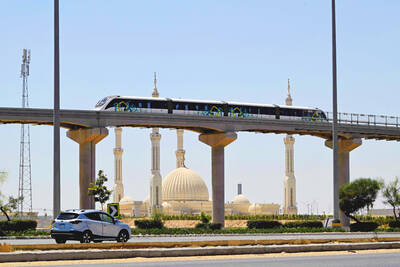
Cairo’s new monorail slices across the city skyline, running above the familiar chaos of blaring horns and aging buses’ exhaust fumes that mark rush hour below. The US$4.5 billion monorail, opened this month, is among Egypt’s most prominent new transport projects, part of a debt-funded infrastructure drive criticized for sapping state finances while bringing limited benefits to most of the country’s 109 million people. “It feels like you’re in a different country,” said Ramy Sayed, a restaurant manager, aboard a driverless Innovia 300 train. “No noise, no traffic, we’re not used to this.” The eastern line runs 56km from the bustling middle-class

Taiwanese firms have increased investment in the Philippines in recent years as Manila’s ties with Washington deepen and global supply chains continue to shift away from China, an expert at the Chung-Hua Institution for Economic Research (CIER, 中華經濟研究院) said yesterday. The Philippines had not been among Taiwanese investors’ top choices in Southeast Asia, CIER Taiwan ASEAN Studies Center director Kristy Hsu (徐遵慈) said at a seminar in Taipei. However, Taiwan’s investment in the country has grown significantly since the COVID-19 pandemic, reaching US $257 million last year, a high in recent years, she said. Although Taiwan’s total investment in the Philippines still lags
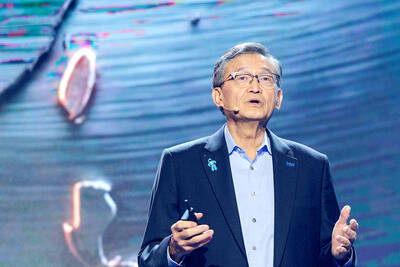
Intel Corp regards Taiwan Semiconductor Manufacturing Co (TSMC, 台積電) as a longstanding partner, as the US chipmaker would continue outsourcing production of advanced chips to TSMC, Intel chief executive officer Lip-Bu Tan (陳立武) said yesterday. “I don’t look at people as competitors. I look at the collaboration... Nvidia is also, you know, a good friend,” Tan told a news conference following his keynote speech at the Computex trade show in Taipei. “It’s a very trusted partnership for us... We are a big, top customer for them, and we’re going to continue doing that,” he said, referring to TSMC, the world’s largest foundry

Artificial intelligence (AI) agents would supplant smartphones as the center of people’s digital lives, fundamentally reshaping personal devices and driving a major computing upgrade cycle, Qualcomm Inc CEO Cristiano Amon said yesterday. In his keynote speech for this year’s Computex trade show in Taipei, Amon said that the rise of "agentic AI" — AI systems capable of reasoning, planning and carrying out tasks autonomously — would transform how people interact with technology across phones, PCs, vehicles and wearable devices. Describing the technology as the next major evolution in computing, Amon said that "2026 is the year of agents.” For decades, smartphones have sat


 RSS
RSS