


Five companies linked to detained Shanghai tycoon Zhou Zhengyi (周正毅) lost US$636 million of market value in two weeks -- nearly double the wealth he accumulated to rank as China's 11th-wealthiest man last year.
Investors aren't waiting for the 42-year-old entrepreneur, who compared himself last year to Hong Kong billionaire Li Ka-shing (李嘉誠), to emerge from police custody. They're dumping shares on speculation more companies may be tied to a widening investigation, traders said.
"Zhou's case reaches further than expected," said Yao Maogong, the deputy chief trader at Shanghai Securities Co.
"More people, including high-ranking officials, are likely to be implicated," Yao said.
Zhou, known as Chau Ching-ngai in Hong Kong, began as a factory accountant, according to the Hong Kong Standard newspaper, which also reported his reference to Li. A quarter-century later, Forbes last year put his wealth at US$320 million.
"Many entrepreneurs make their money through gray transactions," said Ma Jun, who manages the equivalent of US$100 million at E Fund Management Co in Guangzhou. "The implications from Zhou's case are likely wider than reported. More people and corporations are likely to be dragged into it."
Neither Zhou nor his wife Mao Yuping (
Officials at Shanghai Nongkai Development (Group) Co (
Granted, the unfolding property scandal in Shanghai hasn't hurt a planned Hong Kong share sale by Beijing Capital Land Ltd, the city government's developer. Investors say the company's political ties -- and the fact that it's government-owned, unlike Zhou's group -- may buffer Beijing Capital from any fallout.
The three China-listed companies linked to Zhou are Daying Modern Agricultural Holdings Co (
Daying and Hainiao both said their shares have been used as collateral for a 575 million yuan loan borrowed by closely held Huaxing Investment (Group) Co, which is in turn 72.8-percent owned by Nongkai, according to Daying. Daying pledged 15 percent of its shares, while Hainiao's contribution was 26 percent, the two companies said in separate statements.
Huaxing borrowed the money from Industrial Bank, a regional lender based in the Fujian provincial capital of Xiamen. Nongkai is listed on the bank's Web site as the lender's sixth-biggest shareholder.
The China-listed companies are distancing themselves from Zhou. Daying, a Shanghai real estate developer that was indirectly owned by Nongkai as recently as Nov. 21, said Zhou hasn't been a shareholder since Dec. 31.
Its dollar-denominated shares fell 6.3 percent yesterday, bringing its loss since May 26 to 15 percent.
Daying's controlling shareholder is now He Baoxin, who owns 58.9 percent of the company, according to a Daying statement yesterday in the Shanghai Securities News.
His stake comprises the 10 percent he owned before Dec. 31, and 48.9 percent formerly owned by Zhou, analysts said.
"It's not surprising that Daying is trying to wash off its links with Zhou, now that he is in hot water," said Ma Yilun, an analyst at China Communication Securities Co in Shanghai.
Shares of Hainiao, which sells and leases properties in Shanghai, fell 7.3 percent yesterday as they resumed trading after a two day halt, dropping to a 15-month low of 9.39 yuan.
Highlighting the murky ties between the companies and Zhou, two of the companies today published statements in the China Securities Journal, an official newspaper, that contradicted each other.
In one, Hainiao said its biggest shareholder is closely held Shang-hai Donghong Industry Investment Co, with a 26 percent stake. The company said Hainiao isn't part of Nongkai and isn't related to it in any way. In the other statement, Xugong said Donghong is indeed owned by Nongkai.
Shares of Xugong, which makes construction machinery, fell by their daily 10 percent limit in Shenzhen for the day this week, bringing their loss since May 26 to 42 percent.
Zhou made his billions starting in 1995 by buying shares from workers in as many as 60 companies before they went public, the Standard reported Wednesday.


Taiwanese firms have increased investment in the Philippines in recent years as Manila’s ties with Washington deepen and global supply chains continue to shift away from China, an expert at the Chung-Hua Institution for Economic Research (CIER, 中華經濟研究院) said yesterday. The Philippines had not been among Taiwanese investors’ top choices in Southeast Asia, CIER Taiwan ASEAN Studies Center director Kristy Hsu (徐遵慈) said at a seminar in Taipei. However, Taiwan’s investment in the country has grown significantly since the COVID-19 pandemic, reaching US $257 million last year, a high in recent years, she said. Although Taiwan’s total investment in the Philippines still lags

Intel Corp regards Taiwan Semiconductor Manufacturing Co (TSMC, 台積電) as a longstanding partner, as the US chipmaker would continue outsourcing production of advanced chips to TSMC, Intel chief executive officer Lip-Bu Tan (陳立武) said yesterday. “I don’t look at people as competitors. I look at the collaboration... Nvidia is also, you know, a good friend,” Tan told a news conference following his keynote speech at the Computex trade show in Taipei. “It’s a very trusted partnership for us... We are a big, top customer for them, and we’re going to continue doing that,” he said, referring to TSMC, the world’s largest foundry
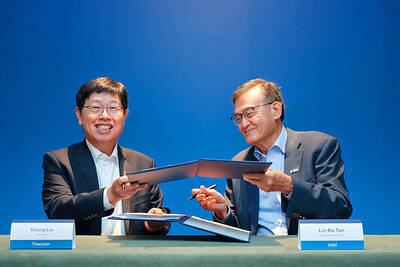
Hon Hai Precision Industry Co (鴻海精密) yesterday said it would work with US chipmaker Intel Corp to jointly develop and deploy next-generation artificial intelligence (AI) infrastructure and intelligent computing platforms in a move to capture booming demand for AI computing systems. Hon Hai, also known as Foxconn Technology Group (富士康), said in a statement that the partnership would combine its global manufacturing scale, system integration expertise and AI data center deployment capabilities with Intel’s strengths in processor architecture, silicon technologies and software ecosystem. The companies said they plan to work on equipment used in AI data centers, including server racks powered by
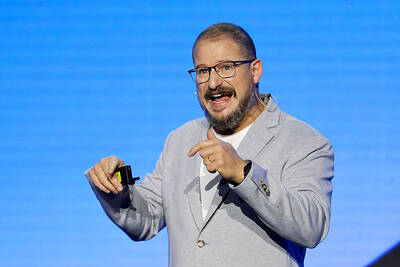
Artificial intelligence (AI) agents would supplant smartphones as the center of people’s digital lives, fundamentally reshaping personal devices and driving a major computing upgrade cycle, Qualcomm Inc CEO Cristiano Amon said yesterday. In his keynote speech for this year’s Computex trade show in Taipei, Amon said that the rise of "agentic AI" — AI systems capable of reasoning, planning and carrying out tasks autonomously — would transform how people interact with technology across phones, PCs, vehicles and wearable devices. Describing the technology as the next major evolution in computing, Amon said that "2026 is the year of agents.” For decades, smartphones have sat


 RSS
RSS