


For the second time in two days, Soft-World International Corp (智冠科技), the nation's major online games developer, yesterday received a massive cash infusion from a foreign giant.
Following Hong Kong and Shanghai Banking Corp's US$10 million (NT$349 million) injection into Soft-World on Wednesday, Mitsubishi group of Japan announced yesterday it will invest US$2.87 million (NT$100 million) in the Taiwanese software developer.
Under these deals, HSBC and Mitsubishi will hold a 6.7-percent and 2.19-percent stake in Soft-World, respectively.
The new capital will help Soft-World tap global markets, including Japan and South Korea.
"Capital investment is merely the beginning, based on our cooperation with Mitsubishi, Soft-World would be able to establish its Japan subsidiary by the end of the year," said company spokesman Gavin Lin (林盛隆).
Apart from setting up its Japan-ese unit, the company also plans to introduce its most popular game software -- Three Kingdoms Online (三國演義) -- to that market as soon as December, Lin said.
The proposed Soft-World Japan will be a joint venture between Soft-World, Mitsubishi, and the Chinese Gamer International Corp (中國網龍), a subsidiary of Soft-World specializing in game-content design and development.
Mitsubishi group, the Japan-based conglomerate that operates automobile, electronics, telecommunications and retail businesses, will benefit Soft-World a lot in terms of distribution and marketing, Lin said.
Shares in Soft-World rose 6.5 percent to NT$127 yesterday.
An industry analyst said Soft-World's move is on the right track.
"With the nation's online gaming market being almost saturated, companies have to switch their focus to other markets for survival," said Helen Chen (陳佩君), a cyber-game-industry analyst at Polaris Securities Co (寶來證券).
Sales in Taiwan's online gaming industry was NT$1.71 billion in 2001, a 250 percent growth from 2000's NT$480 million. The Market Intelligence Center, a government-funded think tank, estimates that the growth rate will significantly decline to about 17 percent in 2004.
In addition, as the broadband or high-speed Internet connection penetration rate in Japan is increasing rapidly, online game players should not overlook that market, Chen said.
However, the investment is less likely to turn into profit in the near future, she pointed out.
"To date, stand-alone TV games still dominate Japan's video game market, accounting for roughly 98 percent of share," Chen said. "Therefore, there's no way that Soft-World would make money in Japan within the next three years."
Another market watcher said the difference in culture will pose another challenge to Soft-World as the company attempts to sell made-in-Taiwan cyber games to non-Chinese markets.
"Soft-World's Jin Yung Online (金庸群俠傳) and Three Kingdoms Online are game products based on Chinese history or Chinese literature ... Foreigners will find it hard to identify with those stories," said Jeff Lin (林是杰), an analyst at Daiwa Securities-Cathy Corp (
Soft-World said its first nine month's sales reached NT$1.76 billion, a 88.6 percent growth over the same period last year. The company may raise its annual financial forecast next month, it said.

Cairo’s new monorail slices across the city skyline, running above the familiar chaos of blaring horns and aging buses’ exhaust fumes that mark rush hour below. The US$4.5 billion monorail, opened this month, is among Egypt’s most prominent new transport projects, part of a debt-funded infrastructure drive criticized for sapping state finances while bringing limited benefits to most of the country’s 109 million people. “It feels like you’re in a different country,” said Ramy Sayed, a restaurant manager, aboard a driverless Innovia 300 train. “No noise, no traffic, we’re not used to this.” The eastern line runs 56km from the bustling middle-class

Taiwanese firms have increased investment in the Philippines in recent years as Manila’s ties with Washington deepen and global supply chains continue to shift away from China, an expert at the Chung-Hua Institution for Economic Research (CIER, 中華經濟研究院) said yesterday. The Philippines had not been among Taiwanese investors’ top choices in Southeast Asia, CIER Taiwan ASEAN Studies Center director Kristy Hsu (徐遵慈) said at a seminar in Taipei. However, Taiwan’s investment in the country has grown significantly since the COVID-19 pandemic, reaching US $257 million last year, a high in recent years, she said. Although Taiwan’s total investment in the Philippines still lags
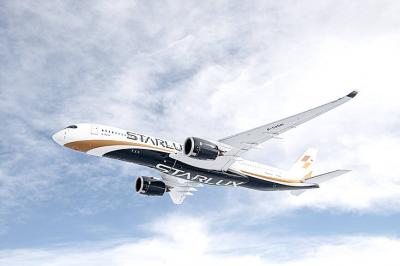
Starlux Airlines Co (星宇航空) today unveiled a long-haul network expansion plan at a shareholders’ meeting in Taipei, including direct flights to Barcelona, Spain, and Zurich, Switzerland, as well as a service connecting Taipei, Sydney and New Zealand. Starlux is to become the first Taiwanese carrier to offer non-stop services to the two European cities, while the inaugural oceanic route is expected to expand transit opportunities within the Australia-New Zealand market, Starlux said. Flight services to Chicago, Dallas, Washington and New York are under evaluation, the airline added. Prior to the shareholders’ meeting, the airline earlier this year announced that it would be

Intel Corp regards Taiwan Semiconductor Manufacturing Co (TSMC, 台積電) as a longstanding partner, as the US chipmaker would continue outsourcing production of advanced chips to TSMC, Intel chief executive officer Lip-Bu Tan (陳立武) said yesterday. “I don’t look at people as competitors. I look at the collaboration... Nvidia is also, you know, a good friend,” Tan told a news conference following his keynote speech at the Computex trade show in Taipei. “It’s a very trusted partnership for us... We are a big, top customer for them, and we’re going to continue doing that,” he said, referring to TSMC, the world’s largest foundry


 RSS
RSS