


Despite her poor showing for after only 48 days as the first female Minister of Economic Affairs, Christine Tsung's (
Tsung, a crony of President Chen Shui-bian, was named chairwoman of Taipei's troubled Grand Hotel (圓山飯店) on Saturday.
"Her world vision and expertise in business management will greatly help the hotel expand its international clientele," Grand Hotel's general manager Jack Niu (
"We look forward to taking advantage of her good governmental resources and interpersonal relationships in bringing in business," said Hu Heng-li (胡恆麗), a spokesperson for the hotel's union.
"Her performance at China Airlines Co (
Replacing Koo Chen-fu (辜振甫), Tsung's appointment is still pending approval from the hotel's board, which is expected to meet at the end of this month, Niu said.
The hotel's current strategy aims to attract organizers of international conferences, upper-crust clientele and leisure travelers from central and southern Taiwan.
Founded in 1952, the Grand Hotel was listed in the 1950s among the top 10 hotels in the world. Fierce competition from the entry of international hotels in combination with poor management by bungling bureaucrats, have cost the Taipei landmark its dominant market position.
Raking in a measly NT$1.6 billion in revenues last year, this year's revenues have, so far, dropped by nearly 20 percent, Hu said.
Average room-occupancy rates are at 70 percent according to hotel officials.
Righting the semi-state-run hotel's sagging business, outdated image, inefficient management and mediocre service will be major challenges for Tsung. But before any improvements can be made, Tsung's first challenge will be implementing internal reforms that will educate and motivate hotel employees to improve their performance, pundits said.
"It's important that she befriends hotel employees and earn their support in making changes," Ta Shee's Chou said.
Tsung should take advantage of the hotel's union to act as a bridge between upper management and employees, he said.
Citing the hotel's former general manager Stanley Yen (
Betty Yen (
One such problem Stanley Yen faced was an inflexible year-end-bonus agreement, which is written into the union contract, Yen said.
Although Tsung doesn't have the hotel savvy of Stanley Yen, her close ties with the DPP administration could make a difference, she said.
"Most of the time, hotel owners who recruit their cronies instead of professionals to run their business, end up in failure. But Tsung may be able to make breakthroughs if she's fully supported by the government to carry out policies," Yen said.


Taiwanese firms have increased investment in the Philippines in recent years as Manila’s ties with Washington deepen and global supply chains continue to shift away from China, an expert at the Chung-Hua Institution for Economic Research (CIER, 中華經濟研究院) said yesterday. The Philippines had not been among Taiwanese investors’ top choices in Southeast Asia, CIER Taiwan ASEAN Studies Center director Kristy Hsu (徐遵慈) said at a seminar in Taipei. However, Taiwan’s investment in the country has grown significantly since the COVID-19 pandemic, reaching US $257 million last year, a high in recent years, she said. Although Taiwan’s total investment in the Philippines still lags
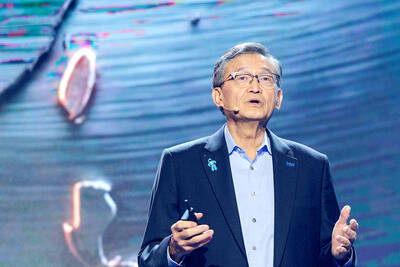
Intel Corp regards Taiwan Semiconductor Manufacturing Co (TSMC, 台積電) as a longstanding partner, as the US chipmaker would continue outsourcing production of advanced chips to TSMC, Intel chief executive officer Lip-Bu Tan (陳立武) said yesterday. “I don’t look at people as competitors. I look at the collaboration... Nvidia is also, you know, a good friend,” Tan told a news conference following his keynote speech at the Computex trade show in Taipei. “It’s a very trusted partnership for us... We are a big, top customer for them, and we’re going to continue doing that,” he said, referring to TSMC, the world’s largest foundry
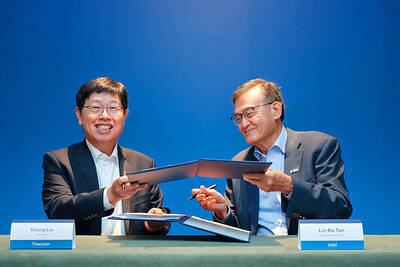
Hon Hai Precision Industry Co (鴻海精密) yesterday said it would work with US chipmaker Intel Corp to jointly develop and deploy next-generation artificial intelligence (AI) infrastructure and intelligent computing platforms in a move to capture booming demand for AI computing systems. Hon Hai, also known as Foxconn Technology Group (富士康), said in a statement that the partnership would combine its global manufacturing scale, system integration expertise and AI data center deployment capabilities with Intel’s strengths in processor architecture, silicon technologies and software ecosystem. The companies said they plan to work on equipment used in AI data centers, including server racks powered by

Artificial intelligence (AI) agents would supplant smartphones as the center of people’s digital lives, fundamentally reshaping personal devices and driving a major computing upgrade cycle, Qualcomm Inc CEO Cristiano Amon said yesterday. In his keynote speech for this year’s Computex trade show in Taipei, Amon said that the rise of "agentic AI" — AI systems capable of reasoning, planning and carrying out tasks autonomously — would transform how people interact with technology across phones, PCs, vehicles and wearable devices. Describing the technology as the next major evolution in computing, Amon said that "2026 is the year of agents.” For decades, smartphones have sat


 RSS
RSS