


State-run landowner Taiwan Sugar Corporation (Taisugar,
"This is a private investment plan, in collaboration with Taisugar, the Tainan County Government and the science park's development office to address the serious lack of recreation for over 10,000 workers there," Taisugar President Ray Dawn (董瑞斌) said at a presentation on the project yesterday afternoon.
"The first recreational project in the park will bring newcomers many business advantages," Tainan County Commissioner Su Huan-chih (蘇煥智) said.
Discussing the science park's outlook, Tai Chein (戴謙), director of the park's development office, said yesterday that another 10,000 workers are expected to move in by year's end, providing a basic customer base for future complex owners.
The new workers will be employed in several new plants planned by United Microelectronics Corp (UMC, 聯電), Taiwan Semiconductor Manufacturing Co (TSMC, 台積電) and other firms. The number of workers at the park is expected to rise to 35,000 by 2005, Tai said.
Tai also said that the area's strong school system should attract both employees and employers.
"This is the best location -- it's surrounded by an elementary school, a junior high school, a foreign school and dormitories with the Asian Vegetable Research and Development Center just nearby," he said.
Taisugar said it welcomes domestic or multinational companies with net assets of NT$500 million, or international hoteliers with net assets of NT$56 million to place bids for the over NT$1 billion of investment opportunities at the park.
Expecting the complex to begin operations in 2004, Taisugar yesterday also laid down the 3 hectare project's terms, including a negotiable franchise fee of NT$80 million and a yearly rental fee of NT$4.69 million over a 20-year period.
A negotiable percentage of commission from revenues will be offered to Taisugar, which will also be entitled to manage part of the complex's business facilities.
"The rent is as preferential as that to high-tech companies [in the park] and unlikely to rise," Su said, adding that the property rights belong to the developers.
He also said that the National Science Council has promised to provide necessary assistance to solve the project's future financing difficulties.
Taisugar said the initial plan calls for a business-class 250-room hotel with restaurants and a conference center to be built to serve high-tech businesspeople and park residents. A 4,500-ping shopping mall will features hypermarkets, retailers, food courts and theme restaurants.
Both Su and Tai added they expect profits at the park to rise as the economy improves.
Tai said that the science park's profit in January and February reached NT$13.3 billion and that "NT$80 billion is foreseeable" in the future.
But Su said that he was told that Chi Mei Optoelectronics Corp (奇美光電) alone is expected to generate a profit of NT$45 to NT$50 billion this year and, therefore, the science park's total profit should be able to break NT$100 billion by year's end.
Su also said the local government is soliciting the central government to zone out an international free trade airport -- the first ever in Taiwan -- in the science park.

Taiwanese firms have increased investment in the Philippines in recent years as Manila’s ties with Washington deepen and global supply chains continue to shift away from China, an expert at the Chung-Hua Institution for Economic Research (CIER, 中華經濟研究院) said yesterday. The Philippines had not been among Taiwanese investors’ top choices in Southeast Asia, CIER Taiwan ASEAN Studies Center director Kristy Hsu (徐遵慈) said at a seminar in Taipei. However, Taiwan’s investment in the country has grown significantly since the COVID-19 pandemic, reaching US $257 million last year, a high in recent years, she said. Although Taiwan’s total investment in the Philippines still lags
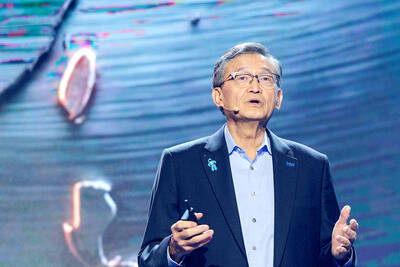
Intel Corp regards Taiwan Semiconductor Manufacturing Co (TSMC, 台積電) as a longstanding partner, as the US chipmaker would continue outsourcing production of advanced chips to TSMC, Intel chief executive officer Lip-Bu Tan (陳立武) said yesterday. “I don’t look at people as competitors. I look at the collaboration... Nvidia is also, you know, a good friend,” Tan told a news conference following his keynote speech at the Computex trade show in Taipei. “It’s a very trusted partnership for us... We are a big, top customer for them, and we’re going to continue doing that,” he said, referring to TSMC, the world’s largest foundry
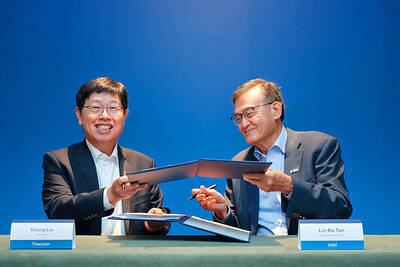
Hon Hai Precision Industry Co (鴻海精密) yesterday said it would work with US chipmaker Intel Corp to jointly develop and deploy next-generation artificial intelligence (AI) infrastructure and intelligent computing platforms in a move to capture booming demand for AI computing systems. Hon Hai, also known as Foxconn Technology Group (富士康), said in a statement that the partnership would combine its global manufacturing scale, system integration expertise and AI data center deployment capabilities with Intel’s strengths in processor architecture, silicon technologies and software ecosystem. The companies said they plan to work on equipment used in AI data centers, including server racks powered by
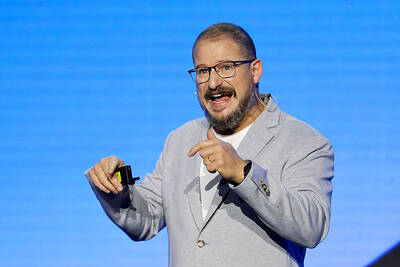
Artificial intelligence (AI) agents would supplant smartphones as the center of people’s digital lives, fundamentally reshaping personal devices and driving a major computing upgrade cycle, Qualcomm Inc CEO Cristiano Amon said yesterday. In his keynote speech for this year’s Computex trade show in Taipei, Amon said that the rise of "agentic AI" — AI systems capable of reasoning, planning and carrying out tasks autonomously — would transform how people interact with technology across phones, PCs, vehicles and wearable devices. Describing the technology as the next major evolution in computing, Amon said that "2026 is the year of agents.” For decades, smartphones have sat


 RSS
RSS