


Adding to the uncertainty over US-based Global Crossing, its Asian subsidiary announced Friday that it would delay reporting its fourth-quarter earnings by a week.
The subsidiary, Asia Global Crossing, did not give a reason for the delay, from Feb. 19 to Feb. 26, but analysts said they believed it was related to questions about accounting practices at its namesake shareholder, which filed for bankruptcy protection last month.
The Securities and Exchange Commission and the Federal Bureau of Investigation are examining how Global Crossing accounted for revenue from swaps of network capacity with other carriers.
So far, the murkiness is not driving away one of the parent company's would-be saviors, the Hong Kong billionaire Li Ka-shing. A spokeswoman for Li's conglomerate, Hutchison Whampoa Ltd, said Friday it would not rescind its offer, made jointly with Singapore Technologies Telemedia, to buy a controlling stake in Global Crossing for about US$750 million.
But the spokeswoman, Laura Cheung, stressed the tentative nature of Hutchison's proposal -- noting that no money would change hands until it was approved by creditors, shareholders and bankruptcy court.
"The letter is conditional on tons of things," Cheung said. "We expressed our interest. That's all."
Cheung said Hutchison would not comment on the multiple investigations of Global Crossing, which came to light after the company filed Chapter 11 and proposed the buyout by its Asian partners.
Hutchison's bid may be hobbled by political concerns as well. Global Crossing's bankruptcy filing prompted the US Defense Department to delay the awarding of a US$450 million contract for a high-speed data network connecting its laboratories and research centers.
Global Crossing originally won the contract last July. But now, members of Congress are questioning whether the military can award such a contract to a company controlled by foreign entities.
Hutchison is no stranger to such objections: When its shipping arm took over the port operations of the Panama Canal, lawmakers said its Chinese ownership posed a risk to national security.
Li, who cultivates ties with the Chinese government but whose company is publicly listed in Hong Kong, waved away those questions with only a hint of irritation. Analysts said he would probably regard the concerns about Global Crossing with similar equanimity.
"They've heard this all before," said Christopher Slaughter, an Asian analyst with Yankee Group, a technology and telecommunications research and consulting firm.
Slaughter predicted Li would keep his gaze on Global Crossing's assets, which include a state-of-the-art network of high-speed Internet and telephone lines. In Asia, the company's subsidiary owns undersea cables, fiber optic rings, and Web hosting centers in several cities.
In Hong Kong and Singapore, Asia Global Crossing operates its facilities in joint ventures with Hutchison Whampoa and Singapore Technologies Telemedia, respectively. Singapore Technologies is the No. 2 local phone company in a city-state dominated by the state-owned carrier.
"By rescuing Global Crossing, it could be that they are trying to protect these investments," Slau-ghter said.
He also noted that Li had a track record of buying distressed assets and selling them later for eye-popping profits. Most famously, Hutchison reaped a US$22 billion profit when it sold its British mobile-phone operation, Orange, to Mannesmann of Germany, which itself was later bought by Vodafone of Britain.
In the case of Global Crossing, Li is swooping in at a moment of dire weakness. His proposal is for Hutchison and Singapore Technologies to invest a total of US$750 million for a 79 percent stake -- contingent on writing off the company's US$12.4 billion in debts.
Creditors would receive the remaining 21 percent of equity, in the form of cash and notes, a 90 percent discount on their loans. Other shareholders of Global Crossing would receive nothing.
Given the paltry return, some analysts say they expect other bidders for the company's assets to emerge. Bankruptcy court has given the company until August to put a plan together.
``This is the beginning of a very long transaction,'' Cheung, the Hutchison spokeswoman, said.
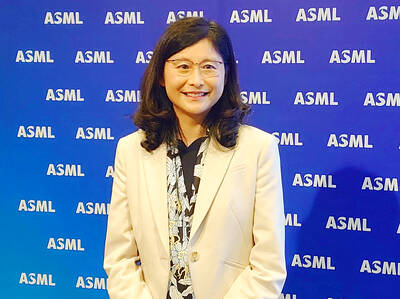
Netherlands-based semiconductor equipment supplier ASML Holding NV yesterday said that it is planning to hire an additional 1,000 people in Taiwan this year in response to growing demand from clients. ASML had previously planned to recruit 600 people this year, but that the plan has been adjusted upward, ASML vice president and ASML Taiwan general manager Grace Wang (汪佳慧) told reporters. ASML has a workforce of more than 4,500 in Taiwan, accounting for about 10 percent of its global total, Wang said. This year’s recruitment campaign would focus on adding people in the customer support, manufacturing and supply chain domains to assist ASML
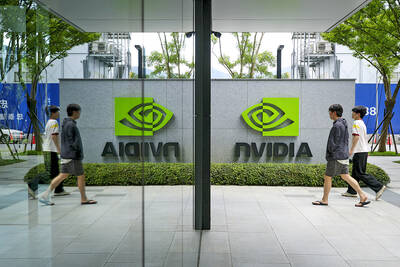
UNDER MICROSCOPE: Taiwan detained three people who allegedly conspired to buy servers in Taiwan and export them using fraudulent documentation, prosecutors said Nvidia Corp chief executive officer Jensen Huang (黃仁勳) on Saturday urged Super Micro Computer Inc to tighten up on compliance after Taiwan detained three people this week for allegedly making fraudulent declarations about artificial intelligence (AI) servers made by its US partner. The development marked the nation’s first crackdown on semiconductor smuggling, which grew after the US slapped restrictions on exports of high-end chips such as Nvidia AI accelerators to China. Nvidia is “rigorous” in explaining regulations to all of its partners, Huang told reporters after arriving in Taipei. “Ultimately Super Micro has to run their own company,” he said in response to

Nvidia Corp yesterday announced that CEO Jensen Huang (黃仁勳) would attend an employee meeting in Taipei tomorrow to celebrate the launch of the company’s Taiwan headquarters project. Huang would attend a gathering at the site of Nvidia’s planned headquarters in Beitou Shilin Technology Park (北投士林科技園區), the company said in a statement. After arriving in Taiwan on Saturday last week, Huang told reporters that he plans to meet with Quanta Computer Inc (廣達) chairman Barry Lam (林百里) and Taiwan Semiconductor Manufacturing Co (TSMC, 台積電) chairman C.C. Wei (魏哲家), and would attend the groundbreaking ceremony for Nvidia’s Taiwan headquarters tomorrow. Nvidia has not yet applied
Huawei Technologies Co (華為) said it has come up with a new pathway to shorten its gap with industry leader Taiwan Semiconductor Manufacturing Co (TSMC, 台積電), potentially achieving a breakthrough in making advanced semiconductors without cutting-edge equipment. Right now there is about a five-year gap between what TSMC is capable of and what Huawei, together with its manufacturing partner Semiconductor Manufacturing International Corp (中芯), can produce. Huawei is to start making 1.4-nanometer chips by 2031 with its own “LogicFolding” technology, Huawei semiconductor chief He Tingbo (何庭波) said in a rare public appearance during a chip conference yesterday, while TSMC has


 RSS
RSS