


The appointment of China Airlines Co (華航) President Christine Tsung (宗才怡) as Minister of Economic Affairs has rattled the nerves of at least one of her new colleagues yesterday.
Premier-designate Yu Shyi-kun named Tsung to the position yesterday, but some questioned her lack of experience.
"She's not qualified for the job as she has little knowledge about Taiwan's industries," said an anonymous high-ranking ministry official.
"Since manufacturers are relocating to China, what is the priority for government policymaking? I question how much she truly understands Taiwan's economy," the official said.
Tsung "may have to delegate a bit more authority to her deputies to offset her scant experience in running a big government agency like this," he said.
Tsung said during a press conference yesterday that she believes Taiwan's economy will improve within two years.
"While Taiwan cannot alter the global economic downturn, our industrial and business sectors are renowned for their ability to adapt to challenges," Tsung said.
She promised to work hard to keep high-tech and high-value-added industries in country, as well as work to attract more foreign investment. But she didn't elaborate on what means she would use to achieve these goals.
Industry and business leaders were hoping that some new blood in the government would help to boost Taiwan's economy.
"The new minister is from the private sector, which will probably make her decisions less hampered by bureaucrats," said Luo Huai-chia (羅懷家), executive director of the Taiwan Electrical and Electronic Manufacturers' Association (電電公會).
"Bringing a successful corporate executive such as Tsung into the Cabinet will inject new vitality into the government. Also, by appointing an experienced hand in international marketing, the government's promotional efforts abroad could stand to benefit.
It would be "worth waiting" to see what policies she comes up with, since "she proved herself by turning around China Airlines over the last 17 months," said Chen Cheng-yi (陳正毅), spokesman for the General Chamber of Commerce (全國商總).
``We think the new Cabinet under Yu will be better able to execute [President] Chen Shui-bian's (陳水扁) policies," Chen said.
Nevertheless, there could still be problems ahead.
"Implementation of public policy is still uncertain because of a lack of effective operating mechanisms," said Ping Chew (周平), associate director at Standard and Poor's (Asia & Pacific).
"The new Cabinet, especially in the area of economic planning, is staffed with more professionals possessed with business acumen. They may come out with some business-friendly and pragmatic ideas, but implementation is another matter," Chew said.
The new Cabinet may also suffer from inadequate resources.
"Despite all the intentions and rhetoric to fix, for example, the `hollowing-out' matter, the available solutions are limited," Chew said. "It will take more than loosening restrictions to address this, despite the fact that more often than not these restrictions are bypassed. Unfortunately, economic policies are still subject to political constraints," he said.


Taiwanese firms have increased investment in the Philippines in recent years as Manila’s ties with Washington deepen and global supply chains continue to shift away from China, an expert at the Chung-Hua Institution for Economic Research (CIER, 中華經濟研究院) said yesterday. The Philippines had not been among Taiwanese investors’ top choices in Southeast Asia, CIER Taiwan ASEAN Studies Center director Kristy Hsu (徐遵慈) said at a seminar in Taipei. However, Taiwan’s investment in the country has grown significantly since the COVID-19 pandemic, reaching US $257 million last year, a high in recent years, she said. Although Taiwan’s total investment in the Philippines still lags

Intel Corp regards Taiwan Semiconductor Manufacturing Co (TSMC, 台積電) as a longstanding partner, as the US chipmaker would continue outsourcing production of advanced chips to TSMC, Intel chief executive officer Lip-Bu Tan (陳立武) said yesterday. “I don’t look at people as competitors. I look at the collaboration... Nvidia is also, you know, a good friend,” Tan told a news conference following his keynote speech at the Computex trade show in Taipei. “It’s a very trusted partnership for us... We are a big, top customer for them, and we’re going to continue doing that,” he said, referring to TSMC, the world’s largest foundry
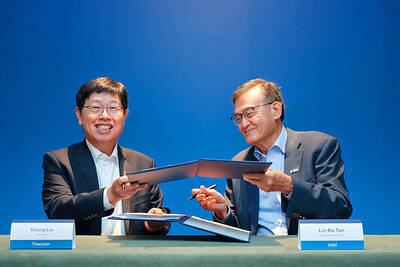
Hon Hai Precision Industry Co (鴻海精密) yesterday said it would work with US chipmaker Intel Corp to jointly develop and deploy next-generation artificial intelligence (AI) infrastructure and intelligent computing platforms in a move to capture booming demand for AI computing systems. Hon Hai, also known as Foxconn Technology Group (富士康), said in a statement that the partnership would combine its global manufacturing scale, system integration expertise and AI data center deployment capabilities with Intel’s strengths in processor architecture, silicon technologies and software ecosystem. The companies said they plan to work on equipment used in AI data centers, including server racks powered by
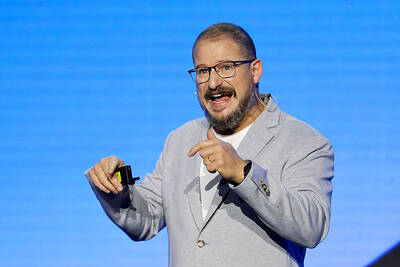
Artificial intelligence (AI) agents would supplant smartphones as the center of people’s digital lives, fundamentally reshaping personal devices and driving a major computing upgrade cycle, Qualcomm Inc CEO Cristiano Amon said yesterday. In his keynote speech for this year’s Computex trade show in Taipei, Amon said that the rise of "agentic AI" — AI systems capable of reasoning, planning and carrying out tasks autonomously — would transform how people interact with technology across phones, PCs, vehicles and wearable devices. Describing the technology as the next major evolution in computing, Amon said that "2026 is the year of agents.” For decades, smartphones have sat


 RSS
RSS