


The growth of mobile Internet access is good news for the nation's telecommunications equipment makers, researchers at the Taiwan Institute of Economic Research (TIER, 台灣經濟研究院) say.
The group estimates that worldwide Internet growth for dial-up and mobile services is pushing Taiwan's telecom equipment manufacturers to boost production in a number of sectors -- including display panels, handset keyboards, networking equipment, ADSL modem equipment, flash memory chips and mobile handsets.
According to TIER, the telecom equipment sector raked in NT$233.5 billion (US$7.7 billion) in revenue last year and is projected to grow by 20 percent to NT$279.9 billion (US$9.33 billion) this year.
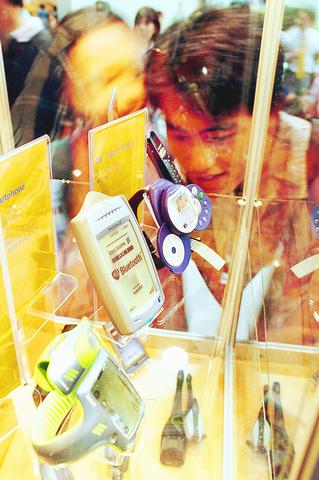
PHOTO: CHEN CHENG-CHANG, TAIPEI TIMESN
The organization notes that the greatest opportunities are in fixed-line, wireless communication and Internet services sec-tors. In addition, the growing local appetite for such products has also given equipment makers a boost.
The population of Taiwan's Internet users has surged to 5.57 million as of the end of June, up 16 percent from a year ago, according to the Institute for Information Industry (III, 資策會).
The nation's leading Internet service providers expect the number of users to increase to 7.5 million within the next two years.
Mobile Internet promises to offer services such as global positioning satellite technology to help mobile users pinpoint their location anywhere in the world.
Vacationers will be able to use handsets with built-in camera lenses to speed vacation photos home.
Thus far, however, the nation's 15 million mobile phone users have opted not to get online through their handsets.
According to local service providers, just 60,000 subscribers have signed up for wireless Internet service, which runs at a pedestrian 9.6 kilobits per second -- the same speed as the average computer modem in 1993.
The second generation of wireless Internet, dubbed GPRS, or General Packet Radio System, has an advertised speed of 115k, twice as fast as today's common household Internet connection.
Although some experts warn this system will initially top out at speeds of only 36k due to mobile phone handset problems, the managing director of Nokia Taiwan, Colin Giles, claims that GPRS enabled-Nokia handsets will run at 110k so long as the service providers keep up.
Giles also emphasized that his company has "no plans" to outsource mobile phone production to Taiwan.
He said the nation's handset makers are "very good," but that "Nokia manufactures its own mobile phones and ... we're already good at low cost manufacturing."
Ever since Ericsson announced a deal with Taiwan's Arima Computer (華宇) on the OEM production of a large, unspecified amount of mobile phones, speculation has been rampant that Motorola and Nokia might soon follow suit.
Motorola officials said they have no plans to increase the work they already do with Acer Communications, formerly Acer Peripherals (明電).
According to III, Taiwan produced 2.8 million mobile phones last year with a total value of US$116 million.
This year, the group estimates that output will increase to nearly 11 million units.

Cairo’s new monorail slices across the city skyline, running above the familiar chaos of blaring horns and aging buses’ exhaust fumes that mark rush hour below. The US$4.5 billion monorail, opened this month, is among Egypt’s most prominent new transport projects, part of a debt-funded infrastructure drive criticized for sapping state finances while bringing limited benefits to most of the country’s 109 million people. “It feels like you’re in a different country,” said Ramy Sayed, a restaurant manager, aboard a driverless Innovia 300 train. “No noise, no traffic, we’re not used to this.” The eastern line runs 56km from the bustling middle-class
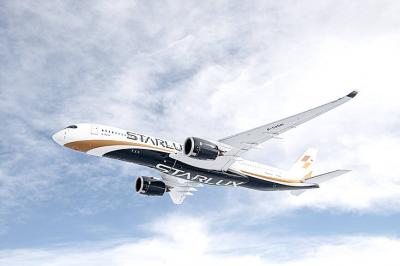
Starlux Airlines Co (星宇航空) today unveiled a long-haul network expansion plan at a shareholders’ meeting in Taipei, including direct flights to Barcelona, Spain, and Zurich, Switzerland, as well as a service connecting Taipei, Sydney and New Zealand. Starlux is to become the first Taiwanese carrier to offer non-stop services to the two European cities, while the inaugural oceanic route is expected to expand transit opportunities within the Australia-New Zealand market, Starlux said. Flight services to Chicago, Dallas, Washington and New York are under evaluation, the airline added. Prior to the shareholders’ meeting, the airline earlier this year announced that it would be

Taiwanese firms have increased investment in the Philippines in recent years as Manila’s ties with Washington deepen and global supply chains continue to shift away from China, an expert at the Chung-Hua Institution for Economic Research (CIER, 中華經濟研究院) said yesterday. The Philippines had not been among Taiwanese investors’ top choices in Southeast Asia, CIER Taiwan ASEAN Studies Center director Kristy Hsu (徐遵慈) said at a seminar in Taipei. However, Taiwan’s investment in the country has grown significantly since the COVID-19 pandemic, reaching US $257 million last year, a high in recent years, she said. Although Taiwan’s total investment in the Philippines still lags

Intel Corp regards Taiwan Semiconductor Manufacturing Co (TSMC, 台積電) as a longstanding partner, as the US chipmaker would continue outsourcing production of advanced chips to TSMC, Intel chief executive officer Lip-Bu Tan (陳立武) said yesterday. “I don’t look at people as competitors. I look at the collaboration... Nvidia is also, you know, a good friend,” Tan told a news conference following his keynote speech at the Computex trade show in Taipei. “It’s a very trusted partnership for us... We are a big, top customer for them, and we’re going to continue doing that,” he said, referring to TSMC, the world’s largest foundry


 RSS
RSS