


Although President Chen Shui-bian (
Following Chen's address, Lin Chuan (
The subsidy, part of Chen's "333" welfare policy, provides a monthly payout of NT$3,000 for senior citizens 65 and older who meet certain qualifications.
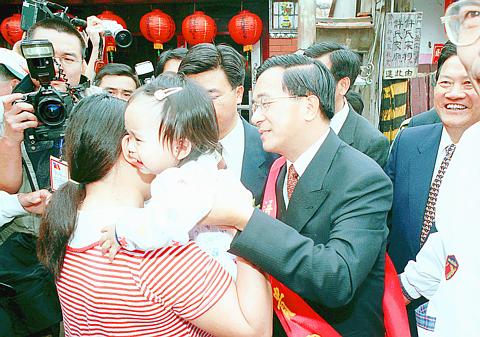
PHOTO: GEORGE TSORNG, TAIPEI TIMES
The other two parts of Chen's "333" plan -- a 3 percent mortgage rate for first time homebuyers and free medical care for children under 3 years of age -- will be included in the 2001 budget and implemented next year.
But financial analysts say the "333" proposal would enlarge the role of the government, in stark contrast to Chen's vision of a "small and effective" government.
"Chen's discussion of economic issues and his `333' welfare policy are contradictory," said Norman Yin (
Yin noted that Taiwan entry's into the WTO, combined with "333," would lead to a NT$700 billion shortfall in revenues, citing DGBAS projections.
"Even after the new administration cuts spending by up to NT$100 billion, a deficit of NT$600 billion is still unavoidable," he said.
At the same time, Chen's administration has promised not to raise taxes in the next four years.
Shea Jia-dong (
But analysts say the no-tax hike pledge will only add more red ink to the nation's balance sheets, which currently has a debt of NT$2.3 trillion.
"This means the national debt will further deteriorate in Chen's four-year term if Chen does not alter his welfare state policy. That burden is likely to be left for our children," Yin said.
Yin also said Chen's speech didn't say enough about future economic policies.
"By saying nothing specific on economic policy, it shows that Chen is not taking economic issues seriously enough," he said. "It's disappointing because Taiwan is facing so many economic and financial problems. Without solid commitment, nobody really knows what he is going to do in the next four years to tackle these issues.
"Instead of increasing fiscal expenditures by adding to the social welfare budget, what Chen really should be doing is to cutting expenditures to try to balance the budget."
Analysts said the stock market's sour reaction to Saturday's inauguration speech was due to Chen's failure to explicitly express his position on "three direct links" and the "one China" issue.
"When uncertainty arose [with regard to `one China'], investors hesitated to hold their positions after Chen's speech," said Larry Liao (
"From a short-term point of view, Chen's vagueness with China could lead to consolidation in the market," Liao said.
"However, I do not expect a severe correction in the short term. Based on the soundness of fundamentals in many sectors, I expect a recovery in the TAIEX as soon as China clarifies its position. It seems no immediate confrontation across the Taiwan Strait lies ahead. In the second half this year, the TAIEX should be able to move up to 10,000 or even 12,000 points."


Taiwanese firms have increased investment in the Philippines in recent years as Manila’s ties with Washington deepen and global supply chains continue to shift away from China, an expert at the Chung-Hua Institution for Economic Research (CIER, 中華經濟研究院) said yesterday. The Philippines had not been among Taiwanese investors’ top choices in Southeast Asia, CIER Taiwan ASEAN Studies Center director Kristy Hsu (徐遵慈) said at a seminar in Taipei. However, Taiwan’s investment in the country has grown significantly since the COVID-19 pandemic, reaching US $257 million last year, a high in recent years, she said. Although Taiwan’s total investment in the Philippines still lags

Intel Corp regards Taiwan Semiconductor Manufacturing Co (TSMC, 台積電) as a longstanding partner, as the US chipmaker would continue outsourcing production of advanced chips to TSMC, Intel chief executive officer Lip-Bu Tan (陳立武) said yesterday. “I don’t look at people as competitors. I look at the collaboration... Nvidia is also, you know, a good friend,” Tan told a news conference following his keynote speech at the Computex trade show in Taipei. “It’s a very trusted partnership for us... We are a big, top customer for them, and we’re going to continue doing that,” he said, referring to TSMC, the world’s largest foundry

Hon Hai Precision Industry Co (鴻海精密) yesterday said it would work with US chipmaker Intel Corp to jointly develop and deploy next-generation artificial intelligence (AI) infrastructure and intelligent computing platforms in a move to capture booming demand for AI computing systems. Hon Hai, also known as Foxconn Technology Group (富士康), said in a statement that the partnership would combine its global manufacturing scale, system integration expertise and AI data center deployment capabilities with Intel’s strengths in processor architecture, silicon technologies and software ecosystem. The companies said they plan to work on equipment used in AI data centers, including server racks powered by
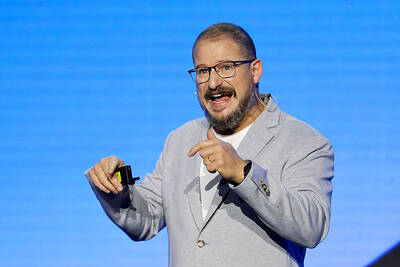
Artificial intelligence (AI) agents would supplant smartphones as the center of people’s digital lives, fundamentally reshaping personal devices and driving a major computing upgrade cycle, Qualcomm Inc CEO Cristiano Amon said yesterday. In his keynote speech for this year’s Computex trade show in Taipei, Amon said that the rise of "agentic AI" — AI systems capable of reasoning, planning and carrying out tasks autonomously — would transform how people interact with technology across phones, PCs, vehicles and wearable devices. Describing the technology as the next major evolution in computing, Amon said that "2026 is the year of agents.” For decades, smartphones have sat


 RSS
RSS