


Alluding to the potential synergies between making petroleum products and making cars, Formosa Plastics Group (
Wang made the announcement during Formosa's 24th annual Sports Day (
"Since we got into petroleum products, we decided to expand into automobiles," Wang said. "This prototype will also help with the further development of our electric car."
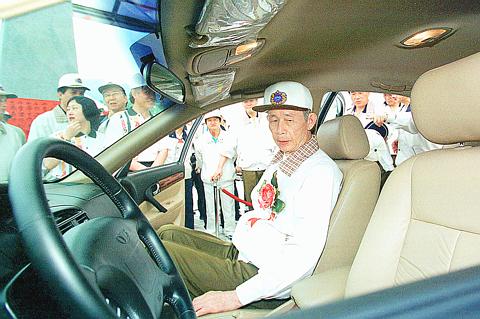
PHOTO: LEE HUNG-MING, LIBERTY TIMESN
Formosa has long provided raw materials and parts for the auto industry. Last year the company said it planned to build and market an electric car.
But yesterday was first time the company has openly said it would build a combustion-engine vehicle.
Wang said that the new auto group, Formosa Autos (
The plan entails using the design and engine for Daewoo's "Magnus" series. Daewoo will make the engines and Formosa Plastics will manufacture the rest of the car.
According to local media, Formosa formally moved ahead in the venture yesterday by purchasing a Taichung County-based manufacturing facility from Sanfu Motors (
Wang said the new mid-sized car would be marketed as a family sedan for middle class Taiwanese consumers. Formosa's version of the car will be known as the "FPG1."
He said the new car would sell for "around NT$700,000," and that it would be available nationwide by the end of the year.
Wang was careful to note that the new vehicle would serve as a prototype for the electric car Formosa plans to manufacture in the future. The company plans to set up its manufacturing base for the electric car in China.
But while Wang is revved up about the auto venture, industry analysts question the move.
EnTrust Securities (永昌綜合證券) stock analyst Peter Griffith noted that while many Asian countries want to manufacture their own cars, the worldwide market is getting crowded and Formosa will face "stiff competition."
But Griffith also said that if Formosa uses its new car venture to develop an electric vehicle, the company could win big.
"Whoever becomes the leader of manufacturing environmentally friendly cars for Asia will make money," he said. "Can you imagine the pollution problems a city like Beijing will have if every bicycle rider there trades in for a gas-guzzling car?"
In keeping with his green ethic that has come to typify Wang's Sports Day, the Formosa chairman said that Taiwanese need to stop using non-recyclable tableware and plastic trash bags.
He blasted the local practice of eating on non-recyclable foam products and said people should instead use washable and reusable plates, bowls and chopsticks.
He also recommended the recycling of plastic trash bags. Although the trend in the plastics industry worldwide has been biodegradable products, Formosa currently doesn't produce biodegradable plastic trash bags.
The company, in fact, has a spotted record with regard to environmental issues.
In late December 1998, Formosa Plastics was forced into the environmental spotlight for illegally dumping 4,600 tonnes of mercury-tainted waste in Sihanoukville, Cambodia.
The toxic waste was directly blamed for the deaths of two people.
Formosa Plastics was eventually forced to reclaim the materials and ship the load back to Kaohsiung, where it sat for nearly a year. A portion of that shipment was disposed of in Rotterdam, the Netherlands. The remainder is reportedly still in Kaohsiung.


Taiwanese firms have increased investment in the Philippines in recent years as Manila’s ties with Washington deepen and global supply chains continue to shift away from China, an expert at the Chung-Hua Institution for Economic Research (CIER, 中華經濟研究院) said yesterday. The Philippines had not been among Taiwanese investors’ top choices in Southeast Asia, CIER Taiwan ASEAN Studies Center director Kristy Hsu (徐遵慈) said at a seminar in Taipei. However, Taiwan’s investment in the country has grown significantly since the COVID-19 pandemic, reaching US $257 million last year, a high in recent years, she said. Although Taiwan’s total investment in the Philippines still lags

Intel Corp regards Taiwan Semiconductor Manufacturing Co (TSMC, 台積電) as a longstanding partner, as the US chipmaker would continue outsourcing production of advanced chips to TSMC, Intel chief executive officer Lip-Bu Tan (陳立武) said yesterday. “I don’t look at people as competitors. I look at the collaboration... Nvidia is also, you know, a good friend,” Tan told a news conference following his keynote speech at the Computex trade show in Taipei. “It’s a very trusted partnership for us... We are a big, top customer for them, and we’re going to continue doing that,” he said, referring to TSMC, the world’s largest foundry
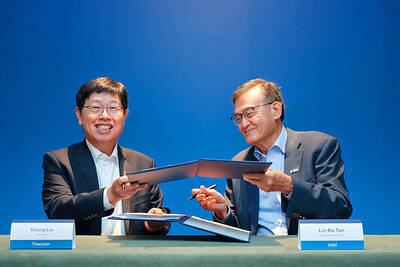
Hon Hai Precision Industry Co (鴻海精密) yesterday said it would work with US chipmaker Intel Corp to jointly develop and deploy next-generation artificial intelligence (AI) infrastructure and intelligent computing platforms in a move to capture booming demand for AI computing systems. Hon Hai, also known as Foxconn Technology Group (富士康), said in a statement that the partnership would combine its global manufacturing scale, system integration expertise and AI data center deployment capabilities with Intel’s strengths in processor architecture, silicon technologies and software ecosystem. The companies said they plan to work on equipment used in AI data centers, including server racks powered by
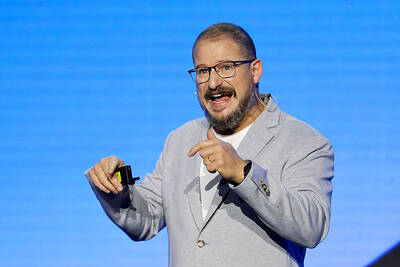
Artificial intelligence (AI) agents would supplant smartphones as the center of people’s digital lives, fundamentally reshaping personal devices and driving a major computing upgrade cycle, Qualcomm Inc CEO Cristiano Amon said yesterday. In his keynote speech for this year’s Computex trade show in Taipei, Amon said that the rise of "agentic AI" — AI systems capable of reasoning, planning and carrying out tasks autonomously — would transform how people interact with technology across phones, PCs, vehicles and wearable devices. Describing the technology as the next major evolution in computing, Amon said that "2026 is the year of agents.” For decades, smartphones have sat


 RSS
RSS