


Before a crowd of insistent reporters that had forced him to hold an impromptu press conference outside of his office, Wang Yung-ching (
Wang's trip to China last week, which coincided with the release of a "white paper" that promised a military attack if Taiwan rebuffs China's unification overtures, had raised eyebrows among loyalists at home.
In addition, as one of Taiwan's leading industrialists, Wang's support would be a plus for any of the three leading candidates in the hotly contested presidential election.
In response to questions about a meeting between Wang and KMT senior adviser Hsu Li-teh (
"I have never said who I am supportive of," Wang said. "Don't you [reporters] use tricks to get me."
But Hsu put a different spin on the story, saying that Wang has been a long time supporter of Lien Chan (
"If you say that I don't care about the presidential election, that would be a lie," Hsu said. But he did say that the meeting was intended to be a political gesture, though "I didn't talk about presidential election with Mr Wang."
When pressed about whether Wang would support Lien, Hsu responded: "It wouldn't be the first time that Mr Wang is supportive of Mr Lien, why do you [reporters] keep asking this question?"
Wang, however, said he hasn't announced who he supports, and that Hsu -- a longtime friend -- has known for years that Wang never likes to talk about politics.
"He came here to ask my opinion on vice president Lien Chan's industrial policies," Wang said. "My mind and heart are only for industrial development."
Wang said that Taiwan should focus on developing basic industries. For example, he said, Formosa Plastics plans to get into the automobile industry, and may set up an auto parts factory down the road.
On the matter of his recent trip to China, Wang tossed aside earlier press reports that he had met with President Jiang Ze-min (
He said his itinerary included stops at his US$3 billion power plant in Zhangzhou (漳州), Shanghai and the Sichuan province.
Wang left Taiwan on Feb. 20, a day before China issued its "white paper." Wang said the focus of his trip was to find possible partners in developing herbal medicine, and to prepare for the group's future expansion into the biotechnology industry.
"Taiwan's Chinese medicine industry is in need of talented doctors and quality medicine," Wang said.
For example, he noted, Chang Gung Memorial Hospital's (長庚醫院) Western clinic is the nation's biggest, with more than 30,000 visits per day. But the Chinese medicine sector, on the otherhand, still has a long way to go.
Still, Wang said he had no concrete plans for future investment in China.
In 1996, Formosa Plastics was forced to abort a multi-billion dollar plan for a petrochemical complex in Fujian after President Lee Teng-hui (
Lin Yi-fu (
According to a report released by the Ministry of Economic Affairs (
That's despite rules that ban businessmen from investing more than US$50 million in a single project, in addition to requiring a case-by-case approval for investments in high-technology industries.


Taiwanese firms have increased investment in the Philippines in recent years as Manila’s ties with Washington deepen and global supply chains continue to shift away from China, an expert at the Chung-Hua Institution for Economic Research (CIER, 中華經濟研究院) said yesterday. The Philippines had not been among Taiwanese investors’ top choices in Southeast Asia, CIER Taiwan ASEAN Studies Center director Kristy Hsu (徐遵慈) said at a seminar in Taipei. However, Taiwan’s investment in the country has grown significantly since the COVID-19 pandemic, reaching US $257 million last year, a high in recent years, she said. Although Taiwan’s total investment in the Philippines still lags
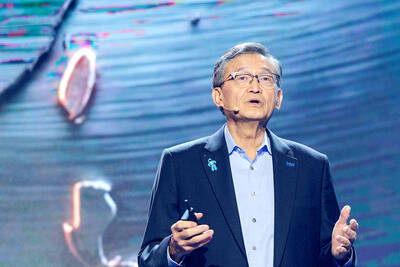
Intel Corp regards Taiwan Semiconductor Manufacturing Co (TSMC, 台積電) as a longstanding partner, as the US chipmaker would continue outsourcing production of advanced chips to TSMC, Intel chief executive officer Lip-Bu Tan (陳立武) said yesterday. “I don’t look at people as competitors. I look at the collaboration... Nvidia is also, you know, a good friend,” Tan told a news conference following his keynote speech at the Computex trade show in Taipei. “It’s a very trusted partnership for us... We are a big, top customer for them, and we’re going to continue doing that,” he said, referring to TSMC, the world’s largest foundry
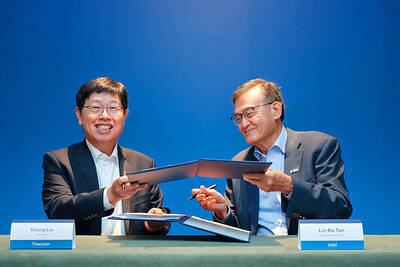
Hon Hai Precision Industry Co (鴻海精密) yesterday said it would work with US chipmaker Intel Corp to jointly develop and deploy next-generation artificial intelligence (AI) infrastructure and intelligent computing platforms in a move to capture booming demand for AI computing systems. Hon Hai, also known as Foxconn Technology Group (富士康), said in a statement that the partnership would combine its global manufacturing scale, system integration expertise and AI data center deployment capabilities with Intel’s strengths in processor architecture, silicon technologies and software ecosystem. The companies said they plan to work on equipment used in AI data centers, including server racks powered by
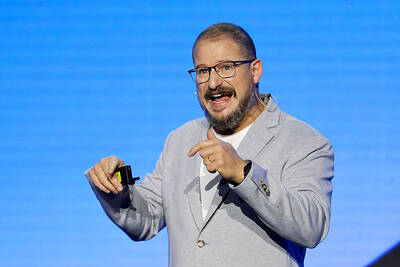
Artificial intelligence (AI) agents would supplant smartphones as the center of people’s digital lives, fundamentally reshaping personal devices and driving a major computing upgrade cycle, Qualcomm Inc CEO Cristiano Amon said yesterday. In his keynote speech for this year’s Computex trade show in Taipei, Amon said that the rise of "agentic AI" — AI systems capable of reasoning, planning and carrying out tasks autonomously — would transform how people interact with technology across phones, PCs, vehicles and wearable devices. Describing the technology as the next major evolution in computing, Amon said that "2026 is the year of agents.” For decades, smartphones have sat


 RSS
RSS