


A series about Taiwanese companies in the new "e-conomy" has to start with Ulead. Sorry, all you other ambitious upstarts, but Taiwan's most successful software maker on the world stage has earned pole position.
It's not only Ulead's tangible track record (yes, it carries the curse of being profitable) that makes the company a standout among new aspirants in the "e-conomy." It's also the experience that it has gained in international markets over the past decade -- a virtual lifetime in Internet terms. For amid all the talk of "new economic paradigms," the difficulties experienced by US "e-tailers" over Christmas has shown that there's still, tsk, tsk, no substitute for preparation when it comes to capitalizing on emerging market opportunities. And on the face of it, Ulead is better prepared than most Taiwanese companies for the Internet's coming of age in Asia.
Ready for the boom
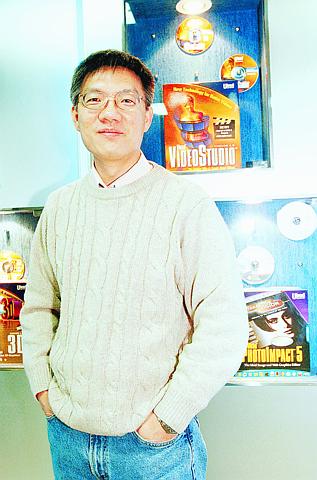
PHOTO: CHIANG YING-YING, TAIPEI TIMESN
After a few hours at the com-pany's headquarters in Taipei, one is left with the feeling that Ulead has been waiting patiently for Internet fever to strike this part of the world for some time. As Dwight Jurling, the company's marketing director puts it, "We've kept Ulead on a medium growth trajectory -- and profitable -- so that we would be ready for the boom when it came."
Ulead hasn't exactly been sitting on its hands since its founding in August 1989, however. It's been involved in intense competition in the world market for imaging software -- photos, videos, graphics, 3D animation -- which is set for explosive growth via the Web, especially as broadband access becomes more widely available. Company officials believe their time in preparation has been well spent, as Ulead has built up the production efficiencies and marketing expertise needed to develop a sound Internet business model.
If only it were that simple, of course. To get to the position where it is now able to meet demand for its products and services online, Ulead has had to do some serious thinking about how to transform itself. Why? Because the Internet has been breaking open traditional software markets, shredding established companies' revenue streams in the process, and blurring the distinction between pure software manufacturers and Internet-based software service providers. Even Microsoft is scared.
Strangely enough, this doesn't appear to have been too tough a quan-dary for Ulead. The company believes it can be both a maker of imaging software and a provider of Web-based services built around those products.
So what's its focus, then? "To empower people to use digital media and the Internet," the company says in its mission statement.
To appreciate what this means, think about your own family photos and/or home videos. Now think about how nice it would be to spruce them up with a bit of retouching and editing. Now think about how easy it would be to share them with friends and relatives over the Web.
"It's the moving of memories online," says Jurling.
Looking at what the com-pany has been through in the past decade of its existence, it's hard not to see why it is so bullish.
Humble beginnings
You could say that Ulead's success was built on its devotion to not developing a brand name in the early stages. Instead of striking directly at the lucrative retail consumer market for imaging software, which came to be dominated by US-based Adobe, Ulead tagged itself to OEM hardware firms. Mouse manufacturers were first, followed by what came to be Ulead's distribution staple and, later, its Achilles heel: scanner makers. (For the past two years, the market has seen a dramatic shake-out, with profit margins taking the pinch). Retail sales were launched much later.
Where Ulead's real break came, though, was with the rise in popularity of the Windows operating system, as its main competitors were focused on developing software for the Apple Macintosh and they sneered at the inferiority of Microsoft's graphical user interface (GUI) operating system.
Like all of today's really successful software companies, Ulead's decision to hitch its wagon to the Windows phenomenon has never been regretted, as it shot the com-pany to the world No. 3 spot for imaging software.
Here and now
So don't talk to Lotus Chen about paradigm shifts. Back when Bill Gates was a long way from becoming the world's richest geek, Ulead's current chairman and one of its four founders, had to convince hardware manufacturers to use a special Windows module provided by Microsoft in order to run his photo editing program. "It was tough," Chen says with characteristic understatement. But it paid off.
It's clear, however, that the cold, hard logic on which Chen's convictions were based then is even more relevant now. Though the platform was relatively unknown, Windows had the potential to provide Ulead with access to a much larger market as it cut across proprietary standards in the industry. The Internet, with browsers as its entry points, promises the same -- only with the ability to reach much, much further across consumer markets.
This may be easy to accept now, but even just a few years ago it wasn't.
Unfortunately, getting ahead of the knowledge curve on the Internet's potential opened Ulead to some disquieting realizations, too. In Chen's words, "The Internet liberates functionality from client to server." In normal language, that means PC-based applications such as Ulead's face a bleak future against the competition of Web-based applications.
With this realization came the understanding that if Ulead wanted to maintain a place in its customers hearts and wallets, it had to serve them online. Which means, ultimately, that placing its products on browsers will have to become more important to Ulead than Windows. "We're moving toward browsers," Chen says, without batting an eyelid.
So does that mean Ulead must also move toward becoming more of an application service provider, ie someone who hosts software services on the Web? "Everyone has to face that reality," says Chen. "Even Microsoft."
Asked for an inkling of just how radical a transformation this could turn out to be, Chen gives off another wry smile. "Browsers bridge the gap with users," he says. "It makes sense to do business with users in a more personalized manner. Giving away software but charging for services is one way to do this."
To show just how unfazed he is by the challenge, however, Chen drops the smile. "Yes, this is a paradigm shift. But we have always had to be ready for para-digm shifts."
Jurling takes the explanation a bit further into the future. "In today's environment, you know the CPU and operating system of your computer. Those are reasonable expectations to have. But with a cell phone, this doesn't apply. Software is moving into such a future, where it will have to become invisible."
So what does this mean for Ulead? Well, for one thing, it means that it has to become that much more focused on Internet-speak. "We're looking to build digital imaging communities," says Chen.
Again, Jurling elaborates. "Lotus likes to use the metaphor of a KTV. What karaoke did for singing, we'd like to do for digital imaging."
Oh yeah?
It's an ambitious plan. To execute it, Ulead has set up no fewer than 13 Web sites in English, German, Japanese, and both traditional and simplified Chinese, offering both software downloads and Web-based services. Together, they are already seeing an average of 3 million page views a month.
Software downloads, or direct selling, are old hat to the company. But take its greeting card site as an example of the service innovations it is now offering (www.ulead.com). Want to send a Valentine to your sweetheart? You can do it in a matter of mouseclicks at Ulead's site -- and for free, too.
Or how about sending a photo of yourself to your grandma far away? Ulead's Image Mechanic service allows you to upload your picture, fiddle with it so that grandma doesn't complain about how much weight you've put on, add a message and send it on its way.
Another example of the company's new focus is the way it offers tutorials for product users; for instance, on how to make better videos of your kids' birthday parties.
And, like any true "community-builder," it stages competitions among its users. "See the winners of the PhotoImpact Challenge!" a message on its main Web site trumpets.
But the biggest is, apparently, yet to come. The company says that sometime in the first quarter of this year, it plans to roll out a new Digital Media Web Site. It will essentially offer home users the ability to upload their photos to the site and share them with others, kind of like a public (or private) photo and video album.
Of course, turning all these great ideas into a viable business model is easier said than done. Building new revenue streams by generating Web site traffic requires a significantly expanded advertising budget. If Ulead is going to focus itself online, it simply has to get its name out there.
Yet again, part-nerships are perhaps more important than clever ad campaigns. Just as Ulead hooked up with scanner makers all those years ago, so it has been smart enough to take equity stakes in a bunch of strategically important companies that can help to promote its brand -- and, at the same time, keep its feelers out in areas where new growth opportunities are to be found. These include Web portal Kimo.com (Ulead is its biggest single institutional investor with a 6.36 percent stake in Sysware, Kimo's parent company), content provider PC Home (3.51 percent), which has the largest subscription base for an e-mail newsletter service in Taiwan, and e-commerce site buysell.com (19 percent), which runs the gamut of online services: business-to-business, business-to-consumer and consumer-to-consumer.
On the international stage, too, Ulead has been quick to cement its ties with Kodak. North American users of Ulead's Photo Impact software can now get "seamless" access to the US-based giant's PhotoNet online printing service.
Back to its roots
Yet despite all its success in the rich markets of the West, probably the brightest prospects for Ulead lie closer to home, as its strategic investments indicate. For it's not only in its business revenues model that paradigm shifts are under way. It's also in its customer profile. Now, Ulead ranks No. 3 worldwide, behind Adobe and MGI. But in the Pacific Rim, it's No. 1, with a commanding 74.2 percent of the market.
Granted, Asia accounts for only 20 percent of sales, compared with North America and Europe's combined 55 percent. But those numbers will change rapidly in the coming few years as Ulead capitalizes on its advantage in regional markets, especially among the Chinese-character-reading community of East Asia.
Japan, in particular, is growing fast, with a staff of 11 based there, while the company has just recently set up a liaison office in Beijing to tap the vast China market.
Rapid expansion presents challenges of its own, of course. Ulead now has a workforce of 280 spread across Taiwan (232), the US, Germany, Japan and China. This is an increase of nearly 50 percent over the past two years and, with a new eight-story headquarters being constructed in Taipei's Neihu district, an even more rapid expansion is envisaged in the coming few years.
So far, recruitment doesn't seem to have been a problem, as Ulead has been hiring young, entry-level graduates from Taiwanese universities -- kids who are keen to be part of a company that's involved in e-business.
Despite the sudden influx of youth, Ulead also has an experienced management team.
Three of its four co-founders, Lotus Chen, Chen Way-zen and Lewis Liaw, worked for the Information Industry Institute (III), which has spawned almost all of Taiwan's well-known high-tech successes. The fourth, Chen Li-ming (who retired last year, handing the reins to Lotus Chen), came from Microtek, bringing with him hands-on marketing experience in the US. And though all were trained engineers, they had the sense to bring in an experienced manager as the company's president. Danielle Liao, who joined a year after Ulead's founding, is widely credited as the person who makes sure that Ulead meets its bottom-line projections, which it has consistently done (see chart).
All this has not gone unnoticed by investors, who have pumped up Ulead's share price since its listing on the OTC nearly a year ago to NT$205 at Friday's close.
Challenges
But still, it's tempting to look at Ulead and say, "You swim with the big fish, prepare to get eaten." The Taiwanese company's business model may sound unique to this audience, but there are a lot of more sophisticated -- and wealthier -- players out there who have seen the same market potential as Ulead has. It's hard to imagine how Ulead would stack up against Apple, for instance, which has integrated its imaging software into its soon-to-be released Mac OSX operating system, and has already rolled out a set of new "iTools" on its Web site which aim to do much of what Ulead has promised in its mission statement.
But Ulead thinks there's too big a pie waiting to be devoured before any assessments start to be made of who will get the biggest share. First, the market has to grow to its potential -- which still appears massive.
In any case, it's not like Ulead hasn't been here before. Back in August, 1994, when its software was beginning to make serious waves in the world market under a marketing agreement with Aldus, Adobe swooped on its arch-rival and bought a majority shareholding. With control of marketing rights to Ulead's PhotoStyler program, it quickly moved to buy full ownership of the product, and as soon as it had done so, PhotoStyler was "withdrawn from the market."
Ulead's response was to pocket the cash and start over with a new brand, PhotoImpact, which went on to become even more successful than its predecessor.
Talk about survival instinct. I wonder if Lotus Chen has any memories of those days and whether he's moved them online already.

Cairo’s new monorail slices across the city skyline, running above the familiar chaos of blaring horns and aging buses’ exhaust fumes that mark rush hour below. The US$4.5 billion monorail, opened this month, is among Egypt’s most prominent new transport projects, part of a debt-funded infrastructure drive criticized for sapping state finances while bringing limited benefits to most of the country’s 109 million people. “It feels like you’re in a different country,” said Ramy Sayed, a restaurant manager, aboard a driverless Innovia 300 train. “No noise, no traffic, we’re not used to this.” The eastern line runs 56km from the bustling middle-class

Taiwanese firms have increased investment in the Philippines in recent years as Manila’s ties with Washington deepen and global supply chains continue to shift away from China, an expert at the Chung-Hua Institution for Economic Research (CIER, 中華經濟研究院) said yesterday. The Philippines had not been among Taiwanese investors’ top choices in Southeast Asia, CIER Taiwan ASEAN Studies Center director Kristy Hsu (徐遵慈) said at a seminar in Taipei. However, Taiwan’s investment in the country has grown significantly since the COVID-19 pandemic, reaching US $257 million last year, a high in recent years, she said. Although Taiwan’s total investment in the Philippines still lags

Starlux Airlines Co (星宇航空) today unveiled a long-haul network expansion plan at a shareholders’ meeting in Taipei, including direct flights to Barcelona, Spain, and Zurich, Switzerland, as well as a service connecting Taipei, Sydney and New Zealand. Starlux is to become the first Taiwanese carrier to offer non-stop services to the two European cities, while the inaugural oceanic route is expected to expand transit opportunities within the Australia-New Zealand market, Starlux said. Flight services to Chicago, Dallas, Washington and New York are under evaluation, the airline added. Prior to the shareholders’ meeting, the airline earlier this year announced that it would be

Intel Corp regards Taiwan Semiconductor Manufacturing Co (TSMC, 台積電) as a longstanding partner, as the US chipmaker would continue outsourcing production of advanced chips to TSMC, Intel chief executive officer Lip-Bu Tan (陳立武) said yesterday. “I don’t look at people as competitors. I look at the collaboration... Nvidia is also, you know, a good friend,” Tan told a news conference following his keynote speech at the Computex trade show in Taipei. “It’s a very trusted partnership for us... We are a big, top customer for them, and we’re going to continue doing that,” he said, referring to TSMC, the world’s largest foundry


 RSS
RSS