


When a handful of heavily armed God's Army rebels entered this country from Myanmar, they were confused about what soft target to seize in their bid to tell Thailand's military to stop its allegedly murderous bombardment of innocent Myanmar civilians along the border.
They also felt emboldened by a mix of Christian and animist powers said to immortalize the two, "black-tongued," 12-year-old leaders of God's Army -- and all minority ethnic Karen guerrillas who obey the influential twins.
But about 24 hours after entering Thailand, all of the 10 Myanmar Karen rebels lay dead inside the sprawling hospital they had brazenly captured in tranquil Ratchaburi town.
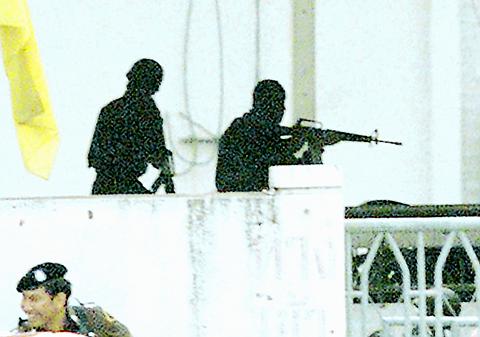
PHOTO: AFP
Whatever spiritual powers the self-proclaimed God's Army guerrillas may have believed in obviously failed when Thai guns blazed in pre-dawn darkness yesterday morning, liberating the hospital and several hundred terrified patients, visitors and medical staff.
Yet the God's Army rebels not only lost their lives but also destroyed much of the tolerance Thailand grants to Myanmar refugees, pro-democracy activists, minority ethnic guerrillas, government-in-exile politicians and others who cross the border seeking sanctuary while fleeing Myanmar's dictatorship and dry-season military offensives.
The Geneva Conventions drawn up after World War II lists as potential war crimes both the use of a hospital in any conflict, and the intentional targeting of refugees.

PHOTO: AFP
In relation to the guerrilla's allegation that Thai forces had been killing escaping Myanmar refugees along the border by bombing them, international law also forbids all such acts.
The Thai military however strongly denied intentionally bombing Myanmar civilians along the nearby border, and insisted its forces had fired last week to chase away armed intruders.
"We fired warning shots to prevent them crossing," said Thailand's Army Chief, General Surayud Chulanont. "The rounds fell in our territory and were not directed at innocent people."
The Bangkok Post yesterday quoted unidentified "security sources" as saying the shelling by Thai forces may have been in response to the deaths of four Thai soldiers in December who reportedly stepped on landmines in the jungle which were planted by Myanmar's Karen rebels.
One source told the paper, "The bombardment (last week) might have killed and injured many in the area. We don't have an exact figure, but the Karen estimate of 200 dead might be exaggerated."
The Nation newspaper said the rebels purposely timed their hospital attack to coincide with the eve of Thai Army Day, which annually hails the bravery of the powerful, politicized and business-minded military.
"Obviously, the gunmen wanted to deliver a strong message to the military, especially to the Ninth Army Division of the First Army Area, which is taking care of the area."
In addition to other demands, the guerrillas urged "the Thai Army to stop assisting the Myanmar Army, and that Thai commanders who ordered the artillery shelling of their camp, should be reprimanded," the report added.
Thai authorities at the hospital, meanwhile, indicated they had little choice but to act tough to end the stand-off because in October, Bangkok allowed a similar group of rebels to take control of Myanmar embassy in the Thai capital and then enjoy safe passage to escape.
Afterwards, Bangkok's government suffered intense grilling by a loud, pro-military opposition which claimed Thai Prime Minister Chuan Leekpai was soft on terrorism for allowing the embassy assault to go unpunished.
As the siege ended, several internationally-funded human rights organizations and other groups which have supported Myanmar's democracy activists were quick to condemn God's Army for using the hospital at Ratchaburi.
They deem the God's Army armed assault at odds with Myanmar's Nobel Peace Prize pro-democracy activist Aung San Suu Kyi who has called for a non-violent struggle and international boycotts to bring democracy to Myanmar.
The groups are now also concerned that Thailand will crack down on thousands of Myanmar refugees and others who are currently sheltering in Thailand where many of them suffer exploitation in Thai sweatshops, brothels, construction sites and elsewhere.
Other Karen guerrillas which were linked to God's Army, such as the 4000-man Karen National Union (KNU), have also distanced themselves from the mystical rebels who number about 200.
The KNU, which reportedly supplied weapons and fighters to God's Army, said that splinter group and the Vigorous Burmese Student Warriors who occupied the Myanmar embassy in October were no longer under KNU control.
"Like the Vigorous Burmese Student Warriors, God's Army has refused to listen to KNU senior officers and hasn't followed orders or heeded objections for some time," said KNU spokesperson Mary Ohn.
Fresh details about how and why God's Army attacked a hospital have also been revealed by the Karen-speaking conductor on the bus which the rebels hijacked from the Thai-Myanmar border to the hospital in Ratchaburi on Monday morning.
"Speaking in Karen, some (rebels) talked about going to Bangkok, but others in their group rejected that, saying it was impossible for them to go that far with heavy weapons on board," said Somchai Dangarun, 40, the conductor on the bus which makes the morning run from the border into town. "All of them looked strong and none seemed over 25 years old. They were dressed in fatigues and had assault rifles and hand grenades. Some tied black cloth to hide their face. Our bus ran at 70 to 80 kilometers-per-hour, and came across one (Thai) police checkpoint, but not a single policeman was there so we passed through."
His cousin, bus driver Pinit Angngern, said, "Villagers waved for me to stop to pick them up as usual. I tried to pass them for their own safety, but the hijackers told us to stop ... If police had stopped us at any place, there would have been an exchange of gunfire and we would have ended up dead."
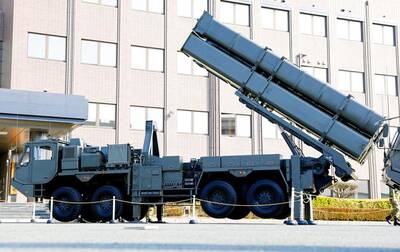
Japan has deployed long-range missiles in a southwestern region near China, the Japanese defense minister said yesterday, at a time when ties with Beijing are at their lowest in recent years. The missiles were installed in Kumamoto in the southern region of Kyushu, as Japan is attempting to shore up its military capacity as China steps up naval activity in the East China Sea. “Standoff defense capabilities enable us to counter the threat of enemy forces attempting to invade our country ... while ensuring the safety of our personnel,” Japanese Minister of Defense Shinjiro Koizumi said. “This is an extremely important initiative for

Chinese Nationalist Party (KMT) Chairwoman Cheng Li-wun (鄭麗文) today accepted an invitation from Chinese President Xi Jinping (習近平) to lead a delegation to China next month, saying she hopes to promote the peaceful development of cross-strait relations and bring stability to the Taiwan Strait. “I am grateful and happy to accept this invitation,” Cheng said in a statement from the KMT chairperson’s office. Cheng said she hopes both sides can work together to promote the peaceful development of cross-strait relations, enhance exchange and cooperation, bring stability to the Taiwan Strait and improve people’s livelihoods. At today's news conference, Cheng said any efforts to

The nation’s fastest supercomputer, Nano 4 (晶創26), is scheduled to be launched in the third quarter, and would be used to train large language models in finance and national defense sectors, the National Center for High-Performance Computing (NCHC) said. The supercomputer, which would operate at about 86.05 petaflops, is being tested at a new cloud computing center in the Southern Taiwan Science Park in Tainan. The exterior of the server cabinet features chip circuitry patterns overlaid with a map of Taiwan, highlighting the nation’s central position in the semiconductor industry. The center also houses Taiwania 2, Taiwania 3, Forerunner 1 and

MORE POPULAR: Taiwan Pass sales increased by 59 percent during the first quarter compared with the same period last year, the Tourism Administration said The Tourism Administration yesterday said that it has streamlined the Taiwan Pass, with two versions available for purchase beginning today. The tourism agency has made the pass available to international tourists since 2024, allowing them to access the high-speed rail, Taiwan Railway Corp services, four MRT systems and four Taiwan Tourist Shuttles. Previously, five types of Taiwan Pass were available, but some tourists have said that the offerings were too complicated. The agency said only two types of Taiwan Pass would be available, starting from a three-day pass with the high-speed rail and a three-day pass with Taiwan Railway Corp. The former costs NT$2,800


 RSS
RSS