


China rolled out its most modern weapons on yesterday to mark the 50th anniversary of communist rule, a display aimed, at least in part, at rival Taiwan and its US backers.
Models of the intercontinental ballistic missile Dong Feng-31 (East Wind-31) on hard-to-find mobile launchers rumbled past Tiananmen Square, the center of student-led demonstrations for democracy crushed by the army in 1989.
Warplanes, including the new indigenous Flying Leopard fighter bomber, flew past the Gate of Heavenly Peace, where head of state, military chief and Communist Party leader Jiang Zemin watched a huge military parade with politburo colleagues.
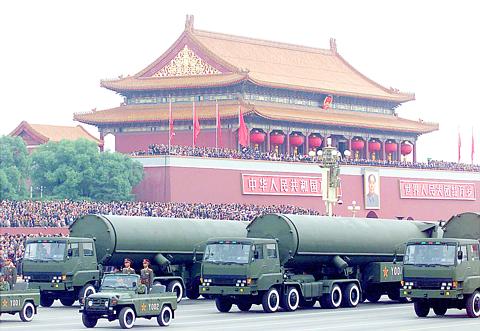
PHOTO: REUTERS
The display of might came amid a bitter row with Taipei over Taiwan President Lee Teng-hui's July declaration of political equality which enraged Beijing, which regards Taiwan as a renegade province.
Beijing, which insists Taiwan must be reunified with the motherland, saw Lee's move as a "dangerous" lurch towards independence.
It has threatened to invade if Taiwan declares independence and yesterday's military parade -- the first since 1984 and the biggest ever -- showed off China's anti-aircraft and anti-ship missiles.
The two-hour parade, which halted traffic in central Beijing, also featured short-range missiles which are believed to be deployed against Taiwan.
"What they wanted to show was missiles and rockets," said one Asian military specialist who did not want to be identified.
"Fifty percent of the military parade was missiles and rockets," he said. "They're reasonably proud of it."
"It's not state of the art, but it's okay for Asia."
The 2.5 million-strong People's Liberation Army also showed off military aircraft ranging from the Russian Sukhoi-27 to bombers, fighters, ground-attack aircraft, strike fighters and helicopters of the army, navy and air force. The supersonic Flying Leopard can carry four air-to-air or air-to-surface missiles with a total weight of five tons. It has a range of about 1,600km.
The DF-31 surface-to-surface missile can carry a single 700kg nuclear warhead over 8,000km, which puts the US within its range.
The green missile, which underwent its latest test in August, is two to three years away from deployment, defense experts said.
It had initially been scheduled for deployment in 2000.
The DF-31 is designed to replace the DF-4, a missile with half the range that was developed in the 1960s, the experts said.
China was expected to build between 10 and 20 DF-31 missiles, they said. The Dong Feng was the subject of spying allegations in a politically explosive report issued in May by a special committee of the US Congress. The report alleged that two decades of Chinese spying on the US helped Beijing advance its missile and nuclear warhead programs.
Chinese-made aerial refuel tankers made their debut, emphasizing an ability to keep warplanes in the air for long periods of time.
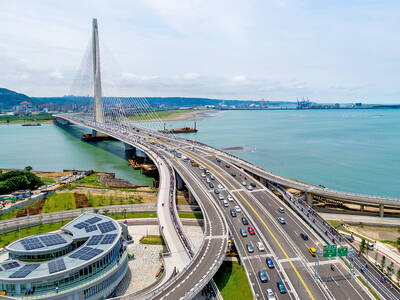
The Ministry of Transportation and Communications yesterday inaugurated the Danjiang Bridge across the Tamsui River in New Taipei City, saying that the structure would be an architectural icon and traffic artery for Taiwan. Feted as a major engineering achievement, the Danjiang Bridge is 920m long, 211m tall at the top of its pylon, and is the longest single-pylon asymmetric cable-stayed bridge in the world, the government’s Web site for the structure said. It was designed by late Iraqi-British architect Zaha Hadid. The structure, with a maximum deck of 70m, accommodates road and light rail traffic, and affords a 200m navigation channel for boats,
Taiwan Semiconductor Manufacturing Co (TSMC, 台積電), the world’s largest foundry service provider, yesterday said that global semiconductor revenue is projected to hit US$1.5 trillion in 2030, after the figure exceeds US$1 trillion this year, as artificial intelligence (AI) demand boosts consumption of token and compute power. “We are still at the beginning of the AI revolution, but we already see a significant impact across the whole semiconductor ecosystem,” TSMC deputy cochief operating officer Kevin Zhang (張曉強) said at the company’s annual technology symposium in Hsinchu City. “It is fair to say that in the past decade, smartphones and other mobile devices were
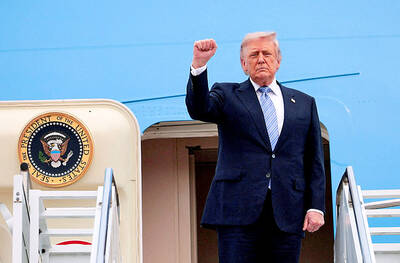
US-CHINA SUMMIT: MOFA welcomed US reassurance of no change in its Taiwan policy; Trump said he did not comment when Xi talked of opposing independence US President Donald Trump yesterday said he has not made a decision on whether to move forward with a major arms package for Taiwan after hearing concerns about it from Chinese President Xi Jinping (習近平). Trump’s comments on Taiwan came as he flew back to Washington after wrapping up critical talks in which both leaders said important progress was made in stabilizing US-China relations even as deep differences persist between the world’s two biggest powers on Iran and Taiwan. “I will make a determination,” Trump said, adding: “I’ll be making decisions. But, you know, I think the last thing we need right
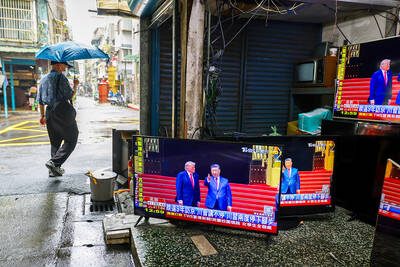
TAIWAN ISSUE: US treasury secretary Scott Bessent said on the first day of meetings that ‘it wouldn’t be a US-China summit without the Taiwan issue coming up’ There were no surprises on the first day of the summit between US President Donald Trump and Chinese President Xi Jinping (習近平), the Mainland Affairs Council (MAC) said yesterday, as the government reiterated that cross-strait stability is crucial to the Asia-Pacific region, as well as the world. As the two presidents met for a highly anticipated summit yesterday, Chinese state media reported that Xi warned Trump that missteps regarding Taiwan could push their two countries into “conflict.” Trump arrived in China with accolades for his host, calling Xi a “great leader” and “friend,” and extending an invitation to visit the White House


 RSS
RSS