


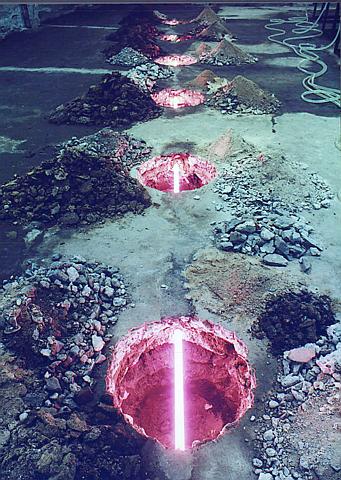
Walk into the dim eerie building in Chuwei that once housed a chicken farm and peer into the darkness: a soft red glow emanates from the floor.
The piles of rocks, cement and sand, seemingly left over from some archaeological dig or perhaps a mystical sign from some witch, sit in little erect formations contrasted with the red luminous resin disks that sparkle like amber. Set on a diagonal access, the disks are placed into six shallowly dug holes. Welcome to the world of artist Lu Pei Lin, whose work "Floating V" is on exhibit at the Bamboo Curtain Studio until Nov. 21. In the Floating Series, Lu uses holes, fluorescent tubes, water, earthy materials and technological equipment to evoke the state of the body.
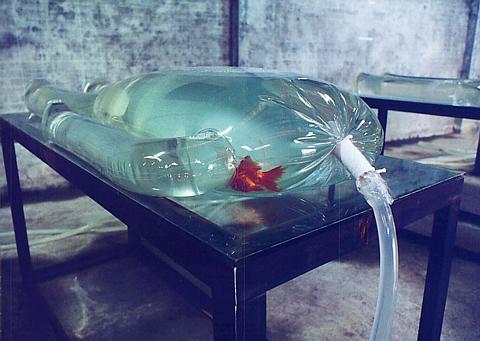
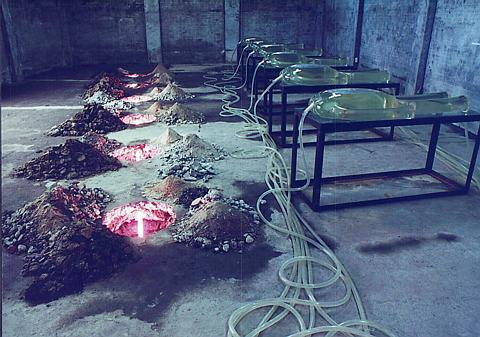
Two years ago, Lu jack-hammered into the concrete floor of the Bamboo Curtain Studio, making six holes for his piece "Floating IV." The holes appeared as disembodied heads. Nearby, resting on surgical tables, six plastic human-shaped forms filled with water and live gold fish were connected to a large fish tank complete with water plants that created an ecosystem. After the show ended, Lu covered the holes, where they remained dormant. Since the holes were already dug, Lu chose to reuse them for his latest work.
Living in an urban environment caused Lu to experience an alienation akin to floating; the anti-gravitational feeling results from the powerlessness he felt due to outside forces. For Lu, his holes intensify the psychological feeling of a void while also creating a sense of weightlessness.
In a typical art exhibition, one walks around the perimeter of the room peering at eye level the works on the walls. This perspective changes for Lu's exhibition since the work is installed in the ground. So ignore the walls and get low to the ground to hear the soft gurgling sounds emanating forth. Each of the six holes contains a light box and an air compressor with its exposed tubes running in and out; the air blows steadily into the small puddle of water and shampoo to create foaming bubbles. The holes are filled in with clay and an inserted fluorescent tube bisects them and shines through the resin, giving the work a sexual appearance. The red glow and the low gurgling sound make it hypnotizing to watch as new bubbles aggregate and conglomerate.
Lu does not actively connect his work to the human body; instead he admits that his work is comparable to what an archaeologist does: to exhume, to discover and to come up with an interpretation that may differ with that of its maker. "When we wash with soap, making many bubbles, each one is unique and that is similar to how we read documents or images," Lu offers, "and each one is special according to how we interpret it." The floating pieces play on the tension between combining electricity with water but also contains a spiritual earthiness akin to primeval art. Commenting on the current state of human life, Lu shows us that the natural body is heavily imbedded with technological and social meanings. However, by introducing technology into his work, he shows us that Edenic utopias are no longer possible. The murmuring sounds and the thin transparent tubes are reminiscent of a hospital patient's life support system and the tubes hint at a life force draining from or into the body.
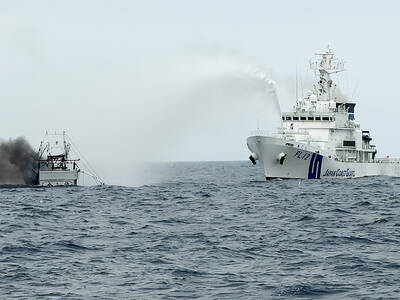
CREDIT-GRABBER: China said its coast guard rescued the crew of a fishing vessel that caught fire, who were actually rescued by a nearby Taiwanese boat and the CGA Maritime search and rescue operations do not have borders, and China should not use a shipwreck to infringe upon Taiwanese sovereignty, the Coast Guard Administration (CGA) said yesterday. The coast guard made the statement in response to the China Coast Guard (CCG) saying it saved a Taiwanese fishing boat. The Chuan Yu No. 6 (全漁6號), a fishing vessel registered in Keelung, on Thursday caught fire and sank in waters northeast of Diaoyutai Islands (釣魚台). The vessel left Keelung’s Badouzih Fishing Harbor (八斗子漁港) at 3:35pm on Sunday last week, with seven people on board — a 62-year-old Taiwanese captain surnamed Chang (張) and six
The Legislative Yuan’s Finance Committee yesterday approved proposed amendments to the Amusement Tax Act (娛樂稅法) that would abolish taxes on films, cultural activities and competitive sporting events, retaining the fee only for dance halls and golf courses. The proposed changes would set the maximum tax rate for dance halls and golf courses at 50 and 20 percent respectively, with local governments authorized to suspend the levies. Article 2 of the act says that “amusement tax shall be levied on tickets sold or fees charged by amusement places, facilities or activities” in six categories: “Cinema; professional singing, story-telling, dancing, circus, magic show, acrobatics
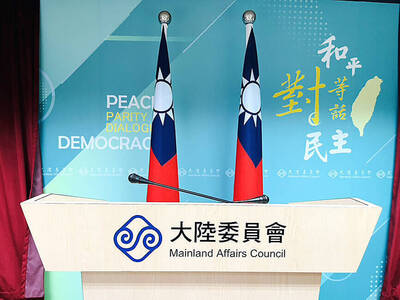
RISKY BUSINESS: The ‘incentives’ include initiatives that get suspended for no reason, creating uncertainty and resulting in considerable losses for Taiwanese, the MAC said China’s “incentives” failed to sway sentiment in Taiwan, as willingness to work in China hit a record low of 1.6 percent, a Ministry of Labor survey showed. The Directorate-General of Budget, Accounting and Statistics (DGBAS) also reported that the number of Taiwanese workers in China has nearly halved from a peak of 430,000 in 2012 to an estimated 231,000 in 2024. That marked a new low in the proportion of Taiwanese going abroad to work. The ministry’s annual survey on “Labor Life and Employment Status” includes questions respondents’ willingness to seek employment overseas. Willingness to work in China has steadily declined from

Tainan, Taipei and New Taipei City recorded the highest fines nationwide for illegal accommodations in the first quarter of this year, with fines issued in the three cities each exceeding NT$7 million (US$220,639), Tourism Administration data showed. Among them, Taipei had the highest number of illegal short-term rental units, with 410. There were 3,280 legally registered hotels nationwide in the first quarter, down by 14 properties, or 0.43 percent, from a year earlier, likely indicating operators exiting the market, the agency said. However, the number of unregistered properties rose to 1,174, including 314 illegal hotels and 860 illegal short-term rental


 RSS
RSS