


Afghanistan's ruling Taliban swept seemingly out of nowhere in the mid-1990s to seize power in Kabul, impose the world's strictest Islam and host the militant training camps that have now entangled them in a war with the US.
So when the bombing and the battles are over, will they slip just as quickly into the background? Can Afghanistan simply close this chapter in its turbulent history and get on with the work of reconstruction?
Exiled Afghans say the fundamentalists, a radical strain spawned by two decades of civil war, cannot be ignored and the "good Taliban" will have to be included in any new power structure.
Sayed Ahmad Gailani, a moderate religious leader canvassing support for ex-King Zahir Shah to return, said opposition ranks would be open to "those who find it their religious, spiritual and national obligation to stand with the rest of the people of Afghanistan."
Hamid Karzai, who was deputy foreign minister in the mujahidin (holy warrior) government that the Taliban overthrew, put it more bluntly: "If they don't have blood on their hands, they are welcome."
Who falls into which category will be decided in a very Afghan way.
Many will be taken back by their tribes as prodigal sons, some will be murdered in cold blood and a few will linger on with nuisance value but no power, analysts say.
The Taliban movement was originally a group of radicalized Koran students bringing Islamic law and order -- including stoning to death for adultery and a ban on women working outside the house -- to a country torn by civil war and the corruption and chaos it caused.
Welcomed by the weary population as a force for peace, the victorious movement quickly grew to cover the spectrum from oppressors to opportunists.
Many local warlords joined just to save their skins.
The Afghan opposition is now openly wooing these turncoats, saying they are welcome in the broad-based power structure to come.
Abdul Haq, a famous commander from the Soviet war who is now campaigning for Zahir Shah's return, said on Friday that more than half of the Taliban could be accepted as partners in the new order.
The pragmatic Afghans understand that these small-time warlords or dignitaries, most hardly known outside their villages and valleys, pay lip service to every new leadership just to preserve their local influence.
"The `safedrish' (`white beards' or tribal elders) will know who has committed crimes and who hasn't, and they will decide who is acceptable," said Abdul Rasul Amin, head of the Afghanistan Study Center in Peshawar.
"A tribal jirga [council] can decide to forget the past and treat everyone like brothers," said Syed Bilal Shah, a Pakistani Pashtun nationalist politician.
"But if a Taliban commander has killed someone's brother and no longer has a powerful force behind him, they might seek revenge."
In the eye-for-an-eye world of the ethnic Pashtuns, that means only one thing -- death, preferably public execution by a relative of the dead man.
In the tribal areas, boys hardly able to hold a gun have executed their fathers' killers, with their approving widowed mothers looking on.
In a twist only Afghanistan's convoluted politics could produce, the ranks of the Taliban -- a movement of religious zealots trying to turn the clock back 1,300 years to the purity of Islam at its birth -- also include many former communists seeking a safe haven in the country's civil war.
Defeated by the anti-Soviet mujahidin, these educated men -- the vanguard of modern life in this poor and backward country -- have mouthed Islamic slogans in exchange for jobs, influence and protection.
"Mullah" Mohammad Hassan, governor of Kandahar province, was not a religious figure before the Taliban made his area their stronghold. Taliban air chief Mohammad Gilani was a general in the communist-era military.
"Of course, there are plenty of old communists in the Taliban." said Abdullah Jan Khalil, a Pakistani Pashtun. "You don't think a Koran school teaches you how to fly a MiG or an attack helicopter, do you?" the Peshawar University historian asked.
Syed Fida Younis, another Pakistani Pashtun analyst, said the new government would have to find a place for the former communists and mujahidin commanders who sided with the Taliban.
"It's not correct to say they're real Taliban. There must be a reconciliation with the Khalqis and Parchamis" he said, using the terms for the two factions -- basically Pashtun and non-Pashtun -- in the Soviet-era communist party.
A sensitive group will be the hardline ideologues who emerge with undinted zeal but no crimes to their name to disqualify them.
These fire-and-brimstone fundamentalists could try to carry the flame of Islamic purity forward in the form of a religious party, not unlike Pakistani groups staging pro-Taliban, anti-US protests these days.
"They could continue as one of these parties, with a dedicated following but not much real power," Amin said.
The bleakest prospects are for the firebrand leadership in Kandahar and the fighters who have thrown in their lot with Taliban supreme leader Mullah Mohammar Omar.
With nowhere else to go as US-led attacks persist and expected opposition offensives loom, these men will fight to the death or perish under the bombs on their bunkers and barracks, analysts say.

LEVERAGE: China did not ‘need to fire a shot’ to deny Taiwan airspace over Africa when it owns ‘half the continent’s debt,’ a US official said, calling it economic warfare The EU has raised concerns about overflight rights following the delay of President William Lai’s (賴清德) planned state visit to the Kingdom of Eswatini after three African nations denied overflight clearance for his charter at the last minute. Taiwanese allies Paraguay and Saint Kitts and Nevis, as well as several US lawmakers and the Inter-Parliamentary Alliance on China (IPAC) condemned China for allegedly pressuring the countries. Lai was scheduled to fly directly to Taiwan’s only African ally from yesterday to Sunday to celebrate the 40th anniversary of King Mswati III’s accession and his 58th birthday, but Seychelles, Mauritius and Madagascar suddenly revoked
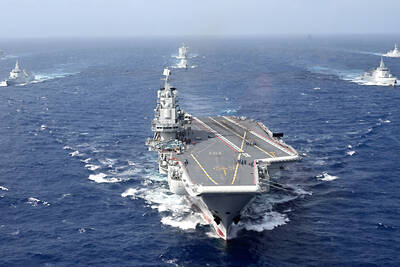
PROVOCATIVE: Chinese Deputy Ambassador to the UN Sun Lei accused Japan of sending military vessels to deliberately provoke tensions in the Taiwan Strait China denounced remarks by Japan and the EU about the South China Sea at a UN Security Council meeting on Monday, and accused Tokyo of provocative behavior in the Taiwan Strait and planning military expansion. Ayano Kunimitsu, a Japanese vice foreign minister, told the Council meeting on maritime security that Tokyo was seriously concerned about the situation in the East China and South China seas, and reiterated Japan’s opposition to any attempt to change the “status quo” by force, and obstruction of freedom of navigation and overflight. Stavros Lambrinidis, head of the EU delegation to the UN, also highlighted South China Sea
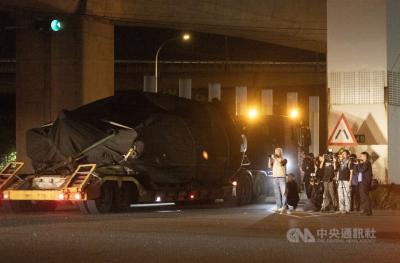
The final batch of 28 M1A2T Abrams tanks purchased from the US arrived at Taipei Port last night and were transported to the Armor Training Command in Hsinchu County’s Hukou Township (湖口), completing the military’s multi-year procurement of 108 of the tanks. Starting at 12:10am today, reporters observed more than a dozen civilian flatbed trailers departing from Taipei Port, each carrying an M1A2T tank covered with black waterproof tarps. Escorted by military vehicles, the convoy traveled via the West Coast Expressway to the Armor Training Command, with police implementing traffic control. The army operates about 1,000 tanks, including CM-11 Brave Tiger
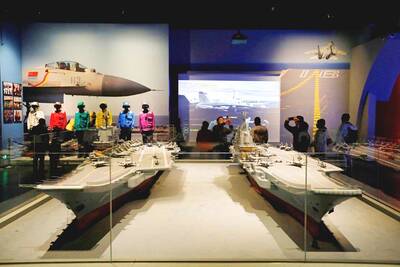
China on Wednesday teased in a video an aircraft carrier that could be its fourth, and the first using nuclear power, while making an allusion to Taiwan and vowing to further build up its islands, as it looks to boost maritime power, secure resources and bolster territorial claims. The video, issued on the eve of the 77th founding anniversary of the Chinese People’s Liberation Army Navy, featured fictional officers with names that are homophones of three commissioned aircraft carriers, the Liaoning (遼寧), Shandong (山東) and Fujian (福建). Titled Into the Deep, it showed a 19-year-old named “Hejian” (何劍) joining the group, sparking


 RSS
RSS