


With six family members squeezed into two bedrooms, the 4m2 temporary housing unit where Chen Chin-shao (陳金繡) lives is cluttered with toys, milk bottles and chair cushions removed to make the seats cooler in the blistering summer heat. Clean jackets hanging beside a table with dirty dishcloths piled up underneath amply illustrate the lack of room in this house, where ventilation is almost non-existent. The only window in the living room is tightly shut to guard against rain water seeping in.
The family, trying to survive on NT$2,000 a day, has been waiting for a promised government mortgage. In the absence of any money, they have gone ahead anyway and built a rickety abode with a light steel frame and thin wooden boards, which would surely buckle in the face of any natural disaster, like a typhoon, flood or landslide.
"We are desperate. Yet without money we cannot convince the bank of our ability to repay the debt. We have nothing," Chen said. Despite the government's policy of providing low-interest mortgages for quake victims, many victims have complained that their applications for mortgages keep being rejected by potential lenders because they are unable to provide the requisite guarantees.
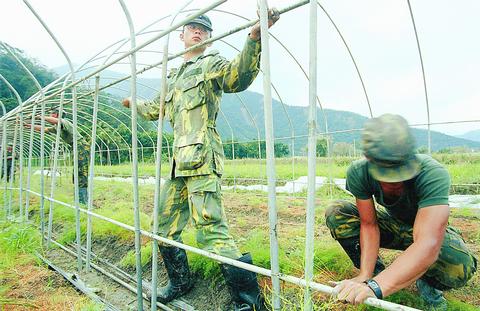
PHOTO: CHIANG YING-YING, TAIPEI TIMES
Both the new DPP government and the old KMT administration vowed to speed up earthquake reconstruction by making the relevant regulations more flexible and proclaiming a number of emergency measures for relief in the most urgent of cases.
Although one year has passed since the devastating tremor struck the country, few victims feel that the passage of time has made any difference to their plight, and feel stranded in a recovery process that appears to be going nowhere.
No help from the government
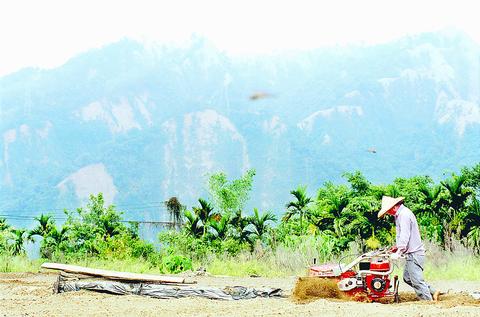
PHOTO: CHEN CHENG-CHANG, TAIPEI TIMES
Many people in agricultural townships and remote areas of central Taiwan have mocked the promises of help the government has made. "We haven't benefited from the efforts of either government since last year," they complain. Many in Puli township (
"Taiwan's reconstruction is all about politics," complained Hsieh Chi-chung (謝志誠), executive director of the 921 Earthquake Reconstruction Foundation (EDRF, 九二一震災重建基金會), complaining that any move the government or politicians make is politicized by those who stand to gain in the reconstruction effort instead of going towards helping victims.
In late August, President Chen Shui-bian (
Yet villager Chen Pan Shen-chi (陳潘順齊) felt her miserable existence had not been improved one iota by Chen's expressions of sympathy. "He's here only to see whether our roofs have really been blown away by the typhoon. It's impossible to see his face for his entourage and the crowds of reporters surrounding him, much less to say anything to him," she said. "They gathered us in a smarter room for Mr President to peer at us."
The old woman, sporting galoshes to keep her feet dry after a torrential downpour saturated the temporary housing, said that no officials had ever been there until the county commissioner turned up with NT$10,000 for each household immediately before the president's visit.
"I'm not surprised that a raft of political concerns is dragging out the overall reconstruction effort. This is just how things work in Taiwan, from central government down to local government," Hsieh Chi-chung said.
Hsieh's remarks epitomize the views of many victims about why they still cannot extricate themselves from their straitened circumstances a whole year after the quake.
According to the Executive Yuan's 921 Earthquake Reconstruction Committee (
No demarcation of roles
A major obstacle to effective reconstruction throughout has been the absence of a clear and transparent demarcation of roles between central and local government agencies involved in the work. This has prevented victims and NGOs from always knowing which agency is responsible for what. It has also caused a lot of waste.
Both the Nantou County Government and the Council of Agriculture (
"It is obvious that different layers of the government would compete to handle projects that are easily do-able in order to outshine others in the eyes of the public," said Wang Chun-kai (王俊凱), executive secretary of the foundation. "As it's always difficult to find out whether there is an agency responsible, or how many agencies there are responsible, many NGOs hesitate to fund reconstruction programs to avoid expenditure on matters that are already being looked after," Wang added.
The duplication of responsibility by government agencies can be traced back to the immediate aftermath of the quake. "The KMT government wanted full control of reconstruction efforts as a means of demonstrating its prowess and in doing so hoped to garner votes in the presidential election which was only months away," said Wang.
KMT scam
Hsieh points out that in order to guarantee local support for the party in the election, the KMT central government would promise money directly to township mayors instead of complying with regular procedures and having the county government first review all township budgets.
"It is understandable that the county commissioner would have to grant the budget for projects the township mayors have promised to local residents. The former wouldn't want to lose votes in any future election either," Hsieh said.
"Recalling TV scenes when former president Lee Teng-hui [李登輝] visited the afflicted areas, it would always be township mayors instead of county commissioners accompanying him," said Chun Shao-nung (張邵農), a social worker participating in the reconstruction efforts.
Meanwhile, a survey conducted by the National Alliance for Post-earthquake Reconstruction (
Nantou County can be singled out for its poor post-quake reconstruction efforts and the bad relationship that exists between the county government and county council.
Hsieh said that as Nantou County Council is controlled by the KMT, the "ritualized" confrontation of the council with Peng Pai-hsien (
Hsieh also revealed that as Peng mobilized victims of the quake to humiliate Chung Wen-tung (鄭文銅), deputy speaker of Nantou County Council, who was involved in construction projects of buildings that collapsed, Chung took his revenge on Peng by attacking Peng's policies and having him recalled. "The battle has only delayed reconstruction," said Hsieh.
Peng may have to find a way out of his predicament. As the election for county commissioner is next year, some have begun to ask questions why only 40 percent of public reconstruction projects have been contracted out so far, saying that the county government has held many projects up to favor specific groups in order to gain support in the election.
Huang Jung-tsung (
Similar aspersions were also cast on where 30 percent of donations from the public, now in the hands of local governments -- including townships -- have gone and how it has been used.
According to victims and NGOs, the other reason why reconstruction had been progressing at such a slow pace was that the former KMT government had pushed rebuilding efforts aside to focus on the presidential election.
"It's obvious, as reconstruction stopped some months before the election," said Yang Kuen-hsin (
The Reconstruction Committee was originally based in Nantou and had representatives of several government agencies from Taipei seconded to it. Its authority, however, was undermined last year when in December most officials returned to their offices in Taipei.
A source in the Reconstruction Committee has alleged that the KMT government withdrew the team as "KMT votes won't increase no matter how much the government invests in these areas."
Although the new government moved the Reconstruction Committee back to Nantou in June, it has been criticized for continually beating about the bush and not getting on with the job at hand. As a number of the committee staff originally worked for the Taiwan Provincial Government, which was downsized last year, whether they are willing to respect and follow Huang is a problem. "As supporters of James Soong [宋楚瑜], the leader of the People First Party and former Taiwan provincial governor, whether they will give their all under the leadership of a DPP administration, is still uncertain," Wang said.

‘NO SECURITY RISK’: The Railway Bureau reassured the public that the technicians’ activities were limited to technical guidance and did not involve sensitive systems The Railway Bureau yesterday said it had invited eight Chinese technicians to assist with an airport MRT construction project. The bureau issued the confirmation after an Internet user said Chinese nationals had entered the construction zone of Taiwan Taoyuan International Airport’s Terminal 3 project. They asked why “individuals from an enemy state” were allowed access to such a major national infrastructure project, which raised serious concerns over Taiwan’s industrial safety, sensitive systems and information security. The bureau’s Northern Region Engineering Branch Office said subcontractor Taiwan Handle Industrial Co (台灣手把工業) of the Taoyuan airport MRT’s “Contract No. CU05 Project A14 Station Civil, MEP &

The National Chungshan Institute of Science and Technology yesterday showcased its locally developed variants of the Vision 60 robotic patrol dog, which it plans to deploy on the nation’s outlying territories in the South China Sea. The variants were produced under the Joint Lab project — created by the institute and domestic companies — and assembled with domestically produced motors, lenses and artificial intelligence (AI) systems alongside licensed tech from the US, Missile and Rocket Systems Research Division deputy director Jen Kuo-kang (任國光) told the media event at a military base in Taipei’s Dazhi (大直) area. Taiwan has built up its strengths

TIT-FOR-TAT: The US allegedly revoked the visa of a Chinese national working at Xinhua News Agency in the US in response to Beijing’s expulsion of Vivian Wang The Presidential Office yesterday condemned China for expelling a New York Times correspondent from Beijing following the newspaper’s interview with President William Lai (賴清德), saying the move highlighted Beijing’s suppression of press freedom and its threat to international news media. Taiwan has noted a series of recent incidents in which Beijing used similar tactics to “threaten and pressure international media outlets and journalists,” Presidential Office spokeswoman Karen Kuo (郭雅慧) said in a statement. “This concerns not only press freedom and freedom of expression, but also the safety of journalists, and Taiwan and relevant partners are paying close attention to the situation,” she

NOT IMMEDIATE: Taiwan has a chance to appeal the proposed 10 percent tariff before it starts, while other countries face a 12.5 percent tariff from the trade office Taiwan is among 60 economies determined by the US to have failed to impose or enforce a ban on the importation of goods produced with forced labor, according to a notice released on Tuesday by the Office of the US Trade Representative (USTR), which proposed imposing an additional 10 percent or more tariff on them. The USTR in a statement said that following an investigation, it had determined under Section 301 of the Trade Act of 1974 that the failure of the 60 economies to impose and effectively enforce a prohibition on the importation of goods produced with forced labor is


 RSS
RSS