


Democratic Progressive Party (DPP) lawmakers have proposed revising military laws to stipulate that any active-duty military personnel who express allegiance to the enemy could face two to seven years in prison, adding that soldiers’ loyalty to the nation means “no freedom of expression.”
In the past few years some military personnel have pledged allegiance to China through videos and documents, but it is not punishable under the law.
In its draft amendment to Article 24 of the Criminal Code of the Armed Forces (陸海空軍刑法), the Ministry of National Defense proposed only making actions that “harm the military’s interests” punishable, citing freedom of speech in its reasoning for the draft amendment.
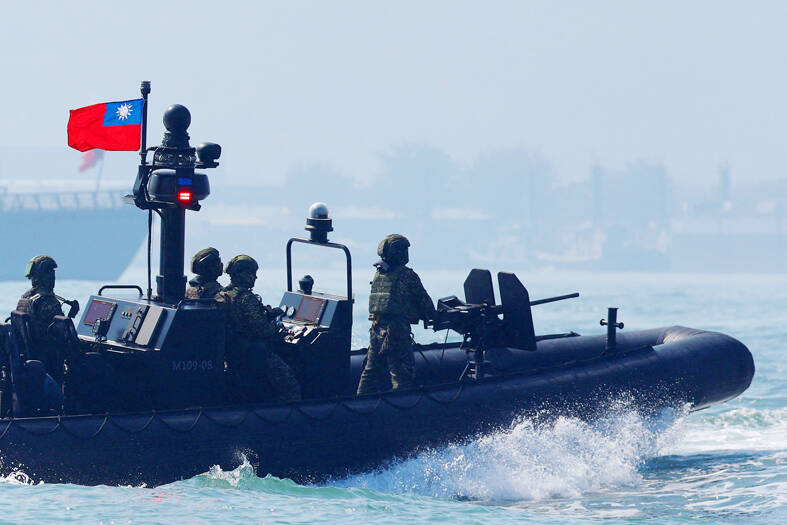
Photo: Carlos Garcia Rawlins, REUTERS
DPP Legislator Wang Ting-yu (王定宇) yesterday said he found the ministry’s rationale “absurd.”
“Receiving money from the CCP to do its bidding is not freedom of speech and should be punished under the law,” he said.
Wang and DPP Legislator Wang Yi-chuan (王義川), along with 14 others, proposed amending Article 24 to make pledging allegiance to the enemy through speech, actions, writings, drawing, recordings or any other means punishable by two to seven years in prison.
Those who plan to commit the offense would be punishable by one to five years in prison.
The proposal referenced a case from the end of 2023 when army Colonel Hsiang Te-en (向德恩) was accused of pledging allegiance to China and receiving payment from Chinese operatives to work as a spy.
Hsiang was recruited by retired lieutenant Shao Wei-chiang (邵維強), and allegedly signed a “pledge of surrender” and promised to “serve, as best he may, in his office for the benefits of the motherland in the event of war across the [Taiwan] Strait.”
The legislators said that incidents involving military personnel wearing their uniforms while waving Chinese flags or agreeing to surrender resulted in 10 people being convicted in February for contravening the National Security Act (國家安全法)
Regardless of whether the country is at war, their ranking or position, military personnel must be loyal to the country, protect the people and safeguard national security according to the Constitution and National Security Act, the legislators said in their proposal.
In this regard, “there is no room for freedom of speech [for soldiers],” they said.
Soldiers who surrender without resisting or express loyalty to the enemy fail in their duty to protect the country, they said.
Even having doubts about loyalty to the nation is grounds for deeming soldiers unfit for service, they added.
Commenting on the ministry’s proposal, lawyer Yang Chung-ting (楊仲庭) said that requiring proof that actions harm military interests makes the evidentiary threshold for punishing disloyalty too high, effectively making it a “toothless tiger.”
If military personnel pledge allegiance to the enemy, it harms the military and the political environment, making people doubt the military’s strength and determination, and impacting their will to resist a foreign hostile force, he said.
The ministry’s proposed amendment and explanation about soldiers’ freedom of speech risks misunderstanding this freedom, he added.
“Soldiers never had so-called freedom of speech,” Institute for National Defense and Security Research researcher Shen Ming-shih (沈明室) said.
Military personnel should be subject to regulations if they make statements that betray the country or affect national security, Shen said yesterday when reached for comment.
Many spies for China have only been sentenced to two or three years in prison, which is a low cost compared with the benefits from spying, he said.
The ministry and lawmakers should reach a consensus on the legislation so that this behavior can be prevented, he said.
Military trials are handled by common courts, where judges might lack sufficient understanding of national security cases, Shen said.
Strengthening legislation and clearly defining China as an enemy or foreign hostile force is necessary to effectively prevent infiltration, he said.

Japan has deployed long-range missiles in a southwestern region near China, the Japanese defense minister said yesterday, at a time when ties with Beijing are at their lowest in recent years. The missiles were installed in Kumamoto in the southern region of Kyushu, as Japan is attempting to shore up its military capacity as China steps up naval activity in the East China Sea. “Standoff defense capabilities enable us to counter the threat of enemy forces attempting to invade our country ... while ensuring the safety of our personnel,” Japanese Minister of Defense Shinjiro Koizumi said. “This is an extremely important initiative for

Chinese Nationalist Party (KMT) Chairwoman Cheng Li-wun (鄭麗文) today accepted an invitation from Chinese President Xi Jinping (習近平) to lead a delegation to China next month, saying she hopes to promote the peaceful development of cross-strait relations and bring stability to the Taiwan Strait. “I am grateful and happy to accept this invitation,” Cheng said in a statement from the KMT chairperson’s office. Cheng said she hopes both sides can work together to promote the peaceful development of cross-strait relations, enhance exchange and cooperation, bring stability to the Taiwan Strait and improve people’s livelihoods. At today's news conference, Cheng said any efforts to

MORE POPULAR: Taiwan Pass sales increased by 59 percent during the first quarter compared with the same period last year, the Tourism Administration said The Tourism Administration yesterday said that it has streamlined the Taiwan Pass, with two versions available for purchase beginning today. The tourism agency has made the pass available to international tourists since 2024, allowing them to access the high-speed rail, Taiwan Railway Corp services, four MRT systems and four Taiwan Tourist Shuttles. Previously, five types of Taiwan Pass were available, but some tourists have said that the offerings were too complicated. The agency said only two types of Taiwan Pass would be available, starting from a three-day pass with the high-speed rail and a three-day pass with Taiwan Railway Corp. The former costs NT$2,800

The nation’s fastest supercomputer, Nano 4 (晶創26), is scheduled to be launched in the third quarter, and would be used to train large language models in finance and national defense sectors, the National Center for High-Performance Computing (NCHC) said. The supercomputer, which would operate at about 86.05 petaflops, is being tested at a new cloud computing center in the Southern Taiwan Science Park in Tainan. The exterior of the server cabinet features chip circuitry patterns overlaid with a map of Taiwan, highlighting the nation’s central position in the semiconductor industry. The center also houses Taiwania 2, Taiwania 3, Forerunner 1 and


 RSS
RSS