


Australia’s central bank yesterday lifted its main interest rate to 4.5 percent, citing inflation concerns, rising house prices and a booming commodities trade linked to Chinese demand.
Reserve Bank of Australia Governor Glenn Stevens said that the risk of serious economic contraction had passed some time ago, and the bank was now adjusting the interest rate toward more average levels.
“The board expects that, as a result of today’s decision, rates for most borrowers will be around average levels,” he said of the widely expected 25 basis point hike — the third in as many months and the sixth since October.
Despite recent debt fears out of Greece, Stevens said world markets were faring well and global growth forecasts had been recently revised upwards.
However, Australian commodity prices were rising faster than expected and looked likely to return to peak levels last seen at the height of the mining boom in 2008, boosting incomes and investment in the resources sector, he said.
“Under these conditions, output growth over the year ahead is likely to exceed that seen last year, even though the effects of earlier expansionary policy measures will be diminishing,” Stevens said.
There was also “considerable buoyancy” in the housing market, he said, with prices continuing to climb over recent months.
According to the Australian Bureau of Statistics, house prices across the country grew by an average 20 percent in the past 12 months.
While underlying inflation had declined owing to slowing private-sector labor costs during the global downturn, Stevens said it was likely to trend in the upper half of the bank’s target range of between 2 and 3 percent.
“The extent of decline from here may not be quite as much as earlier forecast and inflation now appears likely to be in the upper half of the target zone over the coming year,” Stevens said.
Data released last week showed inflation crept up to 2.9 percent year-on-year, with the consumer price index jumping 0.9 percent in the three months to March, led by vegetables, gasoline and electricity.
The central bank’s commodities prices index, released on Monday, showed a 17.6 percent jump last month, with contract and spot prices for iron ore fines increasing 100 percent in the month.
Commonwealth Bank chief economist Michael Blythe said the renewed commodity boom — mainly driven by surging demand caused by China’s voracious appetite for natural resources — underpinned inflationary pressures.
Australian Treasurer Wayne Swan said rate hikes were a “difficult but inevitable consequence” of an economy that was recovering faster than its advanced counterparts.
“Rates could never stay at record lows forever,” Swan said, warning he would hand down a “no frills” annual budget next Tuesday.
“The government has been winding back economic stimulus; what the Reserve Bank has been doing has been returning rates to normal,” he said.

‘NO SECURITY RISK’: The Railway Bureau reassured the public that the technicians’ activities were limited to technical guidance and did not involve sensitive systems The Railway Bureau yesterday said it had invited eight Chinese technicians to assist with an airport MRT construction project. The bureau issued the confirmation after an Internet user said Chinese nationals had entered the construction zone of Taiwan Taoyuan International Airport’s Terminal 3 project. They asked why “individuals from an enemy state” were allowed access to such a major national infrastructure project, which raised serious concerns over Taiwan’s industrial safety, sensitive systems and information security. The bureau’s Northern Region Engineering Branch Office said subcontractor Taiwan Handle Industrial Co (台灣手把工業) of the Taoyuan airport MRT’s “Contract No. CU05 Project A14 Station Civil, MEP &

The National Chungshan Institute of Science and Technology yesterday showcased its locally developed variants of the Vision 60 robotic patrol dog, which it plans to deploy on the nation’s outlying territories in the South China Sea. The variants were produced under the Joint Lab project — created by the institute and domestic companies — and assembled with domestically produced motors, lenses and artificial intelligence (AI) systems alongside licensed tech from the US, Missile and Rocket Systems Research Division deputy director Jen Kuo-kang (任國光) told the media event at a military base in Taipei’s Dazhi (大直) area. Taiwan has built up its strengths
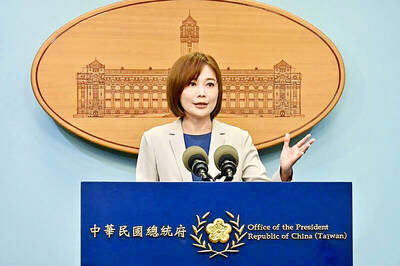
TIT-FOR-TAT: The US allegedly revoked the visa of a Chinese national working at Xinhua News Agency in the US in response to Beijing’s expulsion of Vivian Wang The Presidential Office yesterday condemned China for expelling a New York Times correspondent from Beijing following the newspaper’s interview with President William Lai (賴清德), saying the move highlighted Beijing’s suppression of press freedom and its threat to international news media. Taiwan has noted a series of recent incidents in which Beijing used similar tactics to “threaten and pressure international media outlets and journalists,” Presidential Office spokeswoman Karen Kuo (郭雅慧) said in a statement. “This concerns not only press freedom and freedom of expression, but also the safety of journalists, and Taiwan and relevant partners are paying close attention to the situation,” she

NOT IMMEDIATE: Taiwan has a chance to appeal the proposed 10 percent tariff before it starts, while other countries face a 12.5 percent tariff from the trade office Taiwan is among 60 economies determined by the US to have failed to impose or enforce a ban on the importation of goods produced with forced labor, according to a notice released on Tuesday by the Office of the US Trade Representative (USTR), which proposed imposing an additional 10 percent or more tariff on them. The USTR in a statement said that following an investigation, it had determined under Section 301 of the Trade Act of 1974 that the failure of the 60 economies to impose and effectively enforce a prohibition on the importation of goods produced with forced labor is


 RSS
RSS