


It is not even dawn and Al Sunseri is hustling to load sacks of oysters in a truck as the potentially catastrophic oil leak in the Gulf of Mexico forces him to ponder the unthinkable.
“I guess we’re probably going to end up out of business,” he says of his 134-year-old processing company, P&J Oyster, as he considers what could happen if the state’s shellfish beds are shut down for a long period of time.
The oil spill, already one of the worst in US history as it reaches the state’s coastline, has threatened to cut off supplies of Louisiana oysters, a vital economic resource and a beloved symbol of local culture.
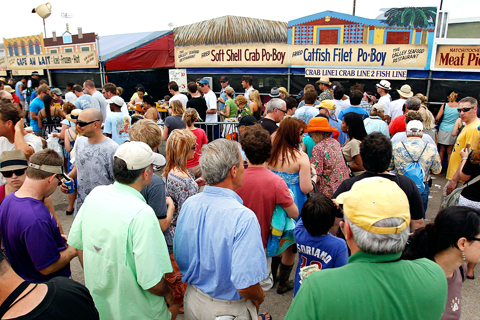
PHOTO: AFP
Louisiana’s shellfish industry provides about a third of the nation’s supply each year and a complete shutdown would badly hit the pocketbooks of many.
However, it would also be a cruel moral blow to an area still struggling to recover from Hurricane Katrina, with oysters on the menu seemingly everywhere in New Orleans, from hole-in-the-wall saloons to the finest restaurants.
Oysters aren’t a delicacy here — they’re practically a necessity.
“That’s why I came here today,” Russell Henderson, a 62-year-old slurping down a dozen raw oysters at Casamento’s in uptown New Orleans, said on Saturday.
“I’m out running errands and I said, ‘I better get some oysters while I can,’” he said.
Oyster gathering areas have already been closed along Louisiana’s coastline east of the Mississippi River, and fishermen and processors fear the worst is yet to come.
Officials say, however, that the oysters that are still being brought to market are safe.
The oil also poses major risks to other seafood products, including crabs, shrimp and a wide range of fish, but an oyster shutdown may hit closest to home.
Louisiana produces about 113.4 million kilograms of oysters each year, amounting to about a third of the US total, said Mike Voisin, who serves on an industry board that advocates for oystermen.
“Oysters are culturally a part of who we are,” he said. “I’m seventh generation in the oyster business. Oyster liquor runs in our blood.”
They’re eaten any number of ways here: fried, on sandwiches called po-boys or raw. There are recipes including Oysters Bienville or Oysters Rockefeller. They are charbroiled sometimes.
“It’s people’s livelihood. There’s a whole economy based on it,” said Greg Placone, a 26-year-old law student who was eating raw oysters at Casamento’s on Saturday.
Casamento’s, a stripped down seafood spot with a white tile dining room where two oyster shuckers work expertly, has been in business since 1919.
Locals mobbed the place on Friday to grab what they feared could be their last Louisiana oysters for some time, owner C.J. Casamento said.
“First time we ran out of every beer we had in here,” he said of Friday night. “I ain’t never seen that.”
Sunseri of P&J said he hoped a first annual oyster festival set to take place next month could still go ahead. He wasn’t ready to throw in the towel.
He said he couldn’t remember the first time he ate an oyster.
“All I know is my daddy said I ate oysters before I could walk,” said the 52-year-old, whose family business is located in the city’s historic French Quarter. “And eating them raw — not just oysters.”
Chuck Brown, 66, ate raw oysters with his nephew at Casamento’s on Saturday and also said he wanted to get them while he still had the chance. Asked why people in New Orleans eat so much of the shellfish, he offered his own theory.
“Oysters, for a man, keeps us healthy,” he said with a sly smile. “I’ll put it as polite as I can.”

‘NO SECURITY RISK’: The Railway Bureau reassured the public that the technicians’ activities were limited to technical guidance and did not involve sensitive systems The Railway Bureau yesterday said it had invited eight Chinese technicians to assist with an airport MRT construction project. The bureau issued the confirmation after an Internet user said Chinese nationals had entered the construction zone of Taiwan Taoyuan International Airport’s Terminal 3 project. They asked why “individuals from an enemy state” were allowed access to such a major national infrastructure project, which raised serious concerns over Taiwan’s industrial safety, sensitive systems and information security. The bureau’s Northern Region Engineering Branch Office said subcontractor Taiwan Handle Industrial Co (台灣手把工業) of the Taoyuan airport MRT’s “Contract No. CU05 Project A14 Station Civil, MEP &

The National Chungshan Institute of Science and Technology yesterday showcased its locally developed variants of the Vision 60 robotic patrol dog, which it plans to deploy on the nation’s outlying territories in the South China Sea. The variants were produced under the Joint Lab project — created by the institute and domestic companies — and assembled with domestically produced motors, lenses and artificial intelligence (AI) systems alongside licensed tech from the US, Missile and Rocket Systems Research Division deputy director Jen Kuo-kang (任國光) told the media event at a military base in Taipei’s Dazhi (大直) area. Taiwan has built up its strengths

TIT-FOR-TAT: The US allegedly revoked the visa of a Chinese national working at Xinhua News Agency in the US in response to Beijing’s expulsion of Vivian Wang The Presidential Office yesterday condemned China for expelling a New York Times correspondent from Beijing following the newspaper’s interview with President William Lai (賴清德), saying the move highlighted Beijing’s suppression of press freedom and its threat to international news media. Taiwan has noted a series of recent incidents in which Beijing used similar tactics to “threaten and pressure international media outlets and journalists,” Presidential Office spokeswoman Karen Kuo (郭雅慧) said in a statement. “This concerns not only press freedom and freedom of expression, but also the safety of journalists, and Taiwan and relevant partners are paying close attention to the situation,” she

NOT IMMEDIATE: Taiwan has a chance to appeal the proposed 10 percent tariff before it starts, while other countries face a 12.5 percent tariff from the trade office Taiwan is among 60 economies determined by the US to have failed to impose or enforce a ban on the importation of goods produced with forced labor, according to a notice released on Tuesday by the Office of the US Trade Representative (USTR), which proposed imposing an additional 10 percent or more tariff on them. The USTR in a statement said that following an investigation, it had determined under Section 301 of the Trade Act of 1974 that the failure of the 60 economies to impose and effectively enforce a prohibition on the importation of goods produced with forced labor is


 RSS
RSS