


A new sense of optimism filled the Detroit auto show as the industry looked forward to a recovery from one of its worst years on record.
The overall mood is significantly more upbeat than a year earlier when General Motors (GM) and Chrysler’s very existence was in doubt as Congress sparred over providing billions of dollars in emergency loans.
“Today is a new beginning for the automotive industry,” US Transportation Secretary Ray LaHood told reporters.
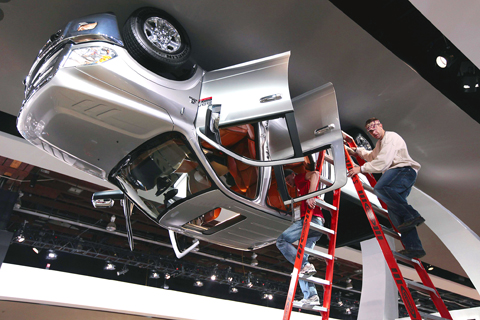
PHOTO: REUTERS
“When people have an opportunity to see the kind of products that are now being manufactured and will be on display, they will realize the auto industry is manufacturing products people want to drive,” he said.
Ford, GM, Toyota and Honda kicked off the show by highlighting their focus on fuel-efficient vehicles.
Ford — which managed to stay afloat and increase its piece of the shrunken US market last year — introduced a much-anticipated update to its compact Ford Focus sedan.
“Companies have to pay attention to the three Es: economy, efficient and the environment,” chairman Bill Ford said as he touted the automaker’s new global vehicle platforms, which will radically reduce costs.
Toyota unveiled a prototype of a compact dedicated hybrid vehicle — the FT-CH — while Honda revealed a hybrid sports coupe — the CR-Z — that will hit US showrooms later this year.
GM opened its presentations by introducing a boxy, low-lying new compact sport utility vehicle, the GMC Granite, a “concept” that would be aimed at young, urban drivers if it ends up being tapped for mass market production.
The automaker also introduced several new smaller cars to be sold under its Chevrolet brand, including the Spark mini car and a sporty Aveo prototype.
Notably absent from the schedule was Chrysler, which had little to present after the turmoil of a painful divorce from Daimler, a brief takeover by private equity group Cerberus and a quick spin through bankruptcy that left the number three US automaker under the management of Italy’s Fiat.
New chief Sergio Marchionne was on hand, however, to speak with the media and give lawmakers a tour of the scaled-back Chrysler display, filled with aggressive trucks, muscle cars, shiny new sports cars and — thanks to the alliance with Fiat — Maserati, Ferrari and the Fiat 500 minicar.
A congressional delegation led by House Speaker Nancy Pelosi saw a strong emphasis on small cars and fuel efficiency at the show, with a 3,440m² exhibit of 20 different electric vehicles replete with a tree-lined test track.
There were also plenty of luxury vehicles on display despite the poor economy and a host of trucks and sport utility vehicles to tempt consumers who are less environmentally conscious.
Kia capitalized on its corner of the lower cost market with a kitchy press conference styled like an infomercial with the constant refrain “but wait, there’s more” as it described its new offerings.
“What we saw here today was vibrant, optimistic leadership to leapfrog over the competition and to keep America number one,” Pelosi said.
“Our hopes are riding on the auto industry succeeding in our country and we thank all those who are making the progress possible,” she said.
There is no doubt that this year will be a challenging year and the competition will be fierce.
Most analysts are forecasting a moderate rebound in US auto sales to between 11 million and 12.5 million vehicles this year after dropping 21 percent to 10.4 million vehicles last year. That will still be drastically below the 15 million to 17 million vehicle range posted in each of the previous 15 years and sales could be sharply hit should the economy take another bad turn.
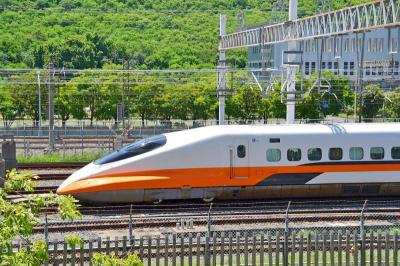
A signaling system malfunction disrupted high-speed rail (HSR) services beginning at 8am today, with trains temporarily reduced to three northbound and three southbound trains per hour as authorities conduct inspections. The malfunction occurred on a section of track in Miaoli County during pre-operation checks early this morning, forcing northbound and southbound trains to use a single track, the HSR operator said. The regular schedule has been replaced with three hourly trains offering only nonreserved seating in each direction, stopping at every station, it said, adding that business class cars would still have reserved seating. Departures from terminal stations are scheduled at the top
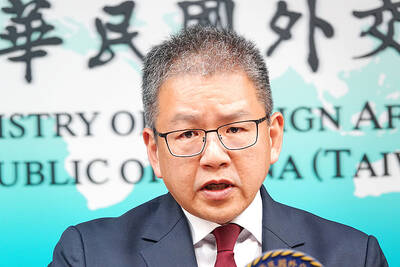
Taiwan is still in the process of assessing the possibility of recruiting workers from Eswatini, the Ministry of Foreign Affairs said yesterday, adding that its goal is to help Eswatini upgrade its vocational training centers. If there are plans to recruit workers from Eswatini, safeguarding national security, protecting public health and ensuring the employment rights of Taiwanese would be prerequisites, Department of West Asian and African Affairs Director-General Yen Chia-liang (顏嘉良) told a news conference. Key considerations would also include filling labor shortages in specific industries, and fostering bilateral professional and technical exchanges, he said. Yen was asked about the progress of labor

A US uncrewed surface vessel (USV) encountered multiple Chinese warships during an autonomous transit of the Taiwan Strait, US defense company Seasats said in a statement on Wednesday. Seasats announced that a Lightfish USV had completed the first autonomous transit of the Taiwan Strait. Over five days, the USV traversed the entire length of the Strait while constantly monitoring surface vessel traffic, the company said. The Lightfish encountered multiple Chinese warships, one of which was a Chinese People’s Liberation Army Navy (PLAN) Type 056 corvette, it said. The Chinese vessels were operating “well within Taiwan’s exclusive economic zone without transmitting their identity via the
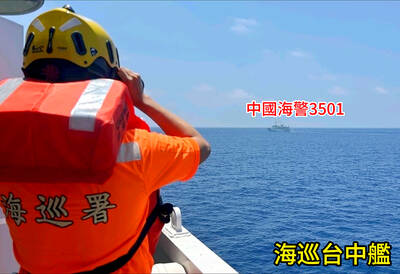
VERBOSE VESSELS: A CGA cutter and a China Coast Guard exchanged verbal barbs for more than a day in Taiwanese-controlled waters before the Chinese vessel left The Taiwanese and Chinese coast guards had a standoff near the strategically located Pratas Islands (Dongsha Islands, 東沙群島) in the north of the South China Sea, the Coast Guard Administration (CGA) said yesterday. The two sides engaged in intense radio exchanges over sovereignty claims during the 33-hour standoff. China Coast Guard vessel 3501 eventually left the restricted waters, 26.6 nautical miles (49.2km) west of the Pratas Islands, at 5pm yesterday, the CGA said. Lying approximately between southern Taiwan and Hong Kong, the Taiwan-controlled Pratas are seen by some security experts as vulnerable to Chinese attack due to their distance — more than


 RSS
RSS