


Goldman Sachs Group Inc, Morgan Stanley and JPMorgan Chase and Co’s investment bank, survivors of the worst financial crisis since the Great Depression, are set to pay record bonuses this year.
The firms — the three biggest banks to exit the Troubled Asset Relief Program — will hand out US$29.7 billion in bonuses, analysts’ forecast. That’s up 60 percent from last year and more than the previous high of US$26.8 billion in 2007. The money, split among 119,000 employees, equals US$250,400 each, almost five times the US$50,303 median household income in the US last year, data compiled by Bloomberg show.
The three will award more in stock and defer more cash payments under pressure from regulators to tie pay to long-term results, compensation experts said. They may still face public wrath over the size of bonuses after the government injected capital into all the major financial institutions following Lehman Brothers Holdings Inc’s collapse in September last year.
“Wall Street is beginning to resemble Clark Gable as Rhett Butler in the film Gone With the Wind: ‘Quite frankly, my dear, I don’t give a damn,’” Paul Hodgson, a senior research associate on compensation at the Portland, Maine-based Corporate Library, said in an e-mail. “It doesn’t seem as if even political threat, disastrous PR, envy, rising unemployment rates and home repossessions is enough to get any of these people to refuse the bonuses they have ‘earned.’”
Bonuses for employees in fixed income will likely jump the most, 40 percent to 45 percent, while employees in asset management may see no growth in their year-end bonuses, said a report from Options Group, a New York-based executive search and compensation consultant firm.
Average bonuses for employees at financial firms worldwide will rise about 35 percent to 40 percent this year, said the annual report, which is set to be released this week. They will still remain below 2007 levels after dropping an average of 40 percent to 45 percent last year, the report said.
Managing directors in high-yield credit sales are expected to see some of the biggest average increase in bonuses, a 50 percent jump to a range of US$1.3 million to US$1.7 million. The bonuses of directors in commodity sales units may also climb 50 percent to a range of US$650,000 to US$850,000, the report said. Managing directors in commodities trading will receive the largest bonuses, an average of US$4 million to US$6 million each.
The report didn’t break out bonuses from total compensation for positions above managing director.
Morgan Stanley is among banks that are offering a bigger portion of bonuses in stock and instituting so-called clawback clauses to tie incentive pay to risk, the report said. JPMorgan and UBS AG are also raising base salaries for some employees to reduce the share of bonuses in total pay.
“Wall Street is all about creating wealth, and when banks start making money again, they have to pay their people,” said Michael Karp, co-founder of Options Group. “But because there’s so much public scrutiny, people will be very sensitive in terms of putting caps on some of these cash figures, and you’ll see a lot more in stock.”
Securities firms typically use slightly less than half of their revenue to pay salaries, benefits and bonuses, a percentage that is adjusted throughout the year. In the first nine months, Goldman Sachs, Morgan Stanley, and JPMorgan’s investment bank told their shareholders that they set aside US$36.4 billion for compensation, up 27 percent from the same period a year earlier.
The three New York-based firms will likely set aside US$49.5 billion for compensation for the full year, showed estimates from David Trone, an analyst at Fox-Pitt Kelton Cochran Caronia Waller in New York. That’s up from US$30.9 billion last year and US$44.7 billion in 2007.
The rise in compensation is led by Goldman Sachs, which had record profit in the second quarter. Its compensation expense is expected to more than double from last year to US$21.9 billion, or about US$691,000 per employee, according to Trone’s estimates. The expense at JPMorgan’s investment bank is expected to jump 55 percent to US$12 billion, about US$482,400 for each employee, while Morgan Stanley’s compensation cost will rise 27 percent to US$15.6 billion, or US$252,000.
Year-end bonuses usually account for about 60 percent of compensation, the Options Group report said. While the total this year is expected to be greater than in 2007, it will come to less per employee than the US$256,000 paid out that year by the three firms because of increased staffing.

ROLLER-COASTER RIDE: More than five earthquakes ranging from magnitude 4.4 to 5.5 on the Richter scale shook eastern Taiwan in rapid succession yesterday afternoon Back-to-back weather fronts are forecast to hit Taiwan this week, resulting in rain across the nation in the coming days, the Central Weather Administration said yesterday, as it also warned residents in mountainous regions to be wary of landslides and rockfalls. As the first front approached, sporadic rainfall began in central and northern parts of Taiwan yesterday, the agency said, adding that rain is forecast to intensify in those regions today, while brief showers would also affect other parts of the nation. A second weather system is forecast to arrive on Thursday, bringing additional rain to the whole nation until Sunday, it
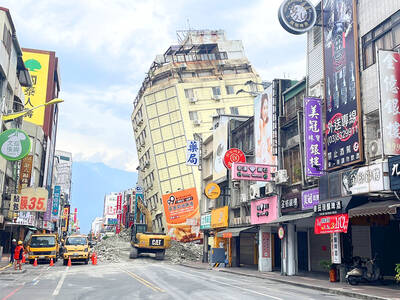
LANDSLIDES POSSIBLE: The agency advised the public to avoid visiting mountainous regions due to more expected aftershocks and rainfall from a series of weather fronts A series of earthquakes over the past few days were likely aftershocks of the April 3 earthquake in Hualien County, with further aftershocks to be expected for up to a year, the Central Weather Administration (CWA) said yesterday. Based on the nation’s experience after the quake on Sept. 21, 1999, more aftershocks are possible over the next six months to a year, the agency said. A total of 103 earthquakes of magnitude 4 on the local magnitude scale or higher hit Hualien County from 5:08pm on Monday to 10:27am yesterday, with 27 of them exceeding magnitude 5. They included two, of magnitude

CONDITIONAL: The PRC imposes secret requirements that the funding it provides cannot be spent in states with diplomatic relations with Taiwan, Emma Reilly said China has been bribing UN officials to obtain “special benefits” and to block funding from countries that have diplomatic ties with Taiwan, a former UN employee told the British House of Commons on Tuesday. At a House of Commons Foreign Affairs Committee hearing into “international relations within the multilateral system,” former Office of the UN High Commissioner for Human Rights (OHCHR) employee Emma Reilly said in a written statement that “Beijing paid bribes to the two successive Presidents of the [UN] General Assembly” during the two-year negotiation of the Sustainable Development Goals. Another way China exercises influence within the UN Secretariat is

Taiwan’s first drag queen to compete on the internationally acclaimed RuPaul’s Drag Race, Nymphia Wind (妮妃雅), was on Friday crowned the “Next Drag Superstar.” Dressed in a sparkling banana dress, Nymphia Wind swept onto the stage for the final, and stole the show. “Taiwan this is for you,” she said right after show host RuPaul announced her as the winner. “To those who feel like they don’t belong, just remember to live fearlessly and to live their truth,” she said on stage. One of the frontrunners for the past 15 episodes, the 28-year-old breezed through to the final after weeks of showcasing her unique


 RSS
RSS