

Billionaire Steven Wynn’s Macau casino company jumped 13 percent in its trading debut on the Hong Kong stock exchange yesterday. Wynn Macau Ltd shares peaked at HK$11.4 (US$1.47) before falling back and trading at HK$10.80 in the afternoon. Shares in the initial public offering were sold at HK$10.08 each, the high end of range at which they were marketed to investors, raising US$1.63 billion.
Wynn’s Macau resort, whose curved, bronze-tinted hotel tower bears a resemblance to his trademark Las Vegas property, has been immensely profitable and helped the company weather the downturn in the US. Profits for the first six months of this year stood at around US$115 million.
The IPO, representing a 25 percent stake in Wynn’s Macau operations, was Hong Kong’s second-biggest of the year and among its most watched due partly to the novelty of a famous, high-end US company deciding to list on the Chinese financial center’s exchange.
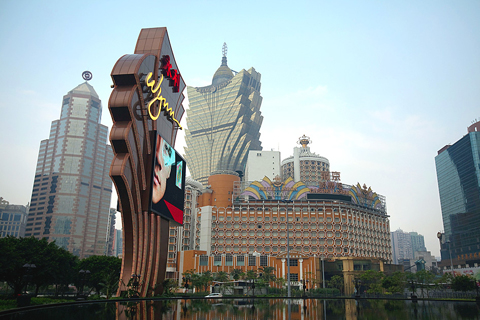
PHOTO: BLOOMBERG
“We have become more of a Chinese company, something that Mr. Wynn ... always wanted,” Allan Zeman, a Wynn Macau director and well-known Hong Kong businessman, said at the Hong Kong stock exchange before trading opened. Wynn, who visited the region recently to promote the offering, was not on hand.
Las Vegas-based Wynn operates one resort in Macau, the world’s largest gambling market, and has a second scheduled to open next year.
The IPO precedes a similar move by Las Vegas Sands Corp, led by tycoon and Wynn rival Sheldon Adelson, who is expected to sell shares in his company’s Macau operations and list them on Hong Kong’s stock exchange.
The robust demand for Wynn’s stock was partly due to better investor sentiment following a revival in Macau, located an hour’s ferry ride from Hong Kong and the one place in China where casinos are legal.
Revenue growth started tapering off during the depths of the economic crisis but has picked up in recent months thanks to a stronger Chinese economy and an easing of visa restrictions on mainland gamblers who are the lifeblood of the city’s casinos.
In August, the enclave had its best month ever, raking in almost 11.4 billion patacas (US$1.4 billion). Early reports suggest last month was even better with over 50 percent growth compared with the same period last year.
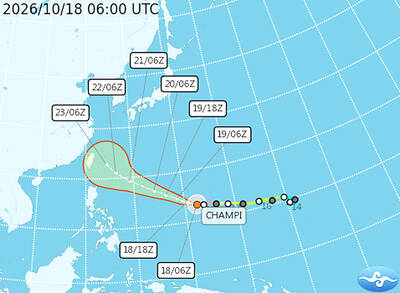
A sea warning for Typhoon Champi could be issued as early as Wednesday night, possibly followed by a land warning on Thursday night or Friday, as the storm approaches Taiwan, the Central Weather Administration (CWA) said yesterday. The typhoon is expected to have its greatest impact on Taiwan on Friday and Saturday, bringing heavy rain to central and northern Taiwan and to Yilan and Hualien counties in the east, CWA forecaster Liu Pei-teng (劉沛滕) said. As of 2pm yesterday, Champi was about 2,470km east-southeast of Oluanpi (鵝鑾鼻), Taiwan’s southernmost tip, moving westnorthwest at 20kph. It had maximum sustained winds of 191kph and a
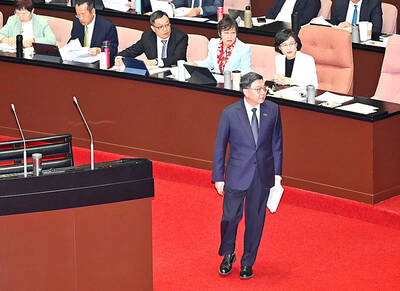
The government is monitoring online rumors that a pneumonic plague outbreak has spread from Russia into China, and it might enhance quarantine measures, Premier Cho Jung-tai (卓榮泰) said yesterday. During a legislative meeting, Democratic Progressive Party Legislator Wang Ting-yu (王定宇) said that rumors had circulated that the disease had spread across several Chinese provinces. He asked Cho whether the government was prepared to prevent the disease spreading to Taiwan, given the volume of traffic between the two sides, and how concerned the government was about the alleged outbreak. The Ministry of Health and Welfare had implemented border quarantine measures after briefing the Executive
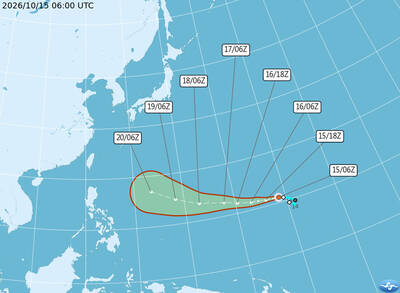
EAST OF GUAM: Tropical Storm Champi is forecast to strengthen into a typhoon, but its effect on Taiwan is uncertain due to the presence of a high-pressure system Tropical Storm Champi formed yesterday and has the potential to increase in strength, the Central Weather Administration (CWA) said yesterday. Forecasters are closely monitoring a Pacific high-pressure system that would dictate whether the storm turns north or moves toward Taiwan next week, the CWA said. The most likely scenario is that it turns northward after passing the Ryukyu Islands, CWA forecaster Cheng Chieh-jen (鄭傑仁) said. As of 8pm yesterday, Champi was east of Guam moving west-northwest at 20kph, CWA data showed. It had maximum sustained winds near the center of 72kph and gusts of up to 101kph, the data showed. If the Pacific high-pressure system
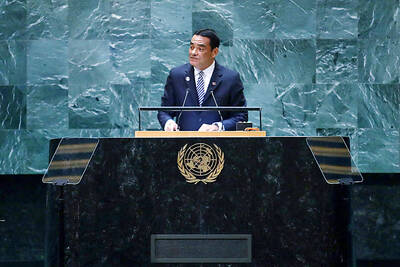
RIGHT TO DIPLOMACY: Under the UN Charter, every state has the right to conduct foreign policy free from external pressure, Belize said in a statement Belize and Paraguay on Monday condemned Beijing sanctions over their countries’ ties with Taiwan, saying China’s actions create unnecessary tensions. Earlier on Monday, Beijing announced sanctions against Paraguayan Minister of Information and Communication Technologies Gustavo Villate and Belizean Minister of Foreign Affairs Francis Fonseca. The Paraguayan Ministry of Foreign Affairs said it rejected the sanctions, writing on X that they created unnecessary friction. It added that it reaffirmed its support for Taiwan and its commitment to democratic values and principles. Villate told the Spanish-language Paraguayan daily ABC Color the sanctions were “predictable” and linked them to several cooperation projects between Taiwan and Paraguay. The projects


 RSS
RSS