


Leading central bank governors said on Sunday that they had agreed on a package of measures to strengthen the regulation and supervision of the banking industry in the wake of the financial crisis.
The measures should “substantially reduce the probability and severity of economic and financial stress,” a statement released by the Basel-based Bank for International Settlements (BIS) said.
The approval sets in motion and enhances revised “Basel II” measures finalized in July, that require banks to bolster capital and remedy flaws exposed by the collapse in credit and financial markets last year.
“The agreements reached today among 27 major countries of the world are essential as they set the new standards for banking regulation and supervision at the global level,” said European Central Bank chief Jean-Claude Trichet, who presided the meeting.
National financial supervisors were also urged to ensure that pay or compensation for commercial bankers was “properly aligned with long-term performance and prudent risk-taking,” said Nout Wellink, chairman of the Basel Committee and Dutch central bank chief.
However, the meeting did not set a firm date for implementation of the package, which will be fleshed out over the coming months.
The central bank governors and supervisors who met in Basel form the oversight body of the Basel Committee on Banking Supervision.
A draft of the measures was first unveiled in January.
The principles agreed notably to bolster standards for key “tier one” capital requirements for commercial banks to raise their “quality, consistency and transparency,” the statement said.
“Banks will be required to move expeditiously to raise the level and quality of capital to the new standards, but in a manner that promotes stability of national banking systems and the broader economy,” it said.
The central bankers endorsed the principle of a minimum global standard to fund liquidity, as well as a framework to oblige banks to build permanent “countercyclical” capital buffers that can be used during periods of financial turmoil.
“These measures will result over time in higher capital and liquidity requirements and less leverage in the banking system, less procyclicality, greater banking sector resilience to stress,” Wellink said.
The measures will be detailed by the end of the year and tested and refined through to the end of next year, the statement said.
They will be introduced gradually in a manner “that does not impede the recovery of the real economy.”
The central bankers meeting came on the heels of a meeting of G20 finance ministers in London on Saturday that painfully hatched a compromise on bankers’ pay and left several financial issues outstanding.
US Treasury Secretary Tim Geithner notably went to London seeking an agreement ensuring that banks were better prepared for tough times.
But he admitted afterwards: “We still need to reach agreement on the level of capital ratio.”
Amid disagreement in their ranks, the G20 ministers fell short of capping bankers’ pay but pledged to reward long-term, not short-term success.
Most of the issues were left for a crucial meeting of G20 leaders in Pittsburgh, Pennsylvania, on Sept. 24 to Sept. 25.
Capital requirements underpin a bank’s business and deposits.
Adequate capital reserves should help avoid sudden collapses like those that occurred a year ago, precipitating the financial crisis and massive state support packages for big banks in several economies.
The existing Basel II accord, finalized in 2004, had already bolstered and expanded on earlier international capital standards for banks.
But it took several years to negotiate amid resistance to some of the criteria in the banking industry.
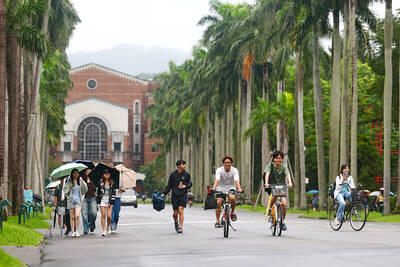
National Taiwan University (NTU) yesterday said it disqualified a person from an entrance examination for using AI smart glasses to cheat, along with two others for making untruthful statements in their curriculum vitae. The three applicants were given null scores, Taiwan’s highest-ranked university said, calling on prospective students to be honest in the admissions process. NTU registrar Lee Hung-sen (李宏森) said that the cheating applicant wore a hat and thick-rimmed glasses to the second written exam for medical school, claiming that they felt cold. Suspicions were aroused when the applicant stared oddly at the test for long stretches while steadily bringing the paper
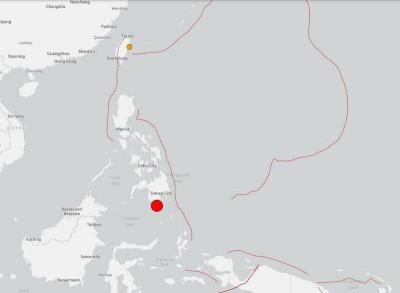
A magnitude 7.8 earthquake struck off the southern coast of Mindanao in the Philippines at 7:38am today, prompting the US Tsunami Warning System to issue an alert for neighboring countries, including Taiwan. The system issued a purple alert indicating a "tsunami threat." The potential threat zone includes Taiwan, the Philippines, Papua New Guinea, Yap and Palau. Philippine authorities were assessing the damage from the quake, with the office of civil defense seeking to verifying initial reports that 15 people had been killed and 129 injured in the region, mostly from falling debris. Arlene Hollero, disaster chief of Maasim town in the Philippines' Sarangani Province,

‘GRAY ZONE’ PRESSURE: Beijing’s activities are intended to create the deceitful impression that China has jurisdiction over the area around Taiwan, the CGA said Taiwan’s rights over its territorial waters and exclusive economic zone must not be violated by any country, the Mainland Affairs Council said yesterday, adding that it will not accept any unprovoked actions. The council issued the remarks in response to the China Coast Guard conducting maritime enforcement drills near eastern Taiwan and claiming to fully exercise China’s maritime administrative law enforcement authority. The Coast Guard Administration (CGA) has been closely monitoring the situation and is taking concrete steps to defend the nation’s sovereignty and secure its waters, the council said. China has no sovereign rights over the waters off eastern
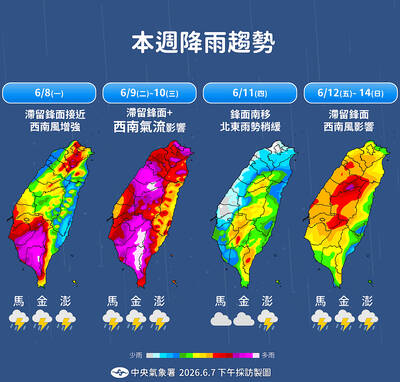
Heavy rain is expected to affect parts of Taiwan this week, the Central Weather Administration (CWA) said yesterday as a meteorologist said the active part of the annual plum rain season has started. A stationary plum rain front and southwesterly winds would bring unstable weather and abundant moisture to Taiwan from today for about a week, with the heaviest rainfall forecast for tomorrow and Wednesday, the CWA said. The agency said western and northeastern Taiwan, and mountainous areas in the east and southeast, could expect showers or thunderstorms on those two days, with localized heavy rain possible. Other parts of


 RSS
RSS