


Commodity prices rallied to multi-month highs this week on increasing signs that the worst of the world recession may be over.
“The recent surge in commodity prices appears to have been driven primarily by hopes of a strong recovery in the global economy,” Capital Economics analyst Julian Jessop said.
“However, there are still many reasons to be cautious. For a start, although some commodity firms have undoubtedly taken advantage of lower prices to rebuild stocks in anticipation of a pick-up in final demand, that increase in demand has yet to materialize,” he said.
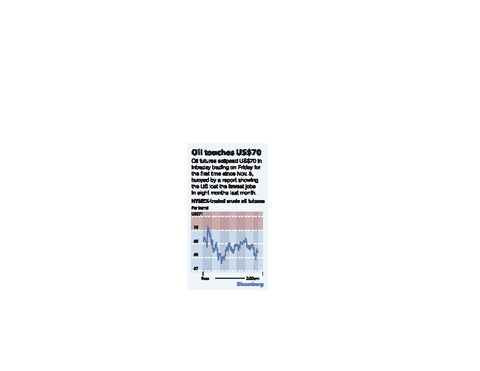
OIL: New York crude oil hit US$70 for the first time in seven months on Friday as the US dollar slid on news of a dramatic slowdown in US job losses, traders said.
New York crude spiked to US$70.32 a barrel, the highest level since Nov. 4. It later retreated sharply as the dollar recovered.
“This initial rally in crude looks to have failed,” aided by a recovering dollar, said Adam Klopfenstein, senior market strategist at Lind-Waldock.
A struggling US currency makes dollar-priced crude cheaper for buyers holding stronger currencies, in turn stimulating demand and pushing up prices. When the dollar strengthens the reverse tends to apply.
After plunging from record highs above US$147 last July on supply concerns, oil prices touched multi-year lows in December, at one point nearing US$32 a barrel, as the economic slowdown crushed demand for energy.
On Friday, on the New York Mercantile Exchange (NYMEX), light sweet crude for delivery in July closed at US$68.44 a barrel from US$65.94 a week earlier. It was down US$0.34 from Thursday, after a jump to US$70.32 a barrel, the highest level since Nov. 4.
On London’s InterContinental Exchange (ICE), Brent North Sea crude for July climbed to US$68.34 a barrel from US$65.05 a week earlier. Brent crude fell US$0.37 from Friday, having spiked as high as US$69.91.
PRECIOUS METALS: Gold prices approached US$1,000 an ounce before traders cashed in their gains late on. By late Friday on the London Bullion Market, gold fell to US$962 an ounce from US$975.50 a week earlier.
Silver rose to US$15.65 an ounce from US$15.52.
On the London Platinum and Palladium Market, platinum climbed to US$1,275 an ounce at the late fixing on Friday from US$1,175.
Palladium jumped to US$257 an ounce from US$236.
GRAINS AND SOYA: Soya and grains prices traded mixed.
By Friday on the Chicago Board of Trade, maize for delivery in July rose to US$4.45 a bushel from US$4.36 a week earlier.
July-dated soyabean meal — used in animal feed — increased to US$12.29 from US$11.84.
Wheat for July fell to US$6.28 a bushel from US$6.37.

The nation’s fastest supercomputer, Nano 4 (晶創26), is scheduled to be launched in the third quarter, and would be used to train large language models in finance and national defense sectors, the National Center for High-Performance Computing (NCHC) said. The supercomputer, which would operate at about 86.05 petaflops, is being tested at a new cloud computing center in the Southern Taiwan Science Park in Tainan. The exterior of the server cabinet features chip circuitry patterns overlaid with a map of Taiwan, highlighting the nation’s central position in the semiconductor industry. The center also houses Taiwania 2, Taiwania 3, Forerunner 1 and
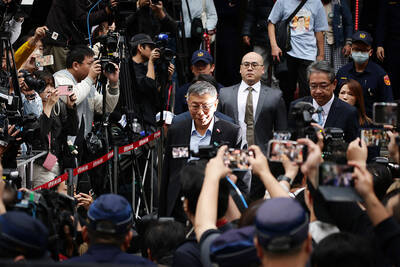
FIRST TRIAL: Ko’s lawyers sought reduced bail and other concessions, as did other defendants, but the bail judge denied their requests, citing the severity of the sentences Former Taipei mayor Ko Wen-je (柯文哲) was yesterday sentenced to 17 years in prison and had his civil rights suspended for six years over corruption, embezzlement and other charges. Taipei prosecutors in December last year asked the Taipei District Court for a combined 28-year, six-month sentence for the four cases against Ko, who founded the Taiwan People’s Party (TPP). The cases were linked to the Core Pacific City (京華城購物中心) redevelopment project and the mismanagement of political donations. Other defendants convicted on separate charges included Chinese Nationalist Party (KMT) Taipei City Councilor Angela Ying (應曉薇), who was handed a 15-year, six-month sentence; Core Pacific
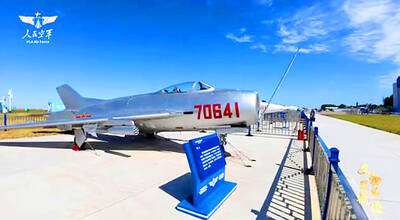
J-6 REMODEL: The converted drones are part of Beijing’s expanding mix of airpower weapons, including bombers with stand-off missiles and UAV swarms, the report said China has stationed obsolete supersonic fighters converted to attack drones at six air bases close to the Taiwan Strait, a report published this month by the Arlington, Virginia-based Mitchell Institute for Aerospace Studies said. Satellite imagery of the airfields from the institute’s “China Airpower Tracker” shows what appear to be lines of stubby, swept-winged aircraft matching the shape of J-6 fighters that first flew with the Chinese People’s Liberation Army (PLA) Air Force in the 1960s. Since their conversion to drones, the aircraft have been identified at five bases in China’s Fujian Province and one in Guangdong Province, the report said. J.

China used fake LinkedIn profiles to harvest sensitive data from NATO and EU institutions by soliciting information from staff, a European security source said on Friday. The operation, allegedly orchestrated by the Chinese Ministry of State Security, targeted dozens of employees at the military alliance or EU organizations through fictitious accounts, the source said, confirming reports in French and Belgian media. Posing as recruiters on the online professional networking platform, Chinese spies would initially request paid reports before later soliciting non-public or even classified information. One particularly active fake profile used the name “Kevin Zhang,” claiming to be the head


 RSS
RSS