


Crude oil rose to a five-week high as US consumer confidence improved and manufacturing shrank at the slowest pace in seven months, signaling that the recession may end later this year.
Oil gained 4.1 percent after a report showed that confidence last month climbed to its highest level since before the collapse of credit late last year. Factory orders and production are steadying after plunging last year as companies cut stockpiles. Prices were down earlier as US supplies rose to the highest since 1990 and fuel demand dropped.
“Like a lot of markets we are rising on hope,” said Tim Evans, an energy analyst with Citi Futures Perspective in New York. “Some people think that the rise in consumer confidence will result in increased petroleum demand.”
Crude oil for June delivery climbed US$2.08 to US$53.20 a barrel at 2:55pm on the New York Mercantile Exchange, the highest settlement since March 26. Prices are up 3.2 percent this week and 19 percent this year.
The Reuters/University of Michigan final index of consumer sentiment rose to 65.1, the second straight gain, from 57.3 in March. The index reached a three-decade low of 55.3 in November. The Institute for Supply Management’s factory index increased to 40.1 last month, higher than forecast, from 36.3 in March. Readings less than 50 signal a contraction.
Oil in New York has tumbled 64 percent from a record US$147.27 last July as the recession in major consuming countries curbed fuel demand. US fuel use in the first quarter averaged 19.2 million barrels a day, the lowest for the period in 11 years, the American Petroleum Institute said in a monthly report on April 16.
Brent crude oil for June settlement rose US$2.05, or 4 percent, to end the session at US$52.85 on London’s ICE Futures Europe exchange.
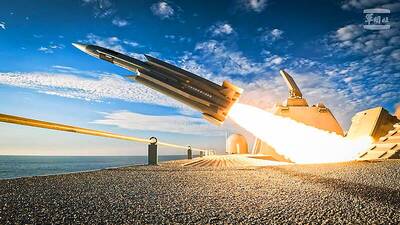
DETERRENCE: With 1,000 indigenous Hsiung Feng II and III missiles and 400 Harpoon missiles, the nation would boast the highest anti-ship missile density in the world With Taiwan wrapping up mass production of Hsiung Feng II and III missiles by December and an influx of Harpoon missiles from the US, Taiwan would have the highest density of anti-ship missiles in the world, a source said yesterday. Taiwan is to wrap up mass production of the indigenous anti-ship missiles by the end of year, as the Chungshan Institute of Science and Technology has been meeting production targets ahead of schedule, a defense official with knowledge of the matter said. Combined with the 400 Harpoon anti-ship missiles Taiwan expects to receive from the US by 2028, the nation would have

North Korea yesterday fired about 10 ballistic missiles to the sea toward Japan, the South Korean Joint Chiefs of Staff (JCS) said, days after Pyongyang warned of “terrible consequences” over ongoing South Korea-US military drills. Pyongyang recently dashed hopes of a diplomatic thaw with Seoul, Washington’s security ally, describing its latest peace efforts as a “clumsy, deceptive farce.” Seoul’s military detected “around 10 ballistic missiles launched from the Sunan area in North Korea toward the East Sea [Sea of Japan] at around 1:20pm,” JCS said in a statement, referring to South Korea’s name for the body of water. The missiles

‘UNWAVERING FRIENDSHIP’: A representative of a Japanese group that co-organized a memorial, said he hopes Japanese never forget Taiwan’s kindness President William Lai (賴清德) yesterday marked the 15th anniversary of the Tohoku earthquake and tsunami, urging continued cooperation between Taiwan and Japan on disaster prevention and humanitarian assistance. Lai wrote on social media that Taiwan and Japan have always helped each other in the aftermath of major disasters. The magnitude 9 earthquake struck northeastern Japan on March 11, 2011, triggering a massive tsunami that claimed more than 19,000 lives, according to data from Japanese authorities. Following the disaster, Taiwan donated more than US$240 million in aid, making it one of the largest contributors of financial assistance to Japan. In addition to cash donations and
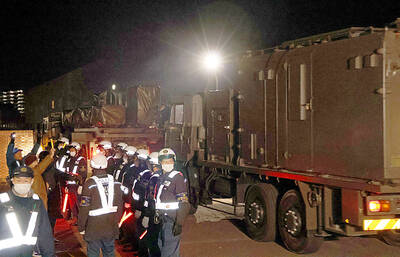
CLOSER TO CHINA: The upgraded Type-12 missile has a range of about 1,000km, compared with the original model’s range of 200km, and can reach mainland China Japan is preparing to deploy its first batch of domestically developed long-range missiles, with their launchers arriving at an army camp yesterday, as the country accelerates its offensive capability in response to rising challenges in the region. The upgraded Type-12 land-to-ship missiles are to be deployed at Camp Kengun in Japan’s southwestern prefecture of Kumamoto by the end of this month, completing the process of deployment, Japanese Chief Cabinet Secretary Minoru Kihara said without giving details. Army vehicles carrying the launchers and other equipment arrived past midnight in a highly secretive mission criticized by residents. Dozens of people stood outside of the


 RSS
RSS