


Asian currencies rose against the dollar for a third week as signs a global recession is easing prompt investors to favor riskier assets, helping emerging markets draw funds.
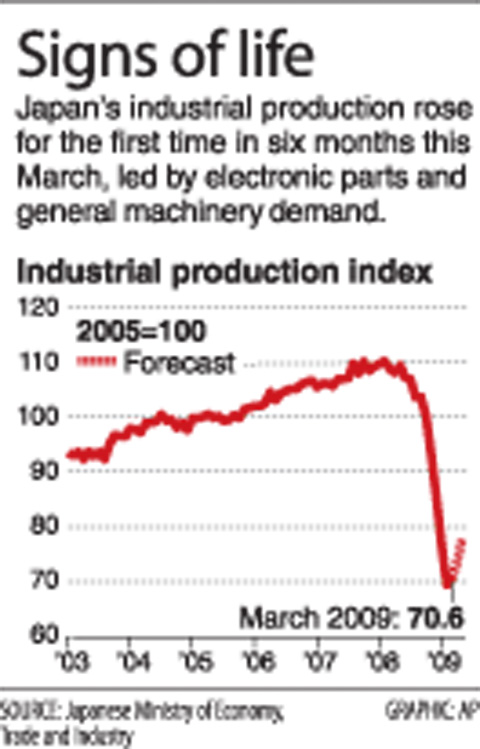
South Korea’s won and Indonesia’s rupiah led the advance on optimism the region’s exports will rebound after Japan reported industrial output grew for the first time in six months and a Chinese gauge of manufacturing climbed for a second month.
The New Taiwan dollar jumped the most in six months on Thursday after Chinese companies were allowed to invest in Taiwan for the first time since 1949.
The NT dollar rose 1.3 percent this week to close at NT$33.233 against the greenback. The currency appreciated 2.1 percent last month, following an advance of 3.1 percent in March.
The won surged 4.7 percent this week to close at 1,282.95 per dollar in Seoul, according to data compiled by Bloomberg. The rupiah climbed 2.1 percent to 10,610.
All regional markets except Indonesia were closed on Friday for the Labor Day holiday. There was no trading in Mumbai on Thursday as well for elections.
The yen traded at 99.17 a dollar after dropping to a two-week low of 99.58 on Friday. It declined to 132.07 per euro on Friday, the lowest since April 14.
The ringgit strengthened 0.8 percent this week to 3.5585 per dollar.
Elsewhere, the Philippine peso gained 0.1 percent this week to 48.360 versus the greenback and the Thai baht rose 0.3 percent to 35.30. China’s yuan was little changed at 6.8230 versus 6.8273 last Friday.
The US dollar dropped as signs of recovery in manufacturing in China and the US sapped demand for the currencies as a refuge.
Australia’s dollar rose for a ninth week against the greenback.
The euro rose 0.9 percent to ¥131.74 at 9:06am in New York on Friday, from ¥130.52 on Thursday, and reached ¥132.35, the highest level since April 14.
The euro on Friday appreciated 0.2 percent to US$1.3253 from US$1.3230 on Thursday.
Japan’s currency fell 2.6 percent versus the euro and 2.3 percent against the dollar this week, the first declines in a month. The US dollar dropped versus the euro for a second week, losing 0.2 percent. The US currency will likely weaken to US$1.40 per euro in six months, Shankar said.
Australia’s currency climbed 1 percent to US$0.7326 and increased 1.7 percent to ¥72.76 as a rally in stocks last month encouraged carry trades.
South Africa’s rand touched 8.4076 per dollar on Friday.

A signaling system malfunction disrupted high-speed rail (HSR) services beginning at 8am today, with trains temporarily reduced to three northbound and three southbound trains per hour as authorities conduct inspections. The malfunction occurred on a section of track in Miaoli County during pre-operation checks early this morning, forcing northbound and southbound trains to use a single track, the HSR operator said. The regular schedule has been replaced with three hourly trains offering only nonreserved seating in each direction, stopping at every station, it said, adding that business class cars would still have reserved seating. Departures from terminal stations are scheduled at the top

Taiwan is still in the process of assessing the possibility of recruiting workers from Eswatini, the Ministry of Foreign Affairs said yesterday, adding that its goal is to help Eswatini upgrade its vocational training centers. If there are plans to recruit workers from Eswatini, safeguarding national security, protecting public health and ensuring the employment rights of Taiwanese would be prerequisites, Department of West Asian and African Affairs Director-General Yen Chia-liang (顏嘉良) told a news conference. Key considerations would also include filling labor shortages in specific industries, and fostering bilateral professional and technical exchanges, he said. Yen was asked about the progress of labor

A US uncrewed surface vessel (USV) encountered multiple Chinese warships during an autonomous transit of the Taiwan Strait, US defense company Seasats said in a statement on Wednesday. Seasats announced that a Lightfish USV had completed the first autonomous transit of the Taiwan Strait. Over five days, the USV traversed the entire length of the Strait while constantly monitoring surface vessel traffic, the company said. The Lightfish encountered multiple Chinese warships, one of which was a Chinese People’s Liberation Army Navy (PLAN) Type 056 corvette, it said. The Chinese vessels were operating “well within Taiwan’s exclusive economic zone without transmitting their identity via the

VERBOSE VESSELS: A CGA cutter and a China Coast Guard exchanged verbal barbs for more than a day in Taiwanese-controlled waters before the Chinese vessel left The Taiwanese and Chinese coast guards had a standoff near the strategically located Pratas Islands (Dongsha Islands, 東沙群島) in the north of the South China Sea, the Coast Guard Administration (CGA) said yesterday. The two sides engaged in intense radio exchanges over sovereignty claims during the 33-hour standoff. China Coast Guard vessel 3501 eventually left the restricted waters, 26.6 nautical miles (49.2km) west of the Pratas Islands, at 5pm yesterday, the CGA said. Lying approximately between southern Taiwan and Hong Kong, the Taiwan-controlled Pratas are seen by some security experts as vulnerable to Chinese attack due to their distance — more than


 RSS
RSS