


■FINANCE
Thain resigns from BOA
John Thain, the former chief executive of the loss-ridden Merrill Lynch, which was taken over by Bank of America, resigned on Thursday from the bank, in which he has been head of global banking, securities and wealth management, an official said. Thain tendered his resignation to Bank of America chief executive Kenneth Lewis. “I can confirm that Ken Lewis flew to New York today to talk to John Thain and it was mutually agreed that his situation was not working out and he would resign,” bank spokesman Robert Stickler said in an e-mail. Thain was given the new post in Bank of America after it acquired Merrill Lynch on Jan. 1 amid financial turmoil that wreaked havoc on American financial institutions.
■TECHNOLOGY
Qimonda files for insolvency
Struggling chipmaker Qimonda has filed for insolvency at a court in Munich, a court spokeswoman said yesterday. The Infineon subsidiary received a US$422 million cash injection last month in a bid to keep it afloat. In addition to its main factory at Dresden in the east of Germany, Qimonda has a plant near Porto in Portugal. Qimonda has suffered from a dramatic fall in prices for computer chips. In November, the company warned it might face insolvency if support was not forthcoming.
■AUTOMOTIVE
Toyota mulls 1,000 job cuts
Japanese carmaker Toyota Motor Corp is considering shedding more than 1,000 regular workers in North America and in Britain, a report said yesterday. Toyota is examining how it could make the cuts at its seven plants in North America and one plant in Britain, and is aiming to finalize the plan by the end of the month, the Japanese business daily Nikkei reported, citing an unnamed senior Toyota official. The possible job cuts would be the first time Toyota has axed regular workers since 1950, when it laid off about 1,600 employees in Japan, the report said.
■STEEL
Nippon to cut crude output
Asia’s largest steelmaker Nippon Steel will cut crude steel output by 15 percent during the current financial year to March from a year earlier, a report said yesterday. The output reduction of 5 million tonnes would be achieved by temporarily suspending blast furnaces at plants in Japan, the Japanese daily Yomiuri Shimbun reported, citing unnamed sources. With the cut, the Japanese firm, the world’s largest steelmaker after behemoth Arcelor Mittal, is aiming to adjust its operation to match output reductions in a wide range of industries including the auto industry, the report said.
■TIRES
Bridgestone sheds 800 jobs
Japanese tiremaker Bridgestone Corp said yesterday that it was shedding about 800 jobs in the US to cope with weaker demand. Bridgestone said it would stop making tires for passenger cars and light trucks at its Tennessee factory with the loss of 543 jobs. It will also reduce production of tires for bigger trucks at the same plant, resulting in a further 259 layoffs. Bridgestone said it hoped to re-hire workers when the economy picks up, perhaps as early as the fourth quarter of this year. The company will continue to produce tires for larger trucks and buses at the plant with more than 700 workers.
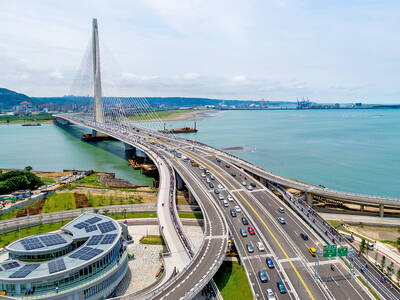
The Ministry of Transportation and Communications yesterday inaugurated the Danjiang Bridge across the Tamsui River in New Taipei City, saying that the structure would be an architectural icon and traffic artery for Taiwan. Feted as a major engineering achievement, the Danjiang Bridge is 920m long, 211m tall at the top of its pylon, and is the longest single-pylon asymmetric cable-stayed bridge in the world, the government’s Web site for the structure said. It was designed by late Iraqi-British architect Zaha Hadid. The structure, with a maximum deck of 70m, accommodates road and light rail traffic, and affords a 200m navigation channel for boats,
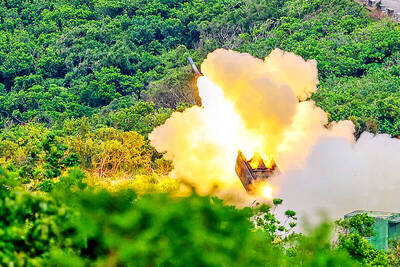
PRECISION STRIKES: The most significant reason to deploy HIMARS to outlying islands is to establish a ‘dead zone’ that the PLA would not dare enter, a source said A High Mobility Artillery Rocket System (HIMARS) would be deployed to Penghu County and Dongyin Island (東引) in Lienchiang County (Matsu) to force the Chinese military to retreat at least 100km from the coastline, a military source said yesterday. Taiwan has been procuring HIMARS and Army Tactical Missile Systems (ATACMS) from the US in batches. Once all batches have been delivered, Taiwan would possess 111 HIMARS units and 504 ATACMS, which have a range of 300km. Considering that “offense is the best defense,” the military plans to forward-deploy the systems to outlying islands such as Penghu and Dongyin so that
Taiwan Semiconductor Manufacturing Co (TSMC, 台積電), the world’s largest foundry service provider, yesterday said that global semiconductor revenue is projected to hit US$1.5 trillion in 2030, after the figure exceeds US$1 trillion this year, as artificial intelligence (AI) demand boosts consumption of token and compute power. “We are still at the beginning of the AI revolution, but we already see a significant impact across the whole semiconductor ecosystem,” TSMC deputy cochief operating officer Kevin Zhang (張曉強) said at the company’s annual technology symposium in Hsinchu City. “It is fair to say that in the past decade, smartphones and other mobile devices were

‘CLEAR MESSAGE’: The bill would set up an interagency ‘tiger team’ to review sanctions tools and other economic options to help deter any Chinese aggression toward Taiwan US Representative Young Kim has introduced a bill to deter Chinese aggression against Taiwan, calling for an interagency “tiger team” to preplan coordinated sanctions and economic measures in response to possible Chinese military or political action against Taiwan. “[Chinese President] Xi Jinping [習近平] has directed the People’s Liberation Army to be ready to invade Taiwan by 2027. China has a plan. America should have one too,” Kim said in a news release on Thursday last week. She introduced the “Deter PRC [People’s Republic of China] aggression against Taiwan act” to “ensure the US has a coordinated sanctions strategy ready should


 RSS
RSS