


The bloodletting in the financial-services industry will accelerate in coming months, with job cuts doubling to about 350,000 worldwide by the middle of next year, said Brian Sullivan, chief executive officer of search firm CTPartners.
Reductions on that scale would be equivalent to 20 percent of the global workforce at financial companies before the credit crisis began, Sullivan, whose firm has worked with Citigroup Inc and JPMorgan Chase & Co, said in an interview. Banks, brokerages and funds have eliminated about 170,000 positions worldwide.
“This is the financial equivalent of World War II,” Sullivan said. “It’s unprecedented. You’re seeing a seismic shift in the population of banking.”
Banks are racing to cut jobs from New York to Sydney as frozen credit markets cause revenues to tumble and the financial industry tries to digest almost US$1 trillion of writedowns and losses. The worst financial crisis since the Great Depression will reshape the investment banking industry, as firms lose the ability to use leverage to boost returns, Sullivan said.
“Without the massive leverage that’s been in the system, the business of some of these big investment banks simply isn’t going to be there,” he said.
Following the collapse of Lehman Brothers Holdings Inc, other firms like Goldman Sachs Group Inc and Morgan Stanley have converted themselves into bank holding companies regulated by the Federal Reserve. As such, their ability to take risks will be curbed, lowering profitability, Sullivan said.
CTPartners is shifting headhunters from banking to industries such as pharmaceuticals and clean energy as demand for finance professionals dries up, he said. The company is the world’s sixth-largest executive search firm, Sullivan said.
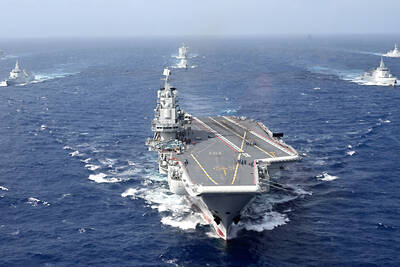
PROVOCATIVE: Chinese Deputy Ambassador to the UN Sun Lei accused Japan of sending military vessels to deliberately provoke tensions in the Taiwan Strait China denounced remarks by Japan and the EU about the South China Sea at a UN Security Council meeting on Monday, and accused Tokyo of provocative behavior in the Taiwan Strait and planning military expansion. Ayano Kunimitsu, a Japanese vice foreign minister, told the Council meeting on maritime security that Tokyo was seriously concerned about the situation in the East China and South China seas, and reiterated Japan’s opposition to any attempt to change the “status quo” by force, and obstruction of freedom of navigation and overflight. Stavros Lambrinidis, head of the EU delegation to the UN, also highlighted South China Sea
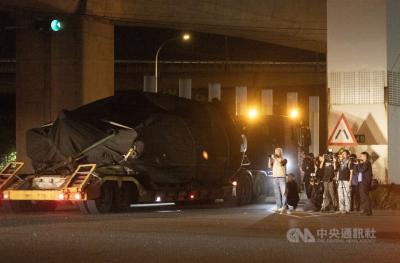
The final batch of 28 M1A2T Abrams tanks purchased from the US arrived at Taipei Port last night and were transported to the Armor Training Command in Hsinchu County’s Hukou Township (湖口), completing the military’s multi-year procurement of 108 of the tanks. Starting at 12:10am today, reporters observed more than a dozen civilian flatbed trailers departing from Taipei Port, each carrying an M1A2T tank covered with black waterproof tarps. Escorted by military vehicles, the convoy traveled via the West Coast Expressway to the Armor Training Command, with police implementing traffic control. The army operates about 1,000 tanks, including CM-11 Brave Tiger
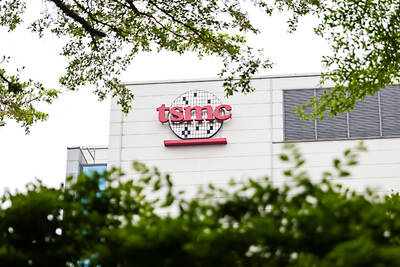
Taiwan Semiconductor Manufacturing Co (TSMC, 台積電), the world’s largest contract chipmaker, said it expects its 2-nanometer (2nm) chip capacity to grow at a compound annual rate of 70 percent from this year to 2028. The projection comes as five fabs begin volume production of 2-nanometer chips this year — two in Hsinchu and three in Kaohsiung — TSMC senior vice president and deputy cochief operating officer Cliff Hou (侯永清) said at the company’s annual technology symposium in Silicon Valley, California, last week. Output in the first year of 2-nanometer production, which began in the fourth quarter of last year, is expected to
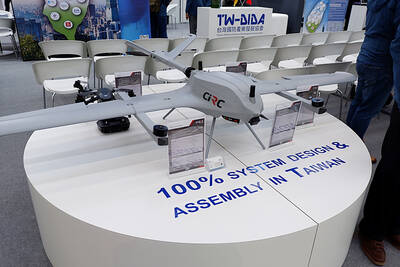
Taiwan’s drone exports surged past US$100 million in the first quarter, exceeding last year’s full-year total, with the Czech Republic emerging as the largest buyer, the Ministry of Economic Affairs said. Exports of complete drones reached US$115.85 million in the period, about 1.2 times the total recorded for all of last year, the ministry said in a report. Exports to the Czech Republic accounted for about US$100 million, far outpacing other markets. Poland, last year’s top destination, recorded about US$11.75 million in the first quarter. Taiwan’s drone exports have expanded rapidly in the past few years, with last year’s total


 RSS
RSS