


South Korea yesterday announced a US$10.7 billion plan to stimulate economic growth in the face of a global slowdown.
The government, saying it expects a significant slowdown in exports, detailed plans to spend an extra 11 trillion won next year, plus tax cuts totaling 3 trillion won, to boost sagging domestic demand.
“The ongoing global financial turmoil originating from the US subprime mortgage credit crunch is causing concern over a global economic downturn,” Minister of Strategy and Finance Kang Man-soo told reporters.
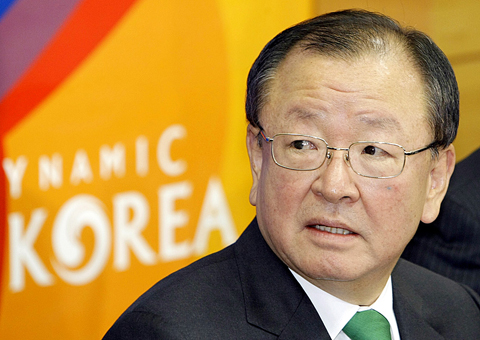
PHOTO: AP
“Financial market uncertainties have been aggravated and are exerting a knock-on impact on the real economy,” he said, stressing the need for the package to stimulate Asia’s fourth largest economy.
The government, under fire for weeks over its perceived weak leadership amid the global crisis, announced a wide-ranging plan to stabilize the shaky won and to boost the economy.
The finance ministry, in a statement announcing the measures, said short-term prospects for a turnaround in the global turmoil appear dim.
“Against this background, the [South] Korean government proposes ... policy measures to cope with these unprecedented challenges by announcing pre-emptive, decisive and sufficient counter-measures,” it said.
Of the 11 trillion won in extra public spending proposed for next year, 4.l6 trillion won would be spent on social infrastructure such as schools, universities, hospitals and libraries. Another 3.4 trillion would be used to help small and medium-sized firms, farmers and fishermen. One trillion won would be used to help low-income households and 1.1 trillion to support local governments. In addition to government spending, public enterprises would also expand investment by 1 trillion won.
Next year’s original budget submitted to parliament this month was for 273.8 trillion won, including spending by state-run funds, based on an assumption of 5 percent growth next year.
But the ministry yesterday cut its growth forecast for next year to around 4 percent, while tipping growth of 4 percent to 4.5 percent this year.
It announced a series of steps to revitalize the sagging property market, warning that “a potential sharp drop in asset prices may undermine the financial health of [South] Korean financial institutions.”
These largely ease restrictions imposed in recent years to curb speculation when the property market was soaring. South Korea had been dogged by fears of a re-run of the 1997-1998 financial crisis, partly because its banks were more exposed than elsewhere in Asia to repayment of dollar-denominated loans.
Last month, the government announced state guarantees worth up to US$100 billion on foreign borrowing by local banks. It followed up last week with news of a currency swap arrangement worth US$30 billion with the US Federal Reserve.
The news sharply pushed up the stock market and the won, which had been Asia’s worst performing major currency this year.
The finance ministry said yesterday it would also try to expand bilateral swap arrangements with China and Japan.
It said it would increase the ceiling of the foreign exchange stabilization fund from the current 15 trillion won to 20.6 trillion won, equivalent to twice the average daily exchange trading volume.
Extra funds would go to promote exports, while efforts to reach free trade deals with the EU and India would be speeded up.
Authorities would try to avoid “extreme volatilities” in the foreign exchange market with smoothing operations. And Foreign currency bank deposits would enjoy the same level of guarantees as local currency deposits.
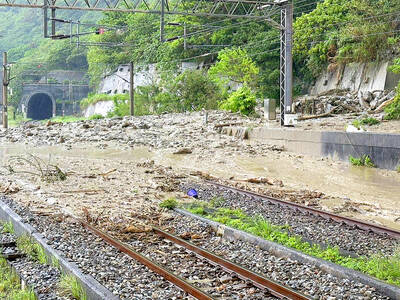
ROLLER-COASTER RIDE: More than five earthquakes ranging from magnitude 4.4 to 5.5 on the Richter scale shook eastern Taiwan in rapid succession yesterday afternoon Back-to-back weather fronts are forecast to hit Taiwan this week, resulting in rain across the nation in the coming days, the Central Weather Administration said yesterday, as it also warned residents in mountainous regions to be wary of landslides and rockfalls. As the first front approached, sporadic rainfall began in central and northern parts of Taiwan yesterday, the agency said, adding that rain is forecast to intensify in those regions today, while brief showers would also affect other parts of the nation. A second weather system is forecast to arrive on Thursday, bringing additional rain to the whole nation until Sunday, it
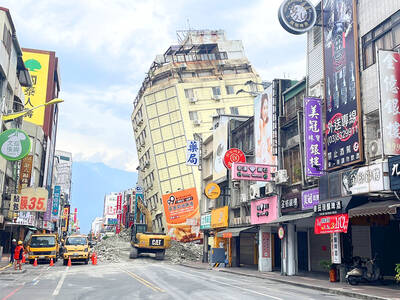
LANDSLIDES POSSIBLE: The agency advised the public to avoid visiting mountainous regions due to more expected aftershocks and rainfall from a series of weather fronts A series of earthquakes over the past few days were likely aftershocks of the April 3 earthquake in Hualien County, with further aftershocks to be expected for up to a year, the Central Weather Administration (CWA) said yesterday. Based on the nation’s experience after the quake on Sept. 21, 1999, more aftershocks are possible over the next six months to a year, the agency said. A total of 103 earthquakes of magnitude 4 on the local magnitude scale or higher hit Hualien County from 5:08pm on Monday to 10:27am yesterday, with 27 of them exceeding magnitude 5. They included two, of magnitude

CONDITIONAL: The PRC imposes secret requirements that the funding it provides cannot be spent in states with diplomatic relations with Taiwan, Emma Reilly said China has been bribing UN officials to obtain “special benefits” and to block funding from countries that have diplomatic ties with Taiwan, a former UN employee told the British House of Commons on Tuesday. At a House of Commons Foreign Affairs Committee hearing into “international relations within the multilateral system,” former Office of the UN High Commissioner for Human Rights (OHCHR) employee Emma Reilly said in a written statement that “Beijing paid bribes to the two successive Presidents of the [UN] General Assembly” during the two-year negotiation of the Sustainable Development Goals. Another way China exercises influence within the UN Secretariat is

Taiwan’s first drag queen to compete on the internationally acclaimed RuPaul’s Drag Race, Nymphia Wind (妮妃雅), was on Friday crowned the “Next Drag Superstar.” Dressed in a sparkling banana dress, Nymphia Wind swept onto the stage for the final, and stole the show. “Taiwan this is for you,” she said right after show host RuPaul announced her as the winner. “To those who feel like they don’t belong, just remember to live fearlessly and to live their truth,” she said on stage. One of the frontrunners for the past 15 episodes, the 28-year-old breezed through to the final after weeks of showcasing her unique


 RSS
RSS