


Two Federal Reserve district bank presidents signaled they’re not prepared to back an interest-rate cut even after the biggest disruption to the US financial industry in seven decades.
“Lowering the rate right now maybe isn’t the right response” because of an “inflation problem,” St Louis Fed President James Bullard said after a speech in Bloomington, Indiana, late on Thursday.
Thomas Hoenig, his Kansas City counterpart, said in Albuquerque, New Mexico, that “there is very strong stimulus in the economy” already.
The remarks underscore a gap between investors’ expectations of further rate reductions and the sentiment among some regional Fed officials that more interest rate cuts may not aid the economy at a time of elevated inflation.
Five of the 12 district-bank chiefs dissented on rate decisions since policy makers started lowering borrowing costs in September last year.
Traders may look to Fed chairman Ben Bernanke’s Oct. 7 speech on the economy for clues on whether the Federal Open Market Committee is open to a cut even before its Oct. 28 to Oct. 29 meeting. Bullard and Hoenig aren’t voters on the FOMC this year.
Hoenig said the Fed’s challenge would be to take back some of the seven rate cuts implemented from September of last year to April this year, while Bullard stressed his concern about inflation dangers. Both Bullard and Hoenig said the financial crisis is taking its toll on the US economy.
“The things that have given me the most concern are the labor market data and the sharp rise in the unemployment rate” and jobless compensation claims that are “at recession levels,” Bullard said.
Meanwhile, the IMF said on Thursday that the US is set for a sharp economic downturn or recession judging by the impact of similar banking crises around the globe over the past 30 years.
In new research, the IMF said the risk of a recession is higher when financial turmoil is preceded by rising house prices and rapid expansion of credit, which was the case in the US.
“The patterns of asset prices, aggregate credit and house borrowing in the United States during the current episode of financial stress appear similar to those of previous episodes that were followed by recessions,” IMF research found.
“It is now all too clear we are seeing the most dangerous shock to mature financial markets since the 1930s, posing a major threat to global growth,” Charles Collyns, deputy director in the IMF’s research department, told reporters.
He said so far the US economy has slowed but not entered into recession — at least through the second quarter — but risks identified in the research showed it could still enter one.
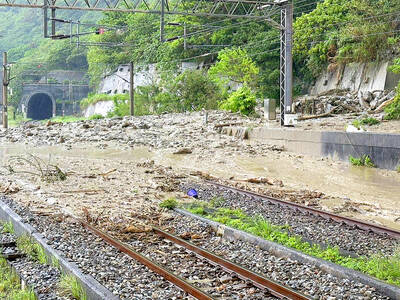
ROLLER-COASTER RIDE: More than five earthquakes ranging from magnitude 4.4 to 5.5 on the Richter scale shook eastern Taiwan in rapid succession yesterday afternoon Back-to-back weather fronts are forecast to hit Taiwan this week, resulting in rain across the nation in the coming days, the Central Weather Administration said yesterday, as it also warned residents in mountainous regions to be wary of landslides and rockfalls. As the first front approached, sporadic rainfall began in central and northern parts of Taiwan yesterday, the agency said, adding that rain is forecast to intensify in those regions today, while brief showers would also affect other parts of the nation. A second weather system is forecast to arrive on Thursday, bringing additional rain to the whole nation until Sunday, it
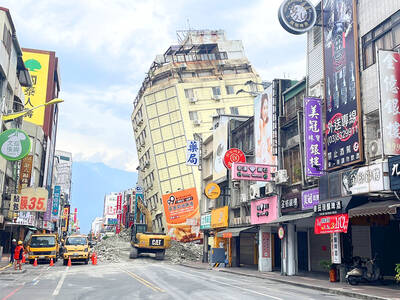
LANDSLIDES POSSIBLE: The agency advised the public to avoid visiting mountainous regions due to more expected aftershocks and rainfall from a series of weather fronts A series of earthquakes over the past few days were likely aftershocks of the April 3 earthquake in Hualien County, with further aftershocks to be expected for up to a year, the Central Weather Administration (CWA) said yesterday. Based on the nation’s experience after the quake on Sept. 21, 1999, more aftershocks are possible over the next six months to a year, the agency said. A total of 103 earthquakes of magnitude 4 on the local magnitude scale or higher hit Hualien County from 5:08pm on Monday to 10:27am yesterday, with 27 of them exceeding magnitude 5. They included two, of magnitude
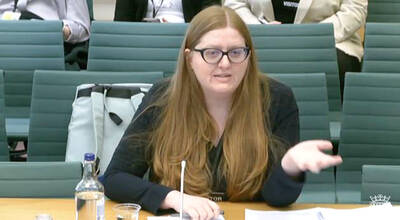
CONDITIONAL: The PRC imposes secret requirements that the funding it provides cannot be spent in states with diplomatic relations with Taiwan, Emma Reilly said China has been bribing UN officials to obtain “special benefits” and to block funding from countries that have diplomatic ties with Taiwan, a former UN employee told the British House of Commons on Tuesday. At a House of Commons Foreign Affairs Committee hearing into “international relations within the multilateral system,” former Office of the UN High Commissioner for Human Rights (OHCHR) employee Emma Reilly said in a written statement that “Beijing paid bribes to the two successive Presidents of the [UN] General Assembly” during the two-year negotiation of the Sustainable Development Goals. Another way China exercises influence within the UN Secretariat is

Taiwan’s first drag queen to compete on the internationally acclaimed RuPaul’s Drag Race, Nymphia Wind (妮妃雅), was on Friday crowned the “Next Drag Superstar.” Dressed in a sparkling banana dress, Nymphia Wind swept onto the stage for the final, and stole the show. “Taiwan this is for you,” she said right after show host RuPaul announced her as the winner. “To those who feel like they don’t belong, just remember to live fearlessly and to live their truth,” she said on stage. One of the frontrunners for the past 15 episodes, the 28-year-old breezed through to the final after weeks of showcasing her unique


 RSS
RSS