


Hewlett-Packard Co’s fiscal third-quarter profit jumped 14 percent, beating Wall Street’s expectations, as strong laptop sales and a robust international presence lifted the technology bellwether.
The Palo Alto-based company’s results, reported after the market closed on Tuesday, signaled that HP is still holding its ground as the world’s No. 1 seller of personal computers even with stronger competition from Dell Inc and Apple Inc and aggressive price cuts.
HP said it earned US$2.03 billion, or US$0.80 per share, in the latest period, up from US$1.78 billion, or US$0.66 per share, a year earlier.
Excluding one-time charges, HP’s profit was US$0.86 per share, US$0.03 higher than the average estimate of analysts polled by Thomson Reuters.
Investors have become accustomed to HP offering conservative guidance and topping those forecasts by a few pennies per share, so HP’s strong results for the May-to-last-month period and a fourth-quarter outlook that was slightly better than analysts expected weren’t much of a surprise.
Still, HP’s optimism about its prospects despite a tough economic environment in the US and parts of Europe helped lift the stock.
HP shares rose US$1.25, or 2.9 percent, to US$44.94 in after-hours trading after the results were reported. The stock had fallen 91 cents, or 2 percent, to US$43.69 during the regular trading session.
HP’s profits were hurt by higher prices for some of its parts and a shift toward cheaper PCs, but stronger sales of technology services and software helped offset those pressures.
The company’s gross profit margin — its profit on each dollar of revenue once manufacturing costs are stripped out — was 24.2 percent of revenues, down slightly from the year-ago period.
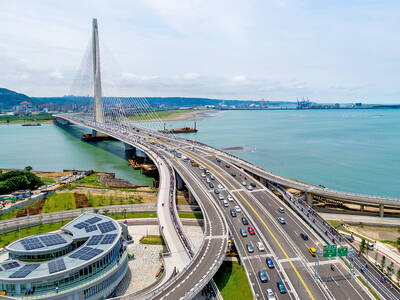
The Ministry of Transportation and Communications yesterday inaugurated the Danjiang Bridge across the Tamsui River in New Taipei City, saying that the structure would be an architectural icon and traffic artery for Taiwan. Feted as a major engineering achievement, the Danjiang Bridge is 920m long, 211m tall at the top of its pylon, and is the longest single-pylon asymmetric cable-stayed bridge in the world, the government’s Web site for the structure said. It was designed by late Iraqi-British architect Zaha Hadid. The structure, with a maximum deck of 70m, accommodates road and light rail traffic, and affords a 200m navigation channel for boats,
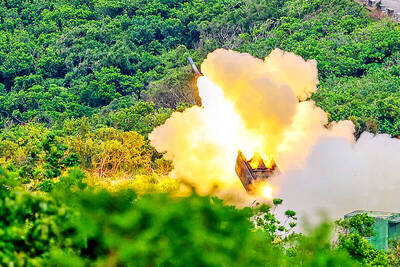
PRECISION STRIKES: The most significant reason to deploy HIMARS to outlying islands is to establish a ‘dead zone’ that the PLA would not dare enter, a source said A High Mobility Artillery Rocket System (HIMARS) would be deployed to Penghu County and Dongyin Island (東引) in Lienchiang County (Matsu) to force the Chinese military to retreat at least 100km from the coastline, a military source said yesterday. Taiwan has been procuring HIMARS and Army Tactical Missile Systems (ATACMS) from the US in batches. Once all batches have been delivered, Taiwan would possess 111 HIMARS units and 504 ATACMS, which have a range of 300km. Considering that “offense is the best defense,” the military plans to forward-deploy the systems to outlying islands such as Penghu and Dongyin so that
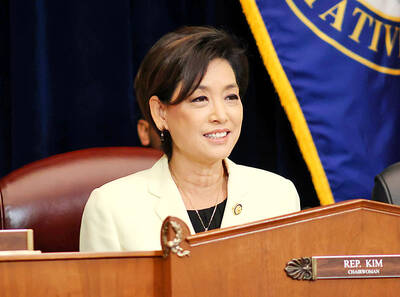
‘CLEAR MESSAGE’: The bill would set up an interagency ‘tiger team’ to review sanctions tools and other economic options to help deter any Chinese aggression toward Taiwan US Representative Young Kim has introduced a bill to deter Chinese aggression against Taiwan, calling for an interagency “tiger team” to preplan coordinated sanctions and economic measures in response to possible Chinese military or political action against Taiwan. “[Chinese President] Xi Jinping [習近平] has directed the People’s Liberation Army to be ready to invade Taiwan by 2027. China has a plan. America should have one too,” Kim said in a news release on Thursday last week. She introduced the “Deter PRC [People’s Republic of China] aggression against Taiwan act” to “ensure the US has a coordinated sanctions strategy ready should
Taiwan Semiconductor Manufacturing Co (TSMC, 台積電), the world’s largest foundry service provider, yesterday said that global semiconductor revenue is projected to hit US$1.5 trillion in 2030, after the figure exceeds US$1 trillion this year, as artificial intelligence (AI) demand boosts consumption of token and compute power. “We are still at the beginning of the AI revolution, but we already see a significant impact across the whole semiconductor ecosystem,” TSMC deputy cochief operating officer Kevin Zhang (張曉強) said at the company’s annual technology symposium in Hsinchu City. “It is fair to say that in the past decade, smartphones and other mobile devices were


 RSS
RSS