


German producer-price inflation accelerated to 8.9 percent, the fastest pace since October 1981, reinforcing speculation that the European Central Bank (ECB) will keep interest rates at a seven-year high even as the economy cools.
Economists expected prices last month for goods from newsprint to plastics to increase 7.5 percent from a year earlier, the median of 30 estimates in a Bloomberg News survey showed. This month, prices rose 2 percent, the Federal Statistics Office in Wiesbaden said yesterday.
Consumer prices are rising as companies pass on higher energy costs to customers. Even though the price of oil has retreated 21 percent from a July 11 record, the ECB kept its benchmark rate at 4.25 percent this month, saying it is worried that past commodity-price increases will push up wage demands and lead to entrenched inflation.
“There’s still a certain pricing pressure in the pipeline,” said Juergen Michels, an economist at Citigroup Inc in London. “The ECB is certainly concerned about inflation, but that doesn’t mean that they’ll raise interest rates given the deteriorating economic environment.”
The euro dropped as low as US$1.4631 after the release from US$1.4663. The yield on the 10-year German bund, Europe’s benchmark government security, was little changed at 4.13 percent by 7:47am in London.
ENERGY JUMP
Oil has declined to US$112.31 from a record of US$147.27 a barrel on July 11. Yesterday’s price was 58 percent more than a year ago. Inflation in Germany accelerated to 3.5 percent last month, the fastest pace in 12 years, and consumer prices in Europe gained an annual 4 percent, the most since 1992.
German energy prices gained 25 percent from a year earlier and prices for electricity increased 23 percent, yesterday’s report showed. The cost of diesel fuel rose 30 percent from last July. Excluding energy, producer prices rose 3.6 percent in the year.
BASF SE, the world’s biggest chemical producer, reported profit that beat analyst estimates for a sixth straight quarter on July 31 after passing on higher costs. The company has raised prices by as much as 20 percent.
ECB President Jean-Claude Trichet said on Aug. 7 that “a pipeline effect” from commodity-price increases “is something which is ongoing and undoubtedly creates more risks.”
There is an “absolute necessity to avoid the materialization of such risks,” he said.
Rising prices are leading to higher wage demands and are pushing up the outlook for prices.
ECB RATES
Inflation expectations, as measured by the so-called breakeven on five-year French indexed bonds, were at 2.2 percent yesterday, up from 2.1 percent in March. They fell from a record 2.83 percent after the ECB raised rates on July 3.
“This should be the peak in producer-price inflation, but it’s too early for the ECB to sound the all clear,” said Nick Matthews, an economist at Barclays Capital in London. “The bank is still concerned about the pass-through of previous price increases and will stay on hold for the foreseeable future.”
Higher prices are eroding purchasing power and curbing growth in an economy already burdened by a stronger euro and the US slowdown.
Germany, which accounts for about one third of the euro-area economy, contracted 0.5 percent in the second quarter, while gross domestic product in the 15 euro nations fell 0.2 percent.
The ZEW Center for European Economic Research was likely to say yesterday that German investor confidence held near a record low this month, increasing the risk of a recession, a survey of economists showed.
The Bundesbank said yesterday economic activity may remain muted for “some time yet,” with the economy likely to experience a “dry spell” in the second half of the year.
Still, it said it doesn’t expect a further deterioration in growth and noted that inflation expectations remain above the ECB’s 2 percent price-stability limit.
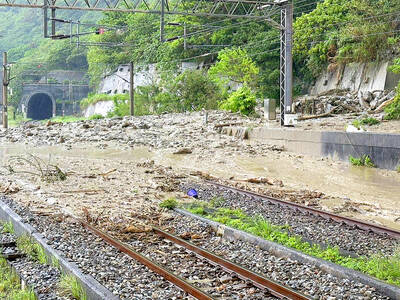
ROLLER-COASTER RIDE: More than five earthquakes ranging from magnitude 4.4 to 5.5 on the Richter scale shook eastern Taiwan in rapid succession yesterday afternoon Back-to-back weather fronts are forecast to hit Taiwan this week, resulting in rain across the nation in the coming days, the Central Weather Administration said yesterday, as it also warned residents in mountainous regions to be wary of landslides and rockfalls. As the first front approached, sporadic rainfall began in central and northern parts of Taiwan yesterday, the agency said, adding that rain is forecast to intensify in those regions today, while brief showers would also affect other parts of the nation. A second weather system is forecast to arrive on Thursday, bringing additional rain to the whole nation until Sunday, it
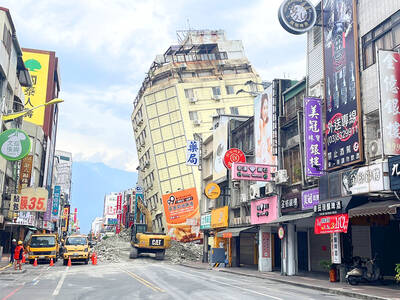
LANDSLIDES POSSIBLE: The agency advised the public to avoid visiting mountainous regions due to more expected aftershocks and rainfall from a series of weather fronts A series of earthquakes over the past few days were likely aftershocks of the April 3 earthquake in Hualien County, with further aftershocks to be expected for up to a year, the Central Weather Administration (CWA) said yesterday. Based on the nation’s experience after the quake on Sept. 21, 1999, more aftershocks are possible over the next six months to a year, the agency said. A total of 103 earthquakes of magnitude 4 on the local magnitude scale or higher hit Hualien County from 5:08pm on Monday to 10:27am yesterday, with 27 of them exceeding magnitude 5. They included two, of magnitude

CONDITIONAL: The PRC imposes secret requirements that the funding it provides cannot be spent in states with diplomatic relations with Taiwan, Emma Reilly said China has been bribing UN officials to obtain “special benefits” and to block funding from countries that have diplomatic ties with Taiwan, a former UN employee told the British House of Commons on Tuesday. At a House of Commons Foreign Affairs Committee hearing into “international relations within the multilateral system,” former Office of the UN High Commissioner for Human Rights (OHCHR) employee Emma Reilly said in a written statement that “Beijing paid bribes to the two successive Presidents of the [UN] General Assembly” during the two-year negotiation of the Sustainable Development Goals. Another way China exercises influence within the UN Secretariat is

Taiwan’s first drag queen to compete on the internationally acclaimed RuPaul’s Drag Race, Nymphia Wind (妮妃雅), was on Friday crowned the “Next Drag Superstar.” Dressed in a sparkling banana dress, Nymphia Wind swept onto the stage for the final, and stole the show. “Taiwan this is for you,” she said right after show host RuPaul announced her as the winner. “To those who feel like they don’t belong, just remember to live fearlessly and to live their truth,” she said on stage. One of the frontrunners for the past 15 episodes, the 28-year-old breezed through to the final after weeks of showcasing her unique


 RSS
RSS