


Sony's new flat-panel TV consumes less energy than comparable regular models without compromising image quality — the latest in Japanese manufacturers' efforts to woo buyers with green products.
The ¥150,000 (US$1,400) Bravia KDL-32JE1 goes on sale in Japan on July 30, and is planned later for overseas markets although dates and other details aren’t decided, Sony Corp’s Emi Nagahara said yesterday.
In a demonstration at Tokyo headquarters, a watt-counter attached to the new 32-inch Bravia consumed 82 watts of energy to show a Blu-ray disc image of a Spanish city on its liquid crystal display.
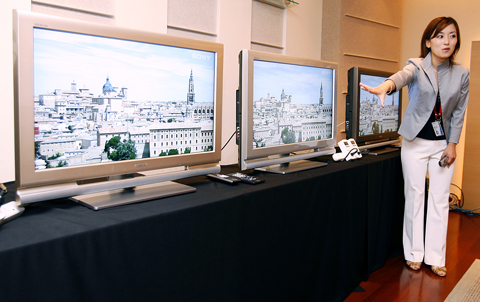
PHOTO: AP
A comparable regular model that cost about ¥10,000 less required 125 watts of energy to show the exact same image.
Sony achieved the energy savings by developing a brighter back light and better filtering that delivers light more efficiently, officials said. Both models have liquid crystal displays and high-definition digital broadcast features.
Compared to an old-style TV with a cathode-ray tube (CRT) monitor, the new TV consumes about 70 percent less energy a year.
By consuming less energy, the new “green” TV reduces carbon dioxide emissions totaling 79kg a year, equivalent to the amount consumed by about six cedar trees, it said.
Consumers also save on their utility bill. In Japan, the green TV delivers about ¥4,300 in savings in electricity payments a year compared with an old-style CRT TV, Sony said.
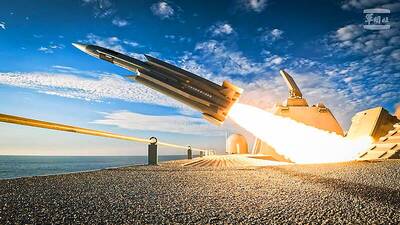
DETERRENCE: With 1,000 indigenous Hsiung Feng II and III missiles and 400 Harpoon missiles, the nation would boast the highest anti-ship missile density in the world With Taiwan wrapping up mass production of Hsiung Feng II and III missiles by December and an influx of Harpoon missiles from the US, Taiwan would have the highest density of anti-ship missiles in the world, a source said yesterday. Taiwan is to wrap up mass production of the indigenous anti-ship missiles by the end of year, as the Chungshan Institute of Science and Technology has been meeting production targets ahead of schedule, a defense official with knowledge of the matter said. Combined with the 400 Harpoon anti-ship missiles Taiwan expects to receive from the US by 2028, the nation would have
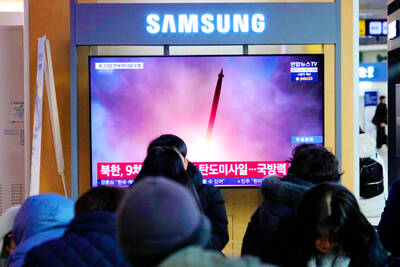
North Korea yesterday fired about 10 ballistic missiles to the sea toward Japan, the South Korean Joint Chiefs of Staff (JCS) said, days after Pyongyang warned of “terrible consequences” over ongoing South Korea-US military drills. Pyongyang recently dashed hopes of a diplomatic thaw with Seoul, Washington’s security ally, describing its latest peace efforts as a “clumsy, deceptive farce.” Seoul’s military detected “around 10 ballistic missiles launched from the Sunan area in North Korea toward the East Sea [Sea of Japan] at around 1:20pm,” JCS said in a statement, referring to South Korea’s name for the body of water. The missiles

‘UNWAVERING FRIENDSHIP’: A representative of a Japanese group that co-organized a memorial, said he hopes Japanese never forget Taiwan’s kindness President William Lai (賴清德) yesterday marked the 15th anniversary of the Tohoku earthquake and tsunami, urging continued cooperation between Taiwan and Japan on disaster prevention and humanitarian assistance. Lai wrote on social media that Taiwan and Japan have always helped each other in the aftermath of major disasters. The magnitude 9 earthquake struck northeastern Japan on March 11, 2011, triggering a massive tsunami that claimed more than 19,000 lives, according to data from Japanese authorities. Following the disaster, Taiwan donated more than US$240 million in aid, making it one of the largest contributors of financial assistance to Japan. In addition to cash donations and
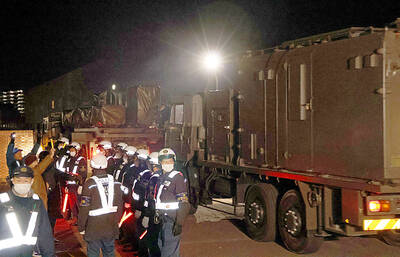
CLOSER TO CHINA: The upgraded Type-12 missile has a range of about 1,000km, compared with the original model’s range of 200km, and can reach mainland China Japan is preparing to deploy its first batch of domestically developed long-range missiles, with their launchers arriving at an army camp yesterday, as the country accelerates its offensive capability in response to rising challenges in the region. The upgraded Type-12 land-to-ship missiles are to be deployed at Camp Kengun in Japan’s southwestern prefecture of Kumamoto by the end of this month, completing the process of deployment, Japanese Chief Cabinet Secretary Minoru Kihara said without giving details. Army vehicles carrying the launchers and other equipment arrived past midnight in a highly secretive mission criticized by residents. Dozens of people stood outside of the


 RSS
RSS