


While last month’s sales of new vehicles in the US dropped to their lowest level since 1992, figures also show that US consumers are buying smaller cars with better fuel economy over trucks and sport utility vehicles.
“Smaller vehicles are going over big,” Toyota Motor Sales president Jim Lentz said. “With oil prices at record levels, compact cars and hybrids continue to lead the way.”
Other Japanese brands, such as Honda, Nissan Subaru and Suzuki, also reported sales increases last month as consumers opted for small cars.
Overall, sales tracker Autodata reported that despite a weak economy, sales of passenger cars increased by 5 percent last month, while sales of trucks and sport utility vehicles plunged 17.4 percent. Car makers report that more consumers are opting for smaller, more fuel-efficient four-cylinder engines when purchasing new cars, such as the Chevrolet Malibu, General Motors (GM) officials said.
“Consumer preference is shifting and we’re shifting with it,” said Mark LaNeve, vice president of GM North America Vehicle Sales, Service and Marketing.
“Throughout the industry, truck sales have been soft,” he said, after GM reported a US$3.3 billion first-quarter loss as its truck sales plunged.
GM announced deep cuts in truck production through the summer even though inventories have already been thinned by a two-month strike at a key supplier.
Ford Motor Co vice president of marketing and sales Jim Farley also said that sales of vehicles such as the Ford Focus and Mercury Milan were helping the company shift its sales profile away from truck and sport utility vehicles. Overall Ford sales were down 9.8 percent, Autodata said.
However, 63 percent of Ford vehicles sold in April were cars or car-like crossover vehicles, while less than 38 percent were trucks or sport utility vehicles — the smallest percentage in more than a decade.
Farley said Focus sales were the best for any April since 2000 and that the hybrid versions of Ford Escape and Mercury Mariner sold so well they were in relatively short supply.
Like GM, Ford also plans to cut truck production in the next quarter, while boosting production of passenger cars.
George Pipas, Ford’s sales analyst, said the company’s dealers also are reporting that consumers who bought F-150 pickup trucks as a fashion statement in the middle of the decade are now opting to purchase cars.
“People who didn’t need the utility of pickup truck are trading them in,” Pipas said.
Even Toyota and Nissan, which mounted elaborate plans to grab a portion of the US pickup truck market, have been forced to change their plans.
Bob Carter, Toyota vice president, said the Japanese giant’s brand new pickup truck plant in San Antonio, Texas, may not reach full-capacity now until 2009 or 2010. Sales of the heavily-advertised Toyota Tundra pick up slid more than 13 percent last month and pickup truck sales will not improve until the housing market begins to recover, Carter said.
Nissan, which has also seen pickup truck sales drop sharply, has announced plans to build a new line of commercial vehicles at its pickup truck plant in Canton, Mississippi, to help fill up the assembly line.
Chrysler LLC, another Detroit company dependent on truck and sport utility vehicle sales, reported a 17.6 percent decline in sales during last month. An increase in sales of compact cars failed to offset the decline, Chrysler officials said.
Steve Landry, however, noted that sales of fuel-efficient vehicles, such as Jeep Grand Cherokee equipped with a diesel engine, have been stymied by the big jump in the price of diesel fuel.
“It’s clear that gas prices are weighing heavily on car-buyers’ minds,” said Jesse Toprak, executive director of Industry Analysis for Edmunds.com in Santa Monica, California.

‘NO SECURITY RISK’: The Railway Bureau reassured the public that the technicians’ activities were limited to technical guidance and did not involve sensitive systems The Railway Bureau yesterday said it had invited eight Chinese technicians to assist with an airport MRT construction project. The bureau issued the confirmation after an Internet user said Chinese nationals had entered the construction zone of Taiwan Taoyuan International Airport’s Terminal 3 project. They asked why “individuals from an enemy state” were allowed access to such a major national infrastructure project, which raised serious concerns over Taiwan’s industrial safety, sensitive systems and information security. The bureau’s Northern Region Engineering Branch Office said subcontractor Taiwan Handle Industrial Co (台灣手把工業) of the Taoyuan airport MRT’s “Contract No. CU05 Project A14 Station Civil, MEP &

A US uncrewed surface vessel (USV) encountered multiple Chinese warships during an autonomous transit of the Taiwan Strait, US defense company Seasats said in a statement on Wednesday. Seasats announced that a Lightfish USV had completed the first autonomous transit of the Taiwan Strait. Over five days, the USV traversed the entire length of the Strait while constantly monitoring surface vessel traffic, the company said. The Lightfish encountered multiple Chinese warships, one of which was a Chinese People’s Liberation Army Navy (PLAN) Type 056 corvette, it said. The Chinese vessels were operating “well within Taiwan’s exclusive economic zone without transmitting their identity via the
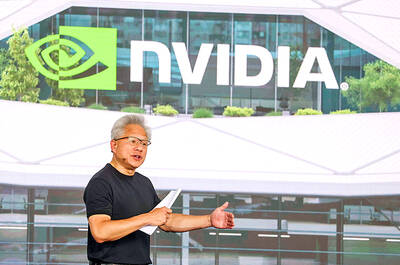
‘BOOMING’: ’ The number of partners we have here is incredible. You can see from their stock prices. They’re doing so well, they’re so happy,’ Jensen Huang said Nvidia Corp’s spending in Taiwan has ballooned to about US$150 billion a year, 10 times the US$10 billion to US$15 billion the company spent five years ago, Nvidia chief executive officer Jensen Huang (黃仁勳) said yesterday, suggesting Taiwan’s strategic importance in the global artificial intelligence (AI) supply chain. “Taiwan is the epicenter of the AI revolution. This is where the chips come, packaging comes. This is where the systems are made. This is where AI supercomputers were created,” Huang said at a meeting for the company’s employees in Beitou-Shilin Technology Park (北投士林科技園區) in Taipei, the planned site of Nvidia’s Taipei headquarters. “Taiwan
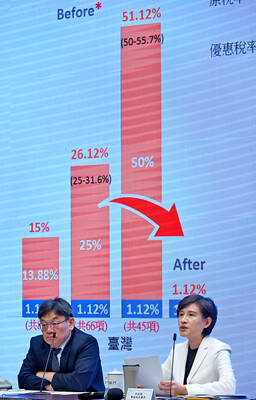
GREATER REACH? Auto parts and wood products would face tariffs of up to 15%, matching those targeting the EU, Japan and South Korea, Vice Premier said The US has announced that preferential tariff treatment for Taiwan’s non-semiconductor Section 232 goods would take effect retroactively from May 1, the Executive Yuan said yesterday. The US government yesterday posted a notice on the Federal Register’s public inspection Web site previewing tariff concessions for Taiwan under a memorandum of understanding (MOU) on Taiwan-US investment after two months of negotiations. The MOU signed on Jan. 15 stipulated three major preferential tariff arrangements: a 15 percent “reciprocal” tariff rate for Taiwan without stacking most-favored nation (MFN) rates; preferential Section 232 treatment for semiconductors and related products; and preferential Section 232 treatment for non-semiconductor


 RSS
RSS