


A proposal on Monday for the most sweeping overhaul of financial market regulation since the New Deal evoked a range of reaction from praise to outright skepticism.
But even backers of the plan, unveiled by US Treasury Secretary Henry Paulson, said the effort would have little or no impact on the current economic turmoil caused by rampant excesses in mortgage lending and speculation.
"Government has a responsibility to make sure our financial system is regulated effectively. And in this area, we can do a better job," Paulson said in unveiling the plan.
Although the plan was announced amid a crisis of confidence in financial markets, Paulson said it is not "a response to the circumstances of the day," but aimed at addressing "complex, long-term issues" to help make markets more efficient and competitive.
Analysts at Wrightson ICAP said the plan "would create a more coherent supervisory scheme and would eliminate some of the inconsistencies arising from today's patchwork system."
Tim Ryan, president of the Securities Industry and Financial Markets Association, said Paulson "delivered a thoughtful and sweeping plan which should provoke intense discussion, debate and potential legislative changes."
"Treasury's three-step approach is very wise because it allows time for serious analysis, discussion and important choices," Ryan said.
But Robert Eisenbeis, economist at Cumberland Advisors, said he was disappointed with the plan.
"Despite the claim that they are not in response to the current problems, this set is like the other in that they are largely recommendations that either have been on the back shelf and/or are knee-jerk responses to perceived immediate problems," Eisenbeis said.
"Most reform proposals fail because they don't address the issue of how to overcome the self-interests of both the regulated and regulatory agencies to move to a better and `more optimal regime.' This report is no exception and will suffer the same fate," he said.
Under the proposal described as the most ambitious since the Great Depression, the US Federal Reserve would gain oversight of Wall Street securities firms which now have access to the central bank's emergency lending facilities.
The plan also calls for a new federal panel that would oversee state systems for regulating participants in mortgage lending.
It would eliminate the differences between supervision of banks and savings-and-loan institutions, creating a single entity to regulate both, and merge the Securities and Exchange Commission, which regulates companies with publicly traded shares, with the Commodities Futures Trading Commission, which oversees commodities trading.
The announcement comes as the US regulatory system is blamed for failing to prevent rampant excesses in mortgage lending that set off what is now seen as the worst financial crisis in decades.
"For those of you who think we are not in a recession, are you convinced now? Forget recession, we have jumped right into depression-like reforms," said Kevin Giddis, market analyst at Morgan Keegan.
Economist Paul Krugman said the plan is "about creating the appearance of responding to the current crisis, without actually doing anything substantive."
Krugman said the Bush administration "has spent the last seven years trying to do away with government oversight of the financial industry."
Democratic presidential hopeful Senator Hillary Clinton said she agrees with some of the recommendations but that it "is too short on action."
"Ensuring effective functioning of our financial markets is not solely an issue of how we rearrange the chairs that regulators sit in," said Clinton, who argued for federal standards for mortgage lenders and tighter supervision of "exotic financial products" such as collateralized debt obligations linked to mortgages.
CME Group, operator of the Chicago Mercantile Exchange, said it would be a mistake to merge the two regulatory agencies that oversee the securities exchanges and futures markets.
"The differences are organic, not accidental, and an effort to homogenize the two regulatory regimes is certain to cause more harm than good," the exchange said.

National Taiwan University (NTU) yesterday said it disqualified a person from an entrance examination for using AI smart glasses to cheat, along with two others for making untruthful statements in their curriculum vitae. The three applicants were given null scores, Taiwan’s highest-ranked university said, calling on prospective students to be honest in the admissions process. NTU registrar Lee Hung-sen (李宏森) said that the cheating applicant wore a hat and thick-rimmed glasses to the second written exam for medical school, claiming that they felt cold. Suspicions were aroused when the applicant stared oddly at the test for long stretches while steadily bringing the paper
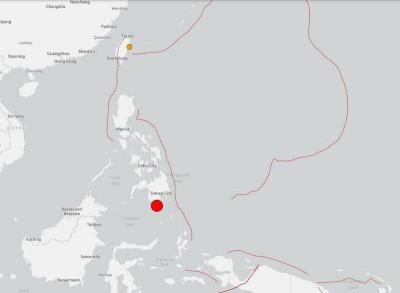
A magnitude 7.8 earthquake struck off the southern coast of Mindanao in the Philippines at 7:38am today, prompting the US Tsunami Warning System to issue an alert for neighboring countries, including Taiwan. The system issued a purple alert indicating a "tsunami threat." The potential threat zone includes Taiwan, the Philippines, Papua New Guinea, Yap and Palau. Philippine authorities were assessing the damage from the quake, with the office of civil defense seeking to verifying initial reports that 15 people had been killed and 129 injured in the region, mostly from falling debris. Arlene Hollero, disaster chief of Maasim town in the Philippines' Sarangani Province,

‘GRAY ZONE’ PRESSURE: Beijing’s activities are intended to create the deceitful impression that China has jurisdiction over the area around Taiwan, the CGA said Taiwan’s rights over its territorial waters and exclusive economic zone must not be violated by any country, the Mainland Affairs Council said yesterday, adding that it will not accept any unprovoked actions. The council issued the remarks in response to the China Coast Guard conducting maritime enforcement drills near eastern Taiwan and claiming to fully exercise China’s maritime administrative law enforcement authority. The Coast Guard Administration (CGA) has been closely monitoring the situation and is taking concrete steps to defend the nation’s sovereignty and secure its waters, the council said. China has no sovereign rights over the waters off eastern
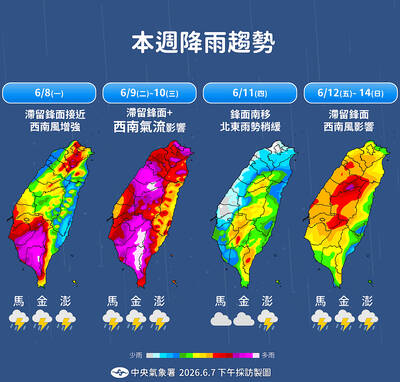
Heavy rain is expected to affect parts of Taiwan this week, the Central Weather Administration (CWA) said yesterday as a meteorologist said the active part of the annual plum rain season has started. A stationary plum rain front and southwesterly winds would bring unstable weather and abundant moisture to Taiwan from today for about a week, with the heaviest rainfall forecast for tomorrow and Wednesday, the CWA said. The agency said western and northeastern Taiwan, and mountainous areas in the east and southeast, could expect showers or thunderstorms on those two days, with localized heavy rain possible. Other parts of


 RSS
RSS