


Switzerland's largest bank UBS faced a rocky shareholder meeting yesterday as plans to plug billions of dollars in subprime losses with funds from foreign investors were likely to meet fierce criticism.
UBS' reputation as a key player in Swiss and international banking has taken a battering in recent weeks, with chairman Marcel Ospel coming in for special opprobrium.
Swiss President Pascal Couchepin stoked the flames further on Tuesday, denouncing the bank chairman's "Pharoah-like" salary of 26.6 million Swiss francs (US$24.5 million) in 2006.
"I'm outraged that Marcel Ospel has earned Pharaoh-like salaries for four to five years and that when the bank wobbles, he can keep it all," Couchepin told Swiss weekly magazine Bilan.
"It's not a state matter, but I consider it incredible," the president said.
The meeting "will be a long and difficult one for the management," Credit Suisse banking analyst Christine Schmid said.
Around 5,000 shareholders are expected to attend in the Swiss city of Basel.
UBS has been under increasing fire after posting its first ever full-year loss last year due to US$18 billion in losses in the US housing market.
The bank revealed a net loss of SF4.4 billion last year, compared with a profit of SF12.3 billion in 2006.
In a bid to restore its balance sheet, UBS in December proposed a capital hike of SF19.4 billion funded chiefly by Singapore's state investment arm (GIC) and an unnamed Middle East investor.
GIC said it would inject SF11 billion into UBS, giving it a stake of about 9 percent and making it the largest single shareholder, while the Middle Eastern investor was to put up SF2 billion.
But the proposal has sparked shareholder ire amid fears the deal could put existing investors at a disadvantage.
Pressure is also growing on Ospel, with rumors rife in the Swiss press that UBS is putting out feelers for a possible replacement.
Deutsche Bank head Josef Ackermann, former ABB boss Fred Kindle and Royal Dutch Shell chief financial officer Peter Voser have all been among the names mentioned.
UBS is scheduled to reelect or pick a new chairman during its annual general meeting on April 23.
Couchepin said that his fate "is for the shareholders to decide."
The Ethos Foundation of small shareholders questioned the need for the bank's proposed capital hike, saying the Swiss bank was far from being under-subscribed at present.
"It would not be the end of the world" if shareholders reject the proposal, a spokesperson for the foundation said.
Another shareholder, the Profond foundation, proposed its own capital hike open to existing shareholders that could then be extended to outside investors.
Small shareholders in another association -- Actares -- warned that failure to agree on one or other of the proposals would have "catastrophic" consequences for the bank.
A two-thirds majority was needed to pass the Swiss bank's own proposal, while the Profond hike required an absolute majority to be approved.
Funds research agency Lipper said UBS had seen an 8.4 percent decline in its assets under management in the past six months, while rival Credit Suisse had seen a 1.9 percent fall.

‘NO SECURITY RISK’: The Railway Bureau reassured the public that the technicians’ activities were limited to technical guidance and did not involve sensitive systems The Railway Bureau yesterday said it had invited eight Chinese technicians to assist with an airport MRT construction project. The bureau issued the confirmation after an Internet user said Chinese nationals had entered the construction zone of Taiwan Taoyuan International Airport’s Terminal 3 project. They asked why “individuals from an enemy state” were allowed access to such a major national infrastructure project, which raised serious concerns over Taiwan’s industrial safety, sensitive systems and information security. The bureau’s Northern Region Engineering Branch Office said subcontractor Taiwan Handle Industrial Co (台灣手把工業) of the Taoyuan airport MRT’s “Contract No. CU05 Project A14 Station Civil, MEP &

The National Chungshan Institute of Science and Technology yesterday showcased its locally developed variants of the Vision 60 robotic patrol dog, which it plans to deploy on the nation’s outlying territories in the South China Sea. The variants were produced under the Joint Lab project — created by the institute and domestic companies — and assembled with domestically produced motors, lenses and artificial intelligence (AI) systems alongside licensed tech from the US, Missile and Rocket Systems Research Division deputy director Jen Kuo-kang (任國光) told the media event at a military base in Taipei’s Dazhi (大直) area. Taiwan has built up its strengths
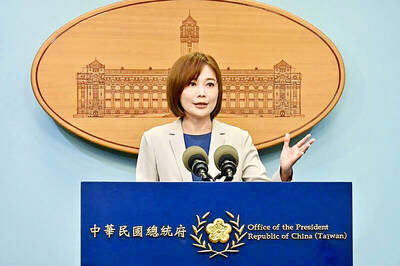
TIT-FOR-TAT: The US allegedly revoked the visa of a Chinese national working at Xinhua News Agency in the US in response to Beijing’s expulsion of Vivian Wang The Presidential Office yesterday condemned China for expelling a New York Times correspondent from Beijing following the newspaper’s interview with President William Lai (賴清德), saying the move highlighted Beijing’s suppression of press freedom and its threat to international news media. Taiwan has noted a series of recent incidents in which Beijing used similar tactics to “threaten and pressure international media outlets and journalists,” Presidential Office spokeswoman Karen Kuo (郭雅慧) said in a statement. “This concerns not only press freedom and freedom of expression, but also the safety of journalists, and Taiwan and relevant partners are paying close attention to the situation,” she
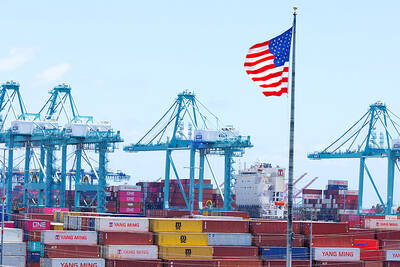
NOT IMMEDIATE: Taiwan has a chance to appeal the proposed 10 percent tariff before it starts, while other countries face a 12.5 percent tariff from the trade office Taiwan is among 60 economies determined by the US to have failed to impose or enforce a ban on the importation of goods produced with forced labor, according to a notice released on Tuesday by the Office of the US Trade Representative (USTR), which proposed imposing an additional 10 percent or more tariff on them. The USTR in a statement said that following an investigation, it had determined under Section 301 of the Trade Act of 1974 that the failure of the 60 economies to impose and effectively enforce a prohibition on the importation of goods produced with forced labor is


 RSS
RSS