


Samsung Electronics Co said yesterday that net profit in the fourth quarter of last year fell 6.6 percent amid sharp declines in prices for computer memory chips, though sales of mobile phone handsets surged to a record.
As the results were being released, South Korean special prosecutors were raiding the Seoul headquarters of Samsung Group, the conglomerate that Samsung Electronics anchors.
Investigators are probing allegations by a former Samsung Group lawyer that the conglomerate set up a slush fund to bribe prosecutors, government officials and others. Samsung has denied the allegations.
Samsung Electronics, the world's largest manufacturer of memory chips, earned 2.212 trillion won (US$2.36 billion), in the three months through last month, the company said in a statement to South Korea's financial regulator. The company posted net profit of 2.368 trillion won a year earlier.
Samsung's earnings result, though its fourth net profit decline in the past five quarters, was better than expected. The average estimate of nine analysts surveyed by Dow Jones Newswires forecast that Samsung would post a net profit of 1.97 trillion won.
Investors -- apparently happy with the earnings results and unflustered by the raid on Samsung Group headquarters -- lifted Samsung's share price as much as 3 percent during trading yesterday. The shares later pared gains as the broader stock market turned south and finished 1.3 percent higher at 532,000 won.
Quarterly sales rose 11 percent to a record 17.48 trillion won from 15.68 trillion won a year earlier. The result was better than the 17.09 trillion won forecast by the analysts.
Samsung also is the world's top producer of liquid crystal displays and flat-screen televisions and ranks No. 2 in mobile phones behind Finland's Nokia Corp.
The Suwon, South Korea-based company manufactures both DRAM, or dynamic random access memory, chips used in personal computers, as well as NAND chips used in digital cameras, music players and mobile phones.
Prices for both products have fallen sharply over the past year.
"For DRAM, demand was strong but pricing was weak because of oversupply, essentially," Chu Woo-sik, executive vice president for investor relations, told analysts on a conference call after the earnings were released.
Lee Min-hee, an analyst at Dongbu Securities Co in Seoul, said industrywide average selling prices for DRAM chips have skidded about 85 percent over the past year amid a supply glut after manufacturers were too optimistic about personal computer demand last year.
He added, however, that Samsung escaped the worst of that because it has diversified into specialty DRAM chips such as mobile DRAM and graphic DRAM.
"The oversupply of chips is still in the distribution channel," he said.

ROLLER-COASTER RIDE: More than five earthquakes ranging from magnitude 4.4 to 5.5 on the Richter scale shook eastern Taiwan in rapid succession yesterday afternoon Back-to-back weather fronts are forecast to hit Taiwan this week, resulting in rain across the nation in the coming days, the Central Weather Administration said yesterday, as it also warned residents in mountainous regions to be wary of landslides and rockfalls. As the first front approached, sporadic rainfall began in central and northern parts of Taiwan yesterday, the agency said, adding that rain is forecast to intensify in those regions today, while brief showers would also affect other parts of the nation. A second weather system is forecast to arrive on Thursday, bringing additional rain to the whole nation until Sunday, it
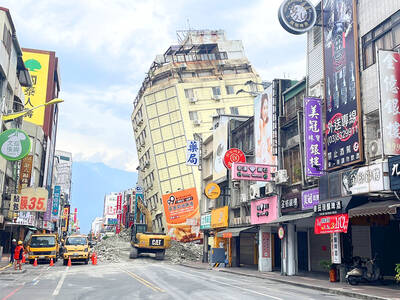
LANDSLIDES POSSIBLE: The agency advised the public to avoid visiting mountainous regions due to more expected aftershocks and rainfall from a series of weather fronts A series of earthquakes over the past few days were likely aftershocks of the April 3 earthquake in Hualien County, with further aftershocks to be expected for up to a year, the Central Weather Administration (CWA) said yesterday. Based on the nation’s experience after the quake on Sept. 21, 1999, more aftershocks are possible over the next six months to a year, the agency said. A total of 103 earthquakes of magnitude 4 on the local magnitude scale or higher hit Hualien County from 5:08pm on Monday to 10:27am yesterday, with 27 of them exceeding magnitude 5. They included two, of magnitude

CONDITIONAL: The PRC imposes secret requirements that the funding it provides cannot be spent in states with diplomatic relations with Taiwan, Emma Reilly said China has been bribing UN officials to obtain “special benefits” and to block funding from countries that have diplomatic ties with Taiwan, a former UN employee told the British House of Commons on Tuesday. At a House of Commons Foreign Affairs Committee hearing into “international relations within the multilateral system,” former Office of the UN High Commissioner for Human Rights (OHCHR) employee Emma Reilly said in a written statement that “Beijing paid bribes to the two successive Presidents of the [UN] General Assembly” during the two-year negotiation of the Sustainable Development Goals. Another way China exercises influence within the UN Secretariat is

Taiwan’s first drag queen to compete on the internationally acclaimed RuPaul’s Drag Race, Nymphia Wind (妮妃雅), was on Friday crowned the “Next Drag Superstar.” Dressed in a sparkling banana dress, Nymphia Wind swept onto the stage for the final, and stole the show. “Taiwan this is for you,” she said right after show host RuPaul announced her as the winner. “To those who feel like they don’t belong, just remember to live fearlessly and to live their truth,” she said on stage. One of the frontrunners for the past 15 episodes, the 28-year-old breezed through to the final after weeks of showcasing her unique


 RSS
RSS