


India's central bank is expected to leave interest rates on hold this week as fears that the country's fast-growing economy is overheating begin to recede, analysts said.
The bank's aggressive monetary tightening has slowed credit and industrial growth and reduced inflation, they said, suggesting that the rate-hiking cycle that started in late 2004 could be ending.
"The unchanged interest rates will likely suggest the Reserve Bank of India's comfort in the current domestic macro-economic scenario," said Manika Premsingh, an economist at the brokerage Edelweiss Capital in Mumbai.
The bank may instead move to reduce cash in the banking system to cope with hefty capital inflows at its quarterly policy meeting tomorrow, analysts said.
The RBI has pushed its benchmark repo rate to a four-year peak of 7.75 percent in its drive to tame inflation, raising the repo, its key short term lending rate, five times between June last year and March this year.
India's inflation accelerated to 4.41 percent for the week ended July 14 from 4.27 percent the previous week, data on Friday showed.
But the figure is well below the bank's ceiling of 5 percent for the fiscal year to March next year and sharply down from a two-year high of nearly seven percent earlier this year, which prompted the central bank to warn that the economy was possibly overheating.
"I expect the RBI to adopt a `wait and watch' message -- with a cautiously watchful attitude to inflation," said Deepak Lalwani, director at London stockbroker Astaire and Partners Ltd.
India's economy grew by 9.4 percent in the last financial year and the central bank has forecast growth of 8.5 percent this year.
Monetary tightening has led to an easing of credit growth by a third to 24 percent after it touched 33 percent in June last year.
Year-on-year industrial production growth fell to 11.1 percent in May from 14.5 percent in March while auto sales fell by 4.4 percent last month.
Freight rail traffic has slowed to a 22-month low of 3.9 percent while export growth has decelerated to a 44-month low of six percent. Business confidence has fallen sharply, mainly due to higher borrowing costs.
"We expect no further policy rate hikes as growth indicators are already pointing towards a significant further deceleration," said Morgan Stanley economist Chetan Ahya.
Analysts also said leaving rates on hold could act as a signal to commercial banks to start reducing lending rates, with a possible first central bank rate cut coming as early as the fourth quarter.
"Assuming the current growth decelerating trend is maintained, we see a 40 percent probability of a policy rate cut in the quarter ended December 2007," Ahya said in a research note.
However, some analysts said they expected the bank to take further action to reduce liquidity amid a surplus of cash that could allow inflation to re-emerge.
Foreign money has been pouring into India's booming stock market amid record highs.
A sharp rise in the bank's foreign currency reserves suggests it has been buying dollars and selling rupees to curb the Indian currency's jump against the US unit, injecting rupee funds into the banking system in the process.
"A hike in the cash reserve ratio [CRR] is a possibility," said India's Development Credit Bank's K. Harihar, referring to the amount of cash commercial banks must hold on deposit with the central bank.

‘NO SECURITY RISK’: The Railway Bureau reassured the public that the technicians’ activities were limited to technical guidance and did not involve sensitive systems The Railway Bureau yesterday said it had invited eight Chinese technicians to assist with an airport MRT construction project. The bureau issued the confirmation after an Internet user said Chinese nationals had entered the construction zone of Taiwan Taoyuan International Airport’s Terminal 3 project. They asked why “individuals from an enemy state” were allowed access to such a major national infrastructure project, which raised serious concerns over Taiwan’s industrial safety, sensitive systems and information security. The bureau’s Northern Region Engineering Branch Office said subcontractor Taiwan Handle Industrial Co (台灣手把工業) of the Taoyuan airport MRT’s “Contract No. CU05 Project A14 Station Civil, MEP &

The National Chungshan Institute of Science and Technology yesterday showcased its locally developed variants of the Vision 60 robotic patrol dog, which it plans to deploy on the nation’s outlying territories in the South China Sea. The variants were produced under the Joint Lab project — created by the institute and domestic companies — and assembled with domestically produced motors, lenses and artificial intelligence (AI) systems alongside licensed tech from the US, Missile and Rocket Systems Research Division deputy director Jen Kuo-kang (任國光) told the media event at a military base in Taipei’s Dazhi (大直) area. Taiwan has built up its strengths
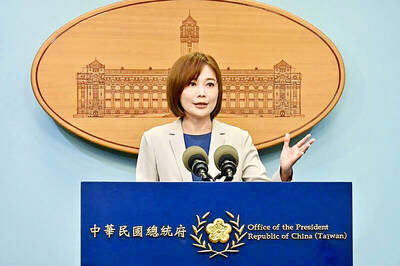
TIT-FOR-TAT: The US allegedly revoked the visa of a Chinese national working at Xinhua News Agency in the US in response to Beijing’s expulsion of Vivian Wang The Presidential Office yesterday condemned China for expelling a New York Times correspondent from Beijing following the newspaper’s interview with President William Lai (賴清德), saying the move highlighted Beijing’s suppression of press freedom and its threat to international news media. Taiwan has noted a series of recent incidents in which Beijing used similar tactics to “threaten and pressure international media outlets and journalists,” Presidential Office spokeswoman Karen Kuo (郭雅慧) said in a statement. “This concerns not only press freedom and freedom of expression, but also the safety of journalists, and Taiwan and relevant partners are paying close attention to the situation,” she

NOT IMMEDIATE: Taiwan has a chance to appeal the proposed 10 percent tariff before it starts, while other countries face a 12.5 percent tariff from the trade office Taiwan is among 60 economies determined by the US to have failed to impose or enforce a ban on the importation of goods produced with forced labor, according to a notice released on Tuesday by the Office of the US Trade Representative (USTR), which proposed imposing an additional 10 percent or more tariff on them. The USTR in a statement said that following an investigation, it had determined under Section 301 of the Trade Act of 1974 that the failure of the 60 economies to impose and effectively enforce a prohibition on the importation of goods produced with forced labor is


 RSS
RSS