


The Hollywood tradition of product placement will soar to a new level when Steven Spielberg-produced action film Transformers is unleashed on US cinema-goers today.
Based on the successful line of toys launched during the 1980s which spawned a popular cartoon series and several comic books, the new movie version of Transformers has become one of the most talked about films in years.
But while film buffs marvel at the spectacular computer-generated pyrotechnics, US automaker General Motors (GM) is hoping that big box-office will translate into big car sales.
Four GM models have prominent roles in the film, which sees them "transform" from cars into robot warriors battling to save planet Earth from destruction against evil rival robots.
The GM vehicles, which unsurprisingly feature in the film as the good guys on the side of mankind, have featured prominently in pre-release publicity for the film.
Dino Bernacchi, associate director of marketing alliances and branded entertainment at GM, said Transformers represents a rare convergence of big-business and Hollywood.
"We try to find properties where the cars are the stars, and literally our cars are the stars of this movie," Bernacchi told the Hollywood Reporter. "You don't get any more heroic than the roles that our four vehicles play."
The car-robot given pride of place in the film, a Chevrolet Camaro, went out of production in 2002 but is set to be re-launched next year.
Alongside the Camaro is a gas-guzzling Hummer H2, a GMC Topkick pick-up truck and a low-cost Pontiac Solstice convertible.
"I think this is a once in motion picture history-type opportunity for an automotive company where you have a film that actually incorporates multiple cars that are actually characters in the film," LeeAnne Stables, senior vice-president of worldwide marketing partnerships at Paramount studios, told the Reporter.
According to movie industry press reports, GM did not pay for the right to feature in Transformers, but instead has helped offset the huge promotional costs of the film by featuring the movie in recent advertising campaigns for its cars.
In exchange, Transformers director Michael Bay (Armageddon, The Rock and Bad Boys) has directed five separated commercials for GM.
Park Choong-whan, a professor of marketing at the University of Southern California, described GM's Transformers tie-in as "probably the most aggressive form of product placement strategy."
But Park also warned that the campaign could backfire.
"People may discount the true effect that may be possible from this tie-in because they already know about it," he said. "There's is a kind of boomerang effect ... If prior attitudes of the people towards General Motors are negative, then it may not have a strong impact at all."
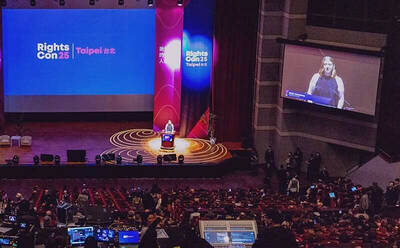
SILENCING CRITICS: In addition to blocking Taiwan, China aimed to prevent rights activists from speaking out against authoritarian states, a Cabinet department said The Ministry of Foreign Affairs (MOFA) yesterday condemned transnational repression by Beijing after RightsCon, a major digital human rights conference scheduled to be held in Zambia this week, was abruptly canceled due to Chinese pressure over Taiwanese participation. This year’s RightsCon, the world’s largest conference discussing issues “at the intersection of human rights and technology,” was scheduled to take place from tomorrow to Friday in Lusaka, and expected to draw 2,600 in-person attendees from 150 countries, along with 1,100 online participants. However, organizers were forced to cancel the event due to behind-the-scenes pressure from China, the ministry said, expressing its “strongest condemnation”
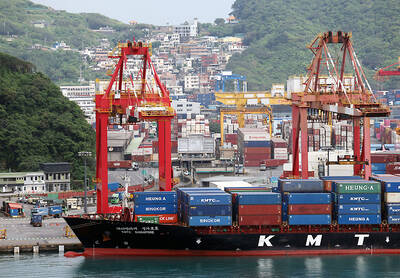
Taiwan’s economy grew far faster than expected in the first quarter, as booming demand for artificial intelligence (AI) applications drove a surge in exports, spilling over into investment and consumption, the Directorate-General of Budget, Accounting and Statistics (DGBAS) said yesterday. GDP growth was 13.69 percent year-on-year during the January-to-March period, beating the DGBAS’ February forecast by 2.23 percentage points and marking the most robust growth in nearly four decades, DGBAS senior official Chiang Hsin-yi (江心怡) told a news conference in Taipei. The result was powered by exports, which remain the backbone of Taiwan’s economy, Chiang said. Outbound shipments jumped 51.12 percent year-on-year to
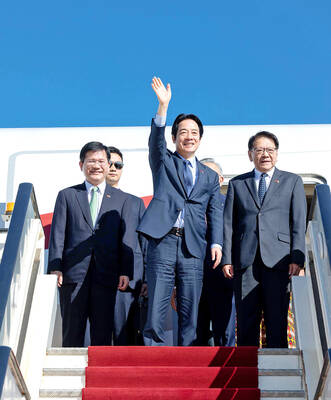
DELAYED BUT DETERMINED: The president’s visit highlights Taiwan’s right to international engagement amid regional pressure from China President Willaim Lai (賴清德) yesterday arrived in Eswatini, more than a week after his planned visit to Taiwan’s sole African ally was suspended because of revoked overflight permits. “The visit, originally scheduled for April 22, was postponed due to unforeseen external factors,” Lai wrote on social media. “After several days of careful arrangements by our diplomatic and national security teams, we successfully arrived today.” Lai said he looked forward to further deepening Taiwan-Eswatini relations through closer cooperation in the economy, agriculture, culture and education, as well as advancing the nation’s international partnerships. The president was initially scheduled to arrive in time to celebrate
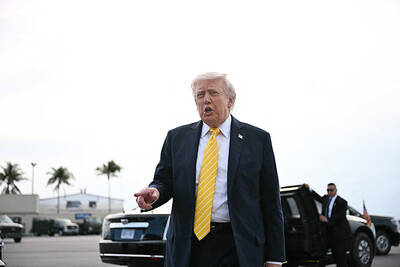
Iran’s Islamic Revolutionary Guard Corp (IRGC) yesterday said the US faced a choice between an “impossible” military operation or a “bad deal” with Tehran, after US President Donald Trump disparaged Iran’s latest peace proposal. Negotiations between the two countries have been deadlocked since a ceasefire came into effect on April 8, with only one round of direct peace talks held so far. Iran’s Tasnim and Fars news agencies reported that Tehran had submitted a 14-point proposal to mediator Pakistan, but Trump was quick to cast doubt on it. “I will soon be reviewing the plan that Iran has just sent to us, but


 RSS
RSS