


The liberalization of the European energy market, which begins on Sunday, is coinciding with a merger frenzy among major players in the sector, abetted in some cases by governments that want to create national industrial champions in a strategic sector.
Recent months have seen several mega deals, particularly in Spain, where electricity giant Endesa has been the target of several takeover bids from different countries, while its peer Iberdrola has purchased Scottish Power.
In France, Suez and Gaz de France have spent more than a year attempting, without much success, to merge with government backing for a French champion.
And in the Netherlands the two main operators, Essent and Nuon, are seeking to get together.
"It's an unexpected byproduct of deregulation," said Colette Lewiner, energy expert analyst with CapGemini.
The main operators have amassed great cash piles and "are afraid to lose market share [in the their home markets] following deregulation, [so] they are looking to win elsewhere," Lewiner said.
The deals show no sign of letting up, with the European Commission requiring that the groups cede some assets when they arrive in a new market to avoid overconcentration.
For example, Spain's Acciona and Italy's Enel, on taking control of Endesa, will have to sell certain assets to unsuccessful Endesa suitor EON of Germany. Suez and Gaz de France also have had to resign themselves to ceding assets in Belgium to bring the commission around to their proposed merger.
Yet the trend for such mega mergers can partly be explained by the structure of the energy market. In a market dominated by only a handful of producers, the leading groups in Europe are seeking to increase their size still further to boost their market power, which will enable them to influence prices.
"Structurally, the opening up [of the market] can only lead to consolidation, as the producer requires the greatest possible power over the market to have an effect on prices," said Patrick Larradet, an administrator with the French electricity transport network.
Acting alongside conglomerates, governments too have had a hand in promoting big tie-ups, even if they are not directly at the helm, as they try to create conditions favorable to national industrial powerhouses.
The French government was heavily implicated in the Suez-Gaz de France merger process, while Madrid's Socialist government fought tooth and nail in order to keep Endesa Spanish, despite European Commission opposition.
The commission maintains that it is essential to break the link between transport operations and production. But some major players, such as France and Germany, oppose the separation, seeing it as a means of depriving their national firms of clout and revenue.
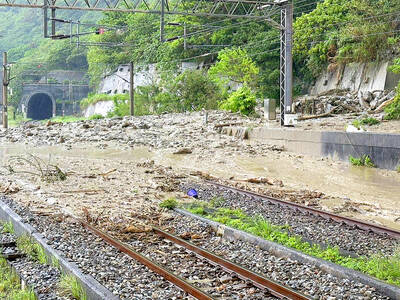
ROLLER-COASTER RIDE: More than five earthquakes ranging from magnitude 4.4 to 5.5 on the Richter scale shook eastern Taiwan in rapid succession yesterday afternoon Back-to-back weather fronts are forecast to hit Taiwan this week, resulting in rain across the nation in the coming days, the Central Weather Administration said yesterday, as it also warned residents in mountainous regions to be wary of landslides and rockfalls. As the first front approached, sporadic rainfall began in central and northern parts of Taiwan yesterday, the agency said, adding that rain is forecast to intensify in those regions today, while brief showers would also affect other parts of the nation. A second weather system is forecast to arrive on Thursday, bringing additional rain to the whole nation until Sunday, it
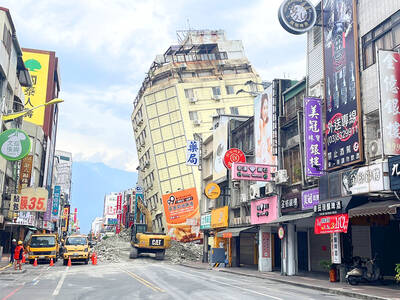
LANDSLIDES POSSIBLE: The agency advised the public to avoid visiting mountainous regions due to more expected aftershocks and rainfall from a series of weather fronts A series of earthquakes over the past few days were likely aftershocks of the April 3 earthquake in Hualien County, with further aftershocks to be expected for up to a year, the Central Weather Administration (CWA) said yesterday. Based on the nation’s experience after the quake on Sept. 21, 1999, more aftershocks are possible over the next six months to a year, the agency said. A total of 103 earthquakes of magnitude 4 on the local magnitude scale or higher hit Hualien County from 5:08pm on Monday to 10:27am yesterday, with 27 of them exceeding magnitude 5. They included two, of magnitude

CONDITIONAL: The PRC imposes secret requirements that the funding it provides cannot be spent in states with diplomatic relations with Taiwan, Emma Reilly said China has been bribing UN officials to obtain “special benefits” and to block funding from countries that have diplomatic ties with Taiwan, a former UN employee told the British House of Commons on Tuesday. At a House of Commons Foreign Affairs Committee hearing into “international relations within the multilateral system,” former Office of the UN High Commissioner for Human Rights (OHCHR) employee Emma Reilly said in a written statement that “Beijing paid bribes to the two successive Presidents of the [UN] General Assembly” during the two-year negotiation of the Sustainable Development Goals. Another way China exercises influence within the UN Secretariat is

Taiwan’s first drag queen to compete on the internationally acclaimed RuPaul’s Drag Race, Nymphia Wind (妮妃雅), was on Friday crowned the “Next Drag Superstar.” Dressed in a sparkling banana dress, Nymphia Wind swept onto the stage for the final, and stole the show. “Taiwan this is for you,” she said right after show host RuPaul announced her as the winner. “To those who feel like they don’t belong, just remember to live fearlessly and to live their truth,” she said on stage. One of the frontrunners for the past 15 episodes, the 28-year-old breezed through to the final after weeks of showcasing her unique


 RSS
RSS