


A US$7 billion pipeline to be laid across northern Malaysia will divert up to a third of oil now being carried through the Malacca Strait, ensuring a secure supply from the Middle East to East Asia, officials said yesterday.
Work on the 300km pipeline from Kedah state on the northwestern coast to Kelantan state in the northeast will begin next year finish in 2014, said Rahim Kamil Sulaiman, chairman of the project owner, Trans-Peninsula Petroleum Sdn Bhd.
"This is not a political project. It is a commercial undertaking. The project is economically viable," he told a news conference.
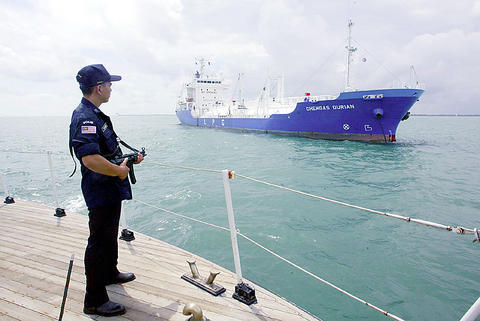
PHOTO: AFP
He said the pipeline will be a substitute for the Strait of Malacca, through which half the world's oil is shipped.
The strait is also notorious for robberies and hijackings, although the number of attacks has fallen since Malaysia, Indonesia and Singapore, which share the waterway, increased patrols in 2005.
Rahim said the timing of the pipeline was perfect as more oil is headed to China, which has become the world's second largest importer of oil.
Earlier yesterday, the Trans-Peninsula company signed an agreement with Malaysia's Ranhill Engineers and Constructors as well as Indonesia's PT Tripatra for the design and construction of the pipeline.
The signing was witnessed by Malaysian Prime Minister Abdullah Ahmad Badawi and Indonesian President Susilo Bambang Yudhoyono.
Trans-Penisula has also tied up with Saudi Arabia's Al-Banader International Group for oil supplies but has given no details.
Funds for the construction of the pipeline will come from local and foreign investors, Rahim said, declining to reveal details.
Under the plan, crude oil would be refined in Kedah, pumped through the pipe to Kelantan and then loaded onto tankers bound for Japan, China and South Korea, completely bypassing Singapore and the Malacca Strait.
Kedah Chief Minister Mahdzir Khalid told reporters that two refineries, costing a total of US$9 billion, will be built in Kedah by 2010 with a combined refining capacity of 450,000 barrels a day.
Malaysian companies SKS Ventures and Merapoh Resources Corp are expected to unveil details of the refineries in August, he said.
In a statement, Trans-Peninsula said the project will create reserve oil facilities for Asia, which accounts for about a third of world oil consumption.
It said offshore mooring facilities will be built in Yan in Kedah and Bachok in Kelantan to accommodate very large crude carriers, while a major storage tank will be built in Jeli in Kelantan.
In the first phase, which is to become operational by mid-2011, it said the pipeline can carry 2 million barrels of oil a day with a 60 million barrels of storage capacity.
This would triple to 6 million barrels a day of throughput and 180 million barrels in storage when fully completed in 2014, it added.
"There will be a faster turn around of oil tankers. Congestion in the Straits [sic] of Malacca will be eased. There will be ample strategic reserve of crude oil reachable within seven days to East Asia," it said.
It takes oil tankers up to three weeks to sail through the strait to reach east Asia.
Rahim said construction will abide by environmental guidelines and will be designed to traverse through the least settled areas to minimize social impact.

CREDIT-GRABBER: China said its coast guard rescued the crew of a fishing vessel that caught fire, who were actually rescued by a nearby Taiwanese boat and the CGA Maritime search and rescue operations do not have borders, and China should not use a shipwreck to infringe upon Taiwanese sovereignty, the Coast Guard Administration (CGA) said yesterday. The coast guard made the statement in response to the China Coast Guard (CCG) saying it saved a Taiwanese fishing boat. The Chuan Yu No. 6 (全漁6號), a fishing vessel registered in Keelung, on Thursday caught fire and sank in waters northeast of Diaoyutai Islands (釣魚台). The vessel left Keelung’s Badouzih Fishing Harbor (八斗子漁港) at 3:35pm on Sunday last week, with seven people on board — a 62-year-old Taiwanese captain surnamed Chang (張) and six

RISKY BUSINESS: The ‘incentives’ include initiatives that get suspended for no reason, creating uncertainty and resulting in considerable losses for Taiwanese, the MAC said China’s “incentives” failed to sway sentiment in Taiwan, as willingness to work in China hit a record low of 1.6 percent, a Ministry of Labor survey showed. The Directorate-General of Budget, Accounting and Statistics (DGBAS) also reported that the number of Taiwanese workers in China has nearly halved from a peak of 430,000 in 2012 to an estimated 231,000 in 2024. That marked a new low in the proportion of Taiwanese going abroad to work. The ministry’s annual survey on “Labor Life and Employment Status” includes questions respondents’ willingness to seek employment overseas. Willingness to work in China has steadily declined from

LEVERAGE: China did not ‘need to fire a shot’ to deny Taiwan airspace over Africa when it owns ‘half the continent’s debt,’ a US official said, calling it economic warfare The EU has raised concerns about overflight rights following the delay of President William Lai’s (賴清德) planned state visit to the Kingdom of Eswatini after three African nations denied overflight clearance for his charter at the last minute. Taiwanese allies Paraguay and Saint Kitts and Nevis, as well as several US lawmakers and the Inter-Parliamentary Alliance on China (IPAC) condemned China for allegedly pressuring the countries. Lai was scheduled to fly directly to Taiwan’s only African ally from yesterday to Sunday to celebrate the 40th anniversary of King Mswati III’s accession and his 58th birthday, but Seychelles, Mauritius and Madagascar suddenly revoked
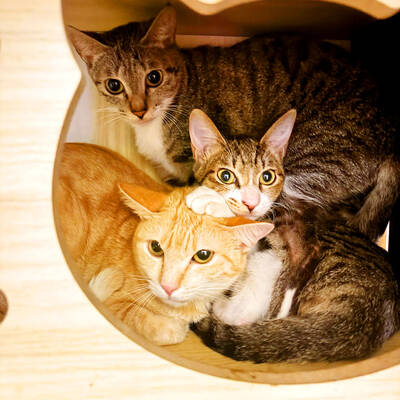
The number of pet cats in Taiwan surpassed that of pet dogs for the first time last year, reaching 1,742,033, a 32.8 percent increase from 2023, the Ministry of Agriculture said yesterday, citing a survey. By contrast, the number of pet dogs declined slightly by 1.2 percent over the same period to 1,462,528, the ministry said. Despite the shift, households with dogs still slightly outnumber those with cats by 1.2 percent. However, while the number of households with multiple dogs has remained relatively stable, households keeping more than two cats have increased, contributing to the overall rise in the feline population. The trend


 RSS
RSS