


Brazil defended its ethanol agreement with the US despite efforts by Venezuelan President Hugo Chavez to undermine the deal using his country's vast reserves of oil and natural gas.
Chavez did not publicly discuss his dispute over ethanol with Brazilian President Luiz Inacio Lula da Silva at the start of a two-day energy summit on Monday, but the Venezuelan leader has pledged to explain his objections to last month's US-Brazil ethanol agreement.
Chavez, a staunch and oftentimes vociferous critic of US President George W. Bush, has warned Brazil's deal with Washington would monopolize arable lands and starve the poor -- concerns shared by his ally Cuban President Fidel Castro.
But Marco Aurelio Garcia, an adviser to Silva, denied that Brazil's plan would cause food prices to skyrocket and defended it as a way of creating jobs.
"Nobody stops eating due to shortage of food. People stop eating due to lack of income. That's the fundamental issue," Garcia said.
The US and Brazil are the world's two biggest producers of ethanol -- the alcohol-based fuel made from crops such as sugarcane or corn.
They signed an "alliance" last month to promote its production in the region and create international quality standards to allow it to be traded as a commodity like oil.
Chavez has not said what he would do to oppose that plan, other than allude to his lobbying efforts against other US-proposed trade agreements.
Officials from a dozen South American countries were attending the two-day summit on Margarita Island, where Chavez was expected to seek support for projects including a regional "Bank of the South," a natural gas pipeline and a proposed gas alliance modeled after the OPEC.
On ethanol, Brazil's interests appear to lie in its agreement with the US, despite Chavez's disapproval.
Silva said before leaving Brazil on Monday that he hopes to discuss the ethanol concerns, especially "the technical or scientific basis of the criticisms."
Chavez used to speak warmly about ethanol's future, but he came out harshly against its promotion as a substitute for gasoline after the agreement between Brazil and the US.
His concerns are shared by some experts who say that even if all arable land on Earth were turned over to biofuel production, it still would not meet world demand for fuel.
Venezuela still plans to expand its own ethanol production for use as a fuel additive.
Without mentioning the ethanol spat, Chavez and Silva met before the summit at a ceremony marking the start of construction on a new petrochemical complex, smiling and shoveling cement side-by-side for the cameras.
In a visit to Brazil, meanwhile, former Florida governor Jeb Bush criticized Cuba and Venezuela for their leaders' newfound opposition to increased ethanol production.
"Mysteriously, for reasons I can't explain, they did a complete about-face," said Bush, the brother of the US president.
Without mentioning Venezuela by name, Jeb Bush said the US needs to boost ethanol use because much of the petroleum it consumes comes from nations that consider themselves "enemies of our country."
Venezuela's information minister, Willian Lara, dismissed Bush's remarks as part of the "open, clear and persistent intention" of the US government to create a negative image of the summit hosted by Chavez.
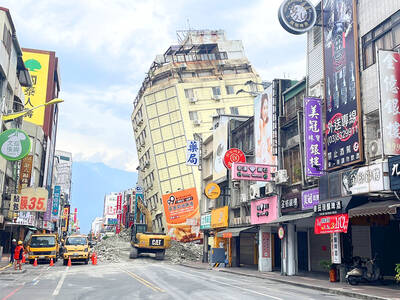
ROLLER-COASTER RIDE: More than five earthquakes ranging from magnitude 4.4 to 5.5 on the Richter scale shook eastern Taiwan in rapid succession yesterday afternoon Back-to-back weather fronts are forecast to hit Taiwan this week, resulting in rain across the nation in the coming days, the Central Weather Administration said yesterday, as it also warned residents in mountainous regions to be wary of landslides and rockfalls. As the first front approached, sporadic rainfall began in central and northern parts of Taiwan yesterday, the agency said, adding that rain is forecast to intensify in those regions today, while brief showers would also affect other parts of the nation. A second weather system is forecast to arrive on Thursday, bringing additional rain to the whole nation until Sunday, it
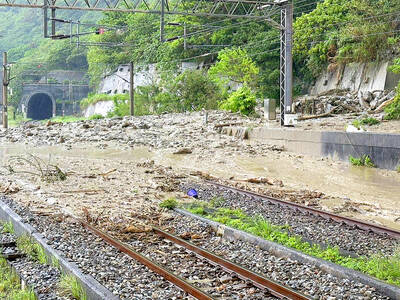
LANDSLIDES POSSIBLE: The agency advised the public to avoid visiting mountainous regions due to more expected aftershocks and rainfall from a series of weather fronts A series of earthquakes over the past few days were likely aftershocks of the April 3 earthquake in Hualien County, with further aftershocks to be expected for up to a year, the Central Weather Administration (CWA) said yesterday. Based on the nation’s experience after the quake on Sept. 21, 1999, more aftershocks are possible over the next six months to a year, the agency said. A total of 103 earthquakes of magnitude 4 on the local magnitude scale or higher hit Hualien County from 5:08pm on Monday to 10:27am yesterday, with 27 of them exceeding magnitude 5. They included two, of magnitude

CONDITIONAL: The PRC imposes secret requirements that the funding it provides cannot be spent in states with diplomatic relations with Taiwan, Emma Reilly said China has been bribing UN officials to obtain “special benefits” and to block funding from countries that have diplomatic ties with Taiwan, a former UN employee told the British House of Commons on Tuesday. At a House of Commons Foreign Affairs Committee hearing into “international relations within the multilateral system,” former Office of the UN High Commissioner for Human Rights (OHCHR) employee Emma Reilly said in a written statement that “Beijing paid bribes to the two successive Presidents of the [UN] General Assembly” during the two-year negotiation of the Sustainable Development Goals. Another way China exercises influence within the UN Secretariat is

Taiwan’s first drag queen to compete on the internationally acclaimed RuPaul’s Drag Race, Nymphia Wind (妮妃雅), was on Friday crowned the “Next Drag Superstar.” Dressed in a sparkling banana dress, Nymphia Wind swept onto the stage for the final, and stole the show. “Taiwan this is for you,” she said right after show host RuPaul announced her as the winner. “To those who feel like they don’t belong, just remember to live fearlessly and to live their truth,” she said on stage. One of the frontrunners for the past 15 episodes, the 28-year-old breezed through to the final after weeks of showcasing her unique


 RSS
RSS