


The US formally lodged its WTO complaint against copyright piracy in China yesterday, with fake DVDs and counterfeit luxury goods the latest issue to sour trade relations between the giants.
A Geneva-based official, who requested anonymity, said the US trade delegation in Geneva had handed the documents detailing the complaint to the WTO, activating the global trade body's dispute settlement process.
US Trade Representative Susan Schwab, announcing the action against China, had said on Monday that piracy and counterfeiting levels in China remained "unacceptably high" despite Beijing's stated commitments to tackling the problem.

PHOTO: AP
The US has also filed a separate case accusing China of restricting distribution of foreign music, films and books, further sharpening tensions with the booming Asian giant.
wto arbitration
Under WTO rules, the two countries will have 60 days to try to iron out their differences. If they do not reach agreement, Washington will then have the right to demand WTO arbitration.
If the US case were ultimately upheld by a settlement panel, the US could then gain the right to impose retaliatory duties and tariffs on Chinese imports.
US firms claim the wide availability of counterfeit goods such as DVDs, software, luxury goods, books, auto parts, footwear and pharmaceuticals deprives them of billions of dollars of revenue per year.
China joined the WTO in 2001 and enjoyed a grace period in the first few years of its membership, but members such as the US are now flexing their muscles and demanding stricter enforcement of trade rules.
A report by the office of the US Trade Representative last December said China's record in implementing its WTO commitments was "decidedly mixed."
In March last year, the US launched a complaint over Beijing's tariffs on foreign parts for local auto assembly, which was subsequently joined by the EU and Canada.
Little under a year later, in February, the US took China to the WTO in a complaint over industrial subsidies. And in an unprecedented decision late last month, Washington announced penalty tariffs on China to offset government subsidies for a paper product.
China warned that the latest US move was ill-informed and would damage trade relations between the two countries.
"China feels regret and is strongly dissatisfied [with the US decision]," Chinese Commerce Ministry spokesman Wang Xinpei (
damage
"The move will seriously damage cooperation [on intellectual property rights protection] that the two parties have already built up and will have a negative impact on trade relations between the two sides," Wang said.
China has issued detailed regulations to fight piracy, but the continuing widespread availability of pirated goods -- from fresh Hollywood blockbusters on DVD to fake Louis Vuitton handbags -- is widely seen as proof that not nearly enough is being done to combat the problem.
Under new rules issues last week, anyone who produces more than 2,500 discs of movies, music or computer software is now regarded a serious offender and can be jailed for seven years.

National Taiwan University (NTU) yesterday said it disqualified a person from an entrance examination for using AI smart glasses to cheat, along with two others for making untruthful statements in their curriculum vitae. The three applicants were given null scores, Taiwan’s highest-ranked university said, calling on prospective students to be honest in the admissions process. NTU registrar Lee Hung-sen (李宏森) said that the cheating applicant wore a hat and thick-rimmed glasses to the second written exam for medical school, claiming that they felt cold. Suspicions were aroused when the applicant stared oddly at the test for long stretches while steadily bringing the paper
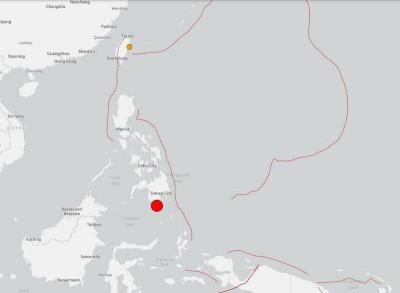
A magnitude 7.8 earthquake struck off the southern coast of Mindanao in the Philippines at 7:38am today, prompting the US Tsunami Warning System to issue an alert for neighboring countries, including Taiwan. The system issued a purple alert indicating a "tsunami threat." The potential threat zone includes Taiwan, the Philippines, Papua New Guinea, Yap and Palau. Philippine authorities were assessing the damage from the quake, with the office of civil defense seeking to verifying initial reports that 15 people had been killed and 129 injured in the region, mostly from falling debris. Arlene Hollero, disaster chief of Maasim town in the Philippines' Sarangani Province,

‘GRAY ZONE’ PRESSURE: Beijing’s activities are intended to create the deceitful impression that China has jurisdiction over the area around Taiwan, the CGA said Taiwan’s rights over its territorial waters and exclusive economic zone must not be violated by any country, the Mainland Affairs Council said yesterday, adding that it will not accept any unprovoked actions. The council issued the remarks in response to the China Coast Guard conducting maritime enforcement drills near eastern Taiwan and claiming to fully exercise China’s maritime administrative law enforcement authority. The Coast Guard Administration (CGA) has been closely monitoring the situation and is taking concrete steps to defend the nation’s sovereignty and secure its waters, the council said. China has no sovereign rights over the waters off eastern
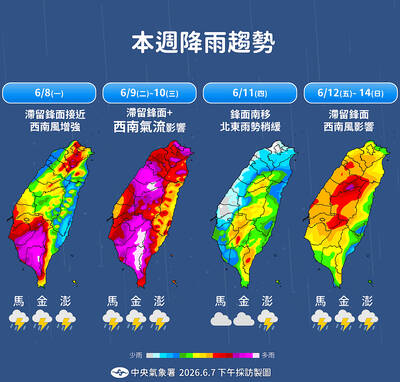
Heavy rain is expected to affect parts of Taiwan this week, the Central Weather Administration (CWA) said yesterday as a meteorologist said the active part of the annual plum rain season has started. A stationary plum rain front and southwesterly winds would bring unstable weather and abundant moisture to Taiwan from today for about a week, with the heaviest rainfall forecast for tomorrow and Wednesday, the CWA said. The agency said western and northeastern Taiwan, and mountainous areas in the east and southeast, could expect showers or thunderstorms on those two days, with localized heavy rain possible. Other parts of


 RSS
RSS