


The economies of China and other East Asian nations could see growth derailed if they fail to boost investment and cope with widening wealth gaps and pollution a decade after the 1997 financial crisis, the World Bank said yesterday.
Developing East Asia -- a region stretching from South Korea to Indonesia -- are richer and have a bigger share of the world economy than in 1997, when a crisis sparked by a plunge in the Thai baht dragged the region into recession, the bank said in a report.
Before the 1997 crisis, half the region's people lived on less than US$2 a day. Now, that rate has receded to 29 percent, it said.
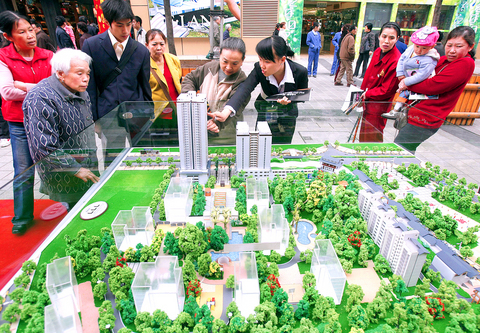
PHOTO: AFP
But many countries suffer from weak investment and a growing rich-poor gap, the report said.
"Even as the region celebrates recovery, new challenges loom, which could slow or even derail growth if not properly handled," the bank said in the report East Asia and Pacific Update.
China is expected to grow by 10 percent this year, but faces a widening wealth gap and rising pollution while also managing the financial strains from a soaring trade surplus, the bank said. It noted that China has 20 of the world's 30 most polluted cities.
Such problems "could affect China's onward development if they are left unchecked," said Milan Brahmbhatt, the bank's chief Asia economist, at a Tokyo news conference connected by video link with reporters in Beijing, Jakarta, Bangkok and other cities.
Brahmbhatt said that in other Asian economies, "growth has actually been somewhat less than in the pre-crisis trends."
"Investment has been somewhat weak and erratic. The reasons for this weak investment are not well understood," he said.
Thailand, epicenter of the 1997 to 1998 crisis, posted 5 percent growth last year, the bank said. That was down from an average annual expansion of 8 percent reported in 1985 to 1995.
Economies also face wrenching changes due to growing Chinese dominance in manufacturing, said the Washington-based bank, which lends money for development projects and alleviating poverty.
China's emergence is "creating intense competitive pressures for other East Asian economies," its report said. It said companies rate uncertainty due to such conditions as their biggest constraint on operations.
As a whole, East Asian economies last year recorded their strongest growth since the 1997 to 1998 crisis, expanding at 8.1 percent.
This year, the bank said growth in the region should slow modestly to 7.3 percent because of the looming downturn in the US economy and slowing export growth.
The report covered what the bank calls Emerging East Asia, which includes China, Indonesia, Malaysia, Philippines, Thailand and Vietnam, as well as Hong Kong, South Korea, Singapore and Taiwan.
The World Bank urged a range of reforms to help poorer Asian countries move up to higher incomes. They included boosting investment by eliminating unnecessary restrictions, expanding capital markets and liberalizing trade in services.
The region needs to invest US$200 billion annually in improving infrastructure over the next five years, the bank said.
The bank also warned of the potential dangers of a growing gap between Asia's rich and poor.
"This matters because high inequality can lead to more social and political conflict [and] can have adverse impacts on growth," Brahmbhatt said.
He said governments could ease such strains by improving access for the poor to higher education and credit to start businesses.
Today, East Asia's economies are seen as more robust and better run. The region has an annual output of US$5 billion, double the dollar value before the crisis, the bank said.
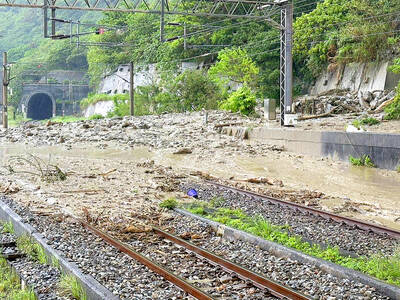
ROLLER-COASTER RIDE: More than five earthquakes ranging from magnitude 4.4 to 5.5 on the Richter scale shook eastern Taiwan in rapid succession yesterday afternoon Back-to-back weather fronts are forecast to hit Taiwan this week, resulting in rain across the nation in the coming days, the Central Weather Administration said yesterday, as it also warned residents in mountainous regions to be wary of landslides and rockfalls. As the first front approached, sporadic rainfall began in central and northern parts of Taiwan yesterday, the agency said, adding that rain is forecast to intensify in those regions today, while brief showers would also affect other parts of the nation. A second weather system is forecast to arrive on Thursday, bringing additional rain to the whole nation until Sunday, it
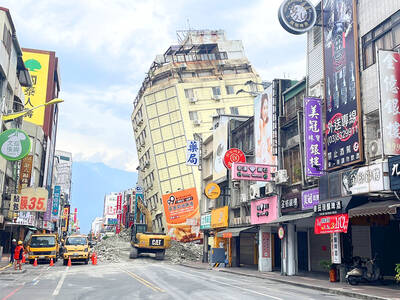
LANDSLIDES POSSIBLE: The agency advised the public to avoid visiting mountainous regions due to more expected aftershocks and rainfall from a series of weather fronts A series of earthquakes over the past few days were likely aftershocks of the April 3 earthquake in Hualien County, with further aftershocks to be expected for up to a year, the Central Weather Administration (CWA) said yesterday. Based on the nation’s experience after the quake on Sept. 21, 1999, more aftershocks are possible over the next six months to a year, the agency said. A total of 103 earthquakes of magnitude 4 on the local magnitude scale or higher hit Hualien County from 5:08pm on Monday to 10:27am yesterday, with 27 of them exceeding magnitude 5. They included two, of magnitude

CONDITIONAL: The PRC imposes secret requirements that the funding it provides cannot be spent in states with diplomatic relations with Taiwan, Emma Reilly said China has been bribing UN officials to obtain “special benefits” and to block funding from countries that have diplomatic ties with Taiwan, a former UN employee told the British House of Commons on Tuesday. At a House of Commons Foreign Affairs Committee hearing into “international relations within the multilateral system,” former Office of the UN High Commissioner for Human Rights (OHCHR) employee Emma Reilly said in a written statement that “Beijing paid bribes to the two successive Presidents of the [UN] General Assembly” during the two-year negotiation of the Sustainable Development Goals. Another way China exercises influence within the UN Secretariat is

Taiwan’s first drag queen to compete on the internationally acclaimed RuPaul’s Drag Race, Nymphia Wind (妮妃雅), was on Friday crowned the “Next Drag Superstar.” Dressed in a sparkling banana dress, Nymphia Wind swept onto the stage for the final, and stole the show. “Taiwan this is for you,” she said right after show host RuPaul announced her as the winner. “To those who feel like they don’t belong, just remember to live fearlessly and to live their truth,” she said on stage. One of the frontrunners for the past 15 episodes, the 28-year-old breezed through to the final after weeks of showcasing her unique


 RSS
RSS