


Having failed in its US$5.3 billion hostile takeover bid for the London Stock Exchange (LSE), he NASDAQ Stock Market Inc is scrambling to lay out a European strategy that will appease its shareholders and ensure it will not be left behind as other major exchanges consolidate.
The world's largest electronic equities exchange was dealt a crushing defeat on Saturday by LSE shareholders who overwhelmingly opted not to accept the bid. NASDAQ's dogged pursuit of the British bourse lasted almost a year and left NASDAQ empty-handed as rival operators NYSE Group Inc and Euronext NV integrate into the first marketplace to span the Atlantic.
Analysts said NASDAQ CEO Robert Greifeld was under intense pressure from investors to cut a deal that would keep his exchange competitive. Wall Street will get a glimpse at Greifeld's next move when he speaks to analysts after the NASDAQ reports third-quarter earnings today.
"He's built up so much expectation that if he were to abandon Europe there would be very strong disappointment among shareholders," said David Easthope, an analyst with the business consulting firm Celent. "Shareholders are looking for them to execute on two strategies: Get your European strategy in place and simultaneously execute one in Asia."
And that is what the New York Stock Exchange accomplished.
So far this year, the Big Board closed the deal to buy Paris-based Euronext, secured a stake in India's National Stock Market and embarked on a broader alliance with the Tokyo Stock Exchange that could lead to a combination.
There was also speculation that NYSE chief executive John Thain might take advantage of NASDAQ's failed bid to make his own run at the LSE, either through an acquisition or most likely a broad alliance.
The NYSE, which declined to comment about such a deal, would face not only competition issues in Europe but also be forced to contend with the nearly 30 percent stake in the London exchange that NASDAQ still holds.
Meanwhile, a spokesman for the LSE told reporters in London that the exchange was already working on a strategic alliance with its Tokyo counterpart.
The fierce rivalry between the NYSE and NASDAQ is palpable. They are fighting for market share in the US, where regulations allow stocks listed on one exchange to be traded on another. They have also been gunning for more stock listings, sometimes persuading companies to defect from one to the other.
NASDAQ has bragging rights for the speediest stock executions, but the NYSE's recent introduction of electronic trading was designed to challenge that.
Until the defeat on Saturday, Greifeld had had a string of successes at NASDAQ. He took a market that was once run by the country's broker-dealers and turned it into one of Wall Street's hottest public companies, bought electronic trading platform Instinet for its technology and took trades away from the NYSE.
"Bob has done a great job for shareholders," said Glenn Hutchins, a NASDAQ board member whose private equity firm Silver Lake Partners is a major shareholder of the exchange. "He took over an exchange that essentially had no value and it now has billions. He's generated a huge amount of volume because it has the best technology and the lowest cost, and is taking market share from the NYSE."
Hutchins views NASDAQ's situation with the LSE as "win-win." It still has the potential to take over the LSE down the line but would profit if another bidder came in and bought the exchange at a higher price.
NASDAQ, which has pledged to shareholders that it would pursue only deals that were strategic fits and would almost immediately reap shareholder value, stood by its claims the LSE was overvalued and refused to increase its bid.

NO-LIMITS PARTNERSHIP: ‘The bottom line’ is that if the US were to have a conflict with China or Russia it would likely open up a second front with the other, a US senator said Beijing and Moscow could cooperate in a conflict over Taiwan, the top US intelligence chief told the US Senate this week. “We see China and Russia, for the first time, exercising together in relation to Taiwan and recognizing that this is a place where China definitely wants Russia to be working with them, and we see no reason why they wouldn’t,” US Director of National Intelligence Avril Haines told a US Senate Committee on Armed Services hearing on Thursday. US Senator Mike Rounds asked Haines about such a potential scenario. He also asked US Defense Intelligence Agency Director Lieutenant General Jeffrey Kruse

INSPIRING: Taiwan has been a model in the Asia-Pacific region with its democratic transition, free and fair elections and open society, the vice president-elect said Taiwan can play a leadership role in the Asia-Pacific region, vice president-elect Hsiao Bi-khim (蕭美琴) told a forum in Taipei yesterday, highlighting the nation’s resilience in the face of geopolitical challenges. “Not only can Taiwan help, but Taiwan can lead ... not only can Taiwan play a leadership role, but Taiwan’s leadership is important to the world,” Hsiao told the annual forum hosted by the Center for Asia-Pacific Resilience and Innovation think tank. Hsiao thanked Taiwan’s international friends for their long-term support, citing the example of US President Joe Biden last month signing into law a bill to provide aid to Taiwan,

China’s intrusive and territorial claims in the Indo-Pacific region are “illegal, coercive, aggressive and deceptive,” new US Indo-Pacific Commander Admiral Samuel Paparo said on Friday, adding that he would continue working with allies and partners to keep the area free and open. Paparo made the remarks at a change-of-command ceremony at Joint Base Pearl Harbor-Hickam in Hawaii, where he took over the command from Admiral John Aquilino. “Our world faces a complex problem set in the troubling actions of the People’s Republic of China [PRC] and its rapid buildup of forces. We must be ready to answer the PRC’s increasingly intrusive and
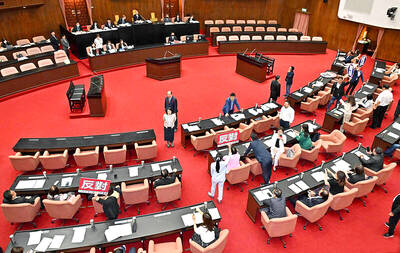
STATE OF THE NATION: The legislature should invite the president to deliver an address every year, the TPP said, adding that Lai should also have to answer legislators’ questions The Chinese Nationalist Party (KMT) yesterday proposed inviting president-elect William Lai (賴清德) to make a historic first state of the nation address at the legislature following his inauguration on May 20. Lai is expected to face many domestic and international challenges, and should clarify his intended policies with the public’s representatives, KMT caucus secretary-general Hung Meng-kai (洪孟楷) said when making the proposal at a meeting of the legislature’s Procedure Committee. The committee voted to add the item to the agenda for Friday, along with another similar proposal put forward by the Taiwan People’s Party (TPP). The invitation is in line with Article 15-2


 RSS
RSS