


Share prices of China's real estate developers were sharply lower in trade yesterday after a revived capital gains tax spooked investors worried that company profits would suffer.
China-based property firms tried to assuage investor fears with a slew of statements to the two domestic bourses in Shanghai and Shenzhen, saying that they expected a limited impact from the belt-tightening regulations.
Nevertheless, nervous investors continued to dump their holdings, with most property concerns falling after Wednesday's rout.
Tax on net gains
The State Administration of Tax-ation announced on Wednesday that it would begin to enforce a land appreciation tax of 30 percent to 60 percent on net gains made from all property development deals starting on Feb. 1.
The tax regulator said it would collect the tax as soon as a development project is completed, in what is a sharp reversal of a law that was first introduced in 1993 but widely ignored.
The move designed to absorb profits depending on the size of a project should reduce the attractiveness of investing in Chinese property amid mounting concerns that previous measures have failed to bring down prices.
Among companies filing statements, China Vanke (
Nevertheless, in afternoon trade shares of Vanke tumbled 3.4 percent to 16.70 yuan (US$2.14) after closing on Wednesday at 17.28, down 10 percent.
Shenzhen Changcheng Estate Group Holding (長城地產集團) said in its filing that it had also prepaid the tax in accordance with local government rules, the Shenzhen exchange-traded group said.
Changcheng stock fell 9.5 percent to 16.23 yuan from Wednesday's finish of 17.93 yuan, down 10 percent.
Inflation worries
Beijing has imposed a series of measures in an effort to cool a boom in construction and bank lending that Chinese leaders worry could spark inflation or a debt crisis.
The government also is trying to encourage developers to supply more moderately priced housing instead of villas and luxury apartments.
Last year, prices of newly built homes in many cities rose more than 10 percent, Xinhua news agency said.
Authorities have raised interest rates twice in the past year and banned outright some types of construction such as luxury villas.
To discourage speculation, the administration also has imposed a tax on sales of existing property that is held for short periods.
Investment in real estate in China in the first 11 months of last year was up 24 percent from the same period of 2005, Xinhua said.
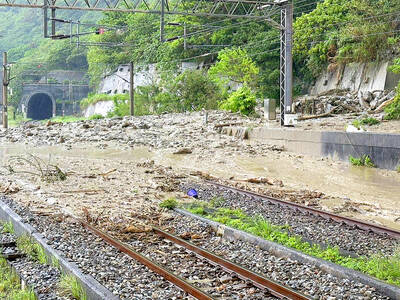
ROLLER-COASTER RIDE: More than five earthquakes ranging from magnitude 4.4 to 5.5 on the Richter scale shook eastern Taiwan in rapid succession yesterday afternoon Back-to-back weather fronts are forecast to hit Taiwan this week, resulting in rain across the nation in the coming days, the Central Weather Administration said yesterday, as it also warned residents in mountainous regions to be wary of landslides and rockfalls. As the first front approached, sporadic rainfall began in central and northern parts of Taiwan yesterday, the agency said, adding that rain is forecast to intensify in those regions today, while brief showers would also affect other parts of the nation. A second weather system is forecast to arrive on Thursday, bringing additional rain to the whole nation until Sunday, it
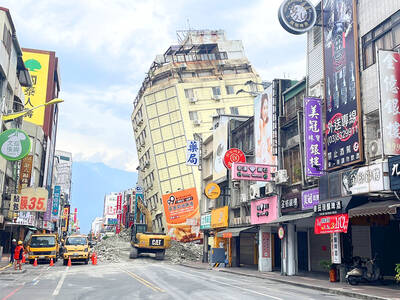
LANDSLIDES POSSIBLE: The agency advised the public to avoid visiting mountainous regions due to more expected aftershocks and rainfall from a series of weather fronts A series of earthquakes over the past few days were likely aftershocks of the April 3 earthquake in Hualien County, with further aftershocks to be expected for up to a year, the Central Weather Administration (CWA) said yesterday. Based on the nation’s experience after the quake on Sept. 21, 1999, more aftershocks are possible over the next six months to a year, the agency said. A total of 103 earthquakes of magnitude 4 on the local magnitude scale or higher hit Hualien County from 5:08pm on Monday to 10:27am yesterday, with 27 of them exceeding magnitude 5. They included two, of magnitude
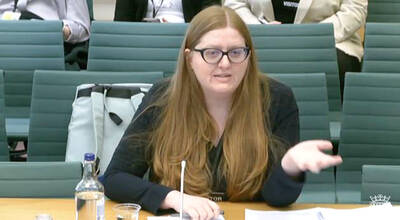
CONDITIONAL: The PRC imposes secret requirements that the funding it provides cannot be spent in states with diplomatic relations with Taiwan, Emma Reilly said China has been bribing UN officials to obtain “special benefits” and to block funding from countries that have diplomatic ties with Taiwan, a former UN employee told the British House of Commons on Tuesday. At a House of Commons Foreign Affairs Committee hearing into “international relations within the multilateral system,” former Office of the UN High Commissioner for Human Rights (OHCHR) employee Emma Reilly said in a written statement that “Beijing paid bribes to the two successive Presidents of the [UN] General Assembly” during the two-year negotiation of the Sustainable Development Goals. Another way China exercises influence within the UN Secretariat is
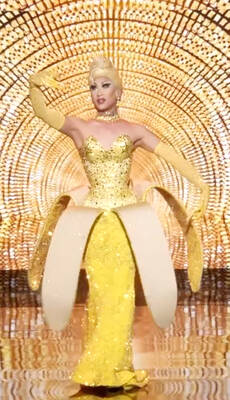
Taiwan’s first drag queen to compete on the internationally acclaimed RuPaul’s Drag Race, Nymphia Wind (妮妃雅), was on Friday crowned the “Next Drag Superstar.” Dressed in a sparkling banana dress, Nymphia Wind swept onto the stage for the final, and stole the show. “Taiwan this is for you,” she said right after show host RuPaul announced her as the winner. “To those who feel like they don’t belong, just remember to live fearlessly and to live their truth,” she said on stage. One of the frontrunners for the past 15 episodes, the 28-year-old breezed through to the final after weeks of showcasing her unique


 RSS
RSS