


The terrorist bombings in Bangkok that rang in the New Year dealt a fresh blow to investor confidence in the Thai economy, already shaken by a year of political turmoil and inept efforts to control the value of the baht, analysts said.
A long holiday weekend provided a short cooling-off period after the Sunday night bombings killed three and injured 38, but weakness in currency and capital markets is expected when trading resumes.
Foreign exchange trading resumed in offshore markets yesterday, while local currency trading and the Stock Exchange of Thailand reopen today.

PHOTO: AFP
The perpetrators of the nine blasts are unknown, though speculation has focused on Islamic separatists, who since January 2004 have been waging a deadly insurgency in the country's southernmost, Muslim-dominated provinces, or embittered supporters of former prime minister Thaksin Shinawatra, ousted in a September coup d'etat.
"Whether it's about the south or internal politics, the aim [of the bombings] is clear and has been successfully achieved, which is to discredit the current government and the National Security Council," said Chalee Keuyen, an analyst at Trinity Securities.
Analysts were already expecting foreign outflows following the Bank of Thailand's shocking move mid last month to impose a 30 percent withholding deposit on selected capital inflows as a means to ease speculative pressure on the baht, which had been steadily strengthening to the detriment of Thai exporters.
Foreigners were heavy sellers on the Thai stock market last month, but many investors were waiting until the New Year to decide whether to cash out of the country, because there was still hope for foreign exchange and market gains this year and the withholding measure means that the cost of money leaving and re-entering the country is high.
The bombings will almost certainly affect the short-term confidence of both foreign and local retail investors, however, so outflows will likely be higher than previously expected.
"The explosions will inevitably raise country risk and political risk ... It won't be a surprise to see panic selling when the stock market reopens [today], and we could probably see the Stock Exchange of Thailand Index fall by around 20-30 points,'' BFIT's Aekpittaya said.
Analysts said the panic selling probably won't be as severe as Dec. 19, Black Tuesday, when the central bank initially imposed the withholding measure, causing a 15 percent drop in the local bourse's SET Index, its biggest ever one-day fall. The measure was amended the next day so as not to restrict equity investment.
"The market probably won't fall as much as Black Tuesday, as this time around investors have two full days to digest information and deliberate their next moves. But it's no doubt the market will surely fall as an initial reaction to the incident," said Pongrat Ratanatawanananda, an analyst at Bualuang Securities.
"We'll see the baht weaken by at least 0.50 to 1 baht [per US dollar] in response to the bombs,'' said a foreign exchange dealer from a local bank, who asked not to be named because he is not authorized to speak for his company.
ROLLER-COASTER RIDE: More than five earthquakes ranging from magnitude 4.4 to 5.5 on the Richter scale shook eastern Taiwan in rapid succession yesterday afternoon Back-to-back weather fronts are forecast to hit Taiwan this week, resulting in rain across the nation in the coming days, the Central Weather Administration said yesterday, as it also warned residents in mountainous regions to be wary of landslides and rockfalls. As the first front approached, sporadic rainfall began in central and northern parts of Taiwan yesterday, the agency said, adding that rain is forecast to intensify in those regions today, while brief showers would also affect other parts of the nation. A second weather system is forecast to arrive on Thursday, bringing additional rain to the whole nation until Sunday, it
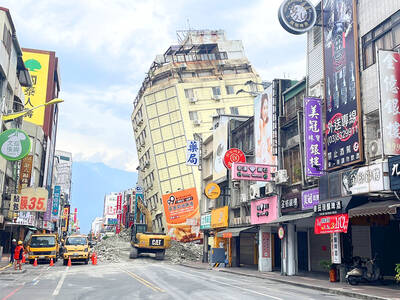
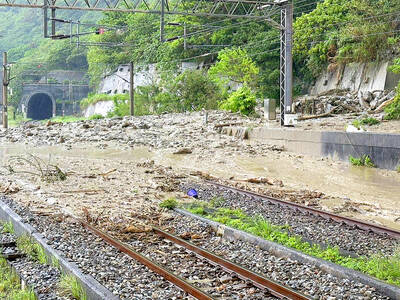
LANDSLIDES POSSIBLE: The agency advised the public to avoid visiting mountainous regions due to more expected aftershocks and rainfall from a series of weather fronts A series of earthquakes over the past few days were likely aftershocks of the April 3 earthquake in Hualien County, with further aftershocks to be expected for up to a year, the Central Weather Administration (CWA) said yesterday. Based on the nation’s experience after the quake on Sept. 21, 1999, more aftershocks are possible over the next six months to a year, the agency said. A total of 103 earthquakes of magnitude 4 on the local magnitude scale or higher hit Hualien County from 5:08pm on Monday to 10:27am yesterday, with 27 of them exceeding magnitude 5. They included two, of magnitude

CONDITIONAL: The PRC imposes secret requirements that the funding it provides cannot be spent in states with diplomatic relations with Taiwan, Emma Reilly said China has been bribing UN officials to obtain “special benefits” and to block funding from countries that have diplomatic ties with Taiwan, a former UN employee told the British House of Commons on Tuesday. At a House of Commons Foreign Affairs Committee hearing into “international relations within the multilateral system,” former Office of the UN High Commissioner for Human Rights (OHCHR) employee Emma Reilly said in a written statement that “Beijing paid bribes to the two successive Presidents of the [UN] General Assembly” during the two-year negotiation of the Sustainable Development Goals. Another way China exercises influence within the UN Secretariat is

Taiwan’s first drag queen to compete on the internationally acclaimed RuPaul’s Drag Race, Nymphia Wind (妮妃雅), was on Friday crowned the “Next Drag Superstar.” Dressed in a sparkling banana dress, Nymphia Wind swept onto the stage for the final, and stole the show. “Taiwan this is for you,” she said right after show host RuPaul announced her as the winner. “To those who feel like they don’t belong, just remember to live fearlessly and to live their truth,” she said on stage. One of the frontrunners for the past 15 episodes, the 28-year-old breezed through to the final after weeks of showcasing her unique


 RSS
RSS