


Qantas is poised for aggressive international expansion, particularly in Asia, if its takeover clears regulatory hurdles and the bid-ders prove they are not corporate raiders, analysts said.
Private equity consortium Airline Partners Australia (APA) will seal one of the largest takeovers in aviation history if its A$11.1 billion (US$8.7 billion) bid proceeds after winning support from the Qantas board earlier in the month.
While board members were won over by a package that includes generous remuneration for top executives, misgivings remain in Australia about the bidders' intentions and the prospect of a national icon being controlled by an international consortium.
APA has repeatedly stressed that Qantas will remain under Australian control under the consortium, with offshore investors including US-based Texas Pacific Group and Canada's Onex re-presenting less that 40 percent of the group.
APA spokesman Bob Mansfield has also denied the consortium would adopt the smash-and-grab tactics typically associated with private equity takeovers, ruling out a Qantas break-up and cuts to regional services.
Instead, Mansfield says APA will remain involved with Qantas for five to 10 years, pressing on with the airline's existing plan to spend A$10 billion on 70 new aircraft to increase capacity by 40 percent over the next five years.
Center for Asia Pacific Aviation managing director Peter Harbison said that if the pledges were met, Qantas would be well placed to meet the challenges of an increasingly-deregulated international aviation market.
While Qantas remains one of the world's most profitable airlines, Harbison said it could perform even better if it was delisted from the Australian Stock Exchange and placed in the hands of owners ready to make long-term investments.
"As a listed company in a small country at the end of the world, Qantas was not previously well-placed to survive, once global markets deregulated," he said. "The new ownership can go where the public company could not."
Harbison predicted the new owners would use Qantas' low-cost offshoot Jetstar as the vehicle for growth because it has lower cost and labor overheads than the main airline.
"As soon as the transaction is completed, it will not be surprising to see an acquisition-oriented Qantas begin moving into new Asian markets," he said.
"It is already represented in Singapore with Jetstar. This model, along with direct minority acquisitions in existing airlines, either by Qantas directly, or by its new owners, will allow it to develop a serious foothold in such markets as China, India, Indonesia and other parts of Southeast Asia," he said.
"In this way, the Qantas/Jetstar brand will become ubiquitous in Asia," he said.
Australian Prime Minister John Howard has made it clear the government will be closely watching the transaction, pointing out the strong association voters feel for the airline dubbed "the flying kangaroo."
The Foreign Investment Review Board will check that offshore investors hold less than 49 percent of the airline, with no individual foreign company allowed to have more than 25 percent.
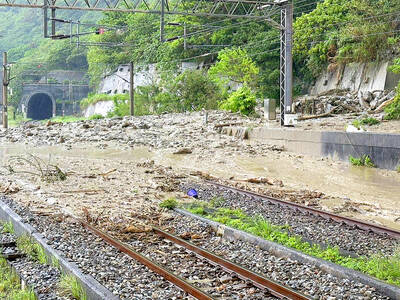
ROLLER-COASTER RIDE: More than five earthquakes ranging from magnitude 4.4 to 5.5 on the Richter scale shook eastern Taiwan in rapid succession yesterday afternoon Back-to-back weather fronts are forecast to hit Taiwan this week, resulting in rain across the nation in the coming days, the Central Weather Administration said yesterday, as it also warned residents in mountainous regions to be wary of landslides and rockfalls. As the first front approached, sporadic rainfall began in central and northern parts of Taiwan yesterday, the agency said, adding that rain is forecast to intensify in those regions today, while brief showers would also affect other parts of the nation. A second weather system is forecast to arrive on Thursday, bringing additional rain to the whole nation until Sunday, it
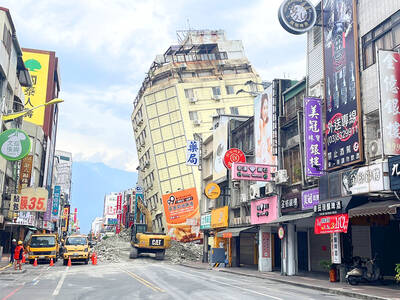
LANDSLIDES POSSIBLE: The agency advised the public to avoid visiting mountainous regions due to more expected aftershocks and rainfall from a series of weather fronts A series of earthquakes over the past few days were likely aftershocks of the April 3 earthquake in Hualien County, with further aftershocks to be expected for up to a year, the Central Weather Administration (CWA) said yesterday. Based on the nation’s experience after the quake on Sept. 21, 1999, more aftershocks are possible over the next six months to a year, the agency said. A total of 103 earthquakes of magnitude 4 on the local magnitude scale or higher hit Hualien County from 5:08pm on Monday to 10:27am yesterday, with 27 of them exceeding magnitude 5. They included two, of magnitude

CONDITIONAL: The PRC imposes secret requirements that the funding it provides cannot be spent in states with diplomatic relations with Taiwan, Emma Reilly said China has been bribing UN officials to obtain “special benefits” and to block funding from countries that have diplomatic ties with Taiwan, a former UN employee told the British House of Commons on Tuesday. At a House of Commons Foreign Affairs Committee hearing into “international relations within the multilateral system,” former Office of the UN High Commissioner for Human Rights (OHCHR) employee Emma Reilly said in a written statement that “Beijing paid bribes to the two successive Presidents of the [UN] General Assembly” during the two-year negotiation of the Sustainable Development Goals. Another way China exercises influence within the UN Secretariat is

Taiwan’s first drag queen to compete on the internationally acclaimed RuPaul’s Drag Race, Nymphia Wind (妮妃雅), was on Friday crowned the “Next Drag Superstar.” Dressed in a sparkling banana dress, Nymphia Wind swept onto the stage for the final, and stole the show. “Taiwan this is for you,” she said right after show host RuPaul announced her as the winner. “To those who feel like they don’t belong, just remember to live fearlessly and to live their truth,” she said on stage. One of the frontrunners for the past 15 episodes, the 28-year-old breezed through to the final after weeks of showcasing her unique


 RSS
RSS