


A series of surprisingly weak reports has prompted fresh debate on whether the US economic expansion could continue through next year or succumb to a housing-led downturn.
Most economists see the economy muddling though at a sub-par growth pace, but soft data in recent weeks has sparked more talk about a recession instead of a so-called soft landing.
Raising concerns is an apparent spillover from a weak housing market to other key sectors of the economy, notably manufacturing.
In this atmosphere, it remains unclear whether consumer spending -- which represents the bulk of economic activity -- can carry the economy through.
The latest warning signs came last week in a series of glum reports on durable goods orders, construction spending and surveys on the manufacturing sector of the economy.
Friday's Institute of Supply Management (ISM) survey of manufacturing showed the first shrinkage in 41 months. The ISM index slipped to 49.5 percent last month, below the figure of 50 percent marking the point between expansion and contraction.
Orders for big-ticket manufactured durable goods fell 8.3 percent in October, while construction spending slipped 1 percent.
Federal Reserve Chairman Ben Bernanke remained upbeat in a speech on Tuesday, saying he believes the US economic expansion is likely to remain on track through next year, weathering a slowdown largely confined to the housing sector.
The government revised up its estimate of third-quarter growth in GDP to 2.2 percent from 1.6 percent. But that covers the period from July to September.
Now, many private economists are marking down their forecasts for the current quarter and beyond.
"Has the economy stalled? We think so," wrote economists Joseph LaVorgna and Carl Riccadonna of Deutsche Bank. "In light of continued weakness in the economic data, we are cutting our fourth-quarter real GDP growth forecast to zero from the 1.0 percent that we were originally predicting. This is largely due to weakness in durable goods shipments and orders, but also due to weak consumer spending."
Princeton University economist Paul Krugman wrote in the New York Times that he sees "economic storm signals" ahead.
"The last time things were this confused was early in 2001, when most economists failed to realize that the United States was sliding into recession," he said.
"If that sounds ominous, it should: the bond market, which has a pretty good record of forecasting recessions, is pointing toward a serious economic slowdown next year," he said.
Nouriel Roubini, a New York University economist who has been bearish for some months.
"I have been arguing for a while that the US economic slowdown will worsen in the fourth quarter and 2007 and lead to a recession by, at the latest, the second quarter of 2007," he said in his economics blog.
"The housing recession is becoming a non-residential construction recession, an auto recession, a manufacturing recession, a real investment recession and soon enough a retail recession," Roubini said.
Other economists are less gloomy.
"I think what we're looking at is a soft landing and we're in the most sluggish part of that now," said Dana Johnson, chief economist at Comerica Bank, who added that the economy is being underpinned by income gains and strong job growth.

NO-LIMITS PARTNERSHIP: ‘The bottom line’ is that if the US were to have a conflict with China or Russia it would likely open up a second front with the other, a US senator said Beijing and Moscow could cooperate in a conflict over Taiwan, the top US intelligence chief told the US Senate this week. “We see China and Russia, for the first time, exercising together in relation to Taiwan and recognizing that this is a place where China definitely wants Russia to be working with them, and we see no reason why they wouldn’t,” US Director of National Intelligence Avril Haines told a US Senate Committee on Armed Services hearing on Thursday. US Senator Mike Rounds asked Haines about such a potential scenario. He also asked US Defense Intelligence Agency Director Lieutenant General Jeffrey Kruse

INSPIRING: Taiwan has been a model in the Asia-Pacific region with its democratic transition, free and fair elections and open society, the vice president-elect said Taiwan can play a leadership role in the Asia-Pacific region, vice president-elect Hsiao Bi-khim (蕭美琴) told a forum in Taipei yesterday, highlighting the nation’s resilience in the face of geopolitical challenges. “Not only can Taiwan help, but Taiwan can lead ... not only can Taiwan play a leadership role, but Taiwan’s leadership is important to the world,” Hsiao told the annual forum hosted by the Center for Asia-Pacific Resilience and Innovation think tank. Hsiao thanked Taiwan’s international friends for their long-term support, citing the example of US President Joe Biden last month signing into law a bill to provide aid to Taiwan,
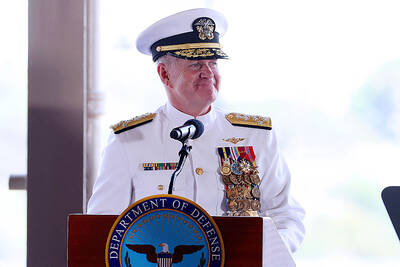
China’s intrusive and territorial claims in the Indo-Pacific region are “illegal, coercive, aggressive and deceptive,” new US Indo-Pacific Commander Admiral Samuel Paparo said on Friday, adding that he would continue working with allies and partners to keep the area free and open. Paparo made the remarks at a change-of-command ceremony at Joint Base Pearl Harbor-Hickam in Hawaii, where he took over the command from Admiral John Aquilino. “Our world faces a complex problem set in the troubling actions of the People’s Republic of China [PRC] and its rapid buildup of forces. We must be ready to answer the PRC’s increasingly intrusive and
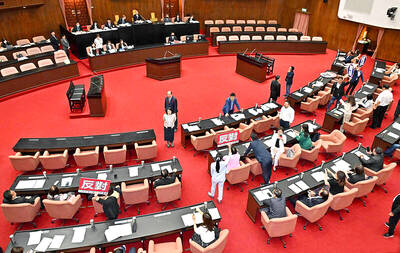
STATE OF THE NATION: The legislature should invite the president to deliver an address every year, the TPP said, adding that Lai should also have to answer legislators’ questions The Chinese Nationalist Party (KMT) yesterday proposed inviting president-elect William Lai (賴清德) to make a historic first state of the nation address at the legislature following his inauguration on May 20. Lai is expected to face many domestic and international challenges, and should clarify his intended policies with the public’s representatives, KMT caucus secretary-general Hung Meng-kai (洪孟楷) said when making the proposal at a meeting of the legislature’s Procedure Committee. The committee voted to add the item to the agenda for Friday, along with another similar proposal put forward by the Taiwan People’s Party (TPP). The invitation is in line with Article 15-2


 RSS
RSS